
Webinar | Beyond Taste: Multisensory Trends Driving Food Indulgence
14 August | 12 PM ET: Register Now

Home / Case Studies / Transforming Complex FinFET Structures into an Interactive 3D Model

Transforming Complex FinFET Structures into an Interactive 3D Model

finfet

Value Delivered

The client gained a clearer, more effective way to understand and communicate a complex FinFET structure during the prior-art discussion.

The research challenge involved a dense FinFET structure where the 3D geometry was difficult to interpret from traditional patent drawings. Instead of relying only on flat figures, the team created a visual bridge by converting the patent figures and claim elements into an interactive 3D model.

This helped the client visualize the invention before reviewing technical details, making discussions more efficient and improving understanding of the underlying structure.

Problem Solved

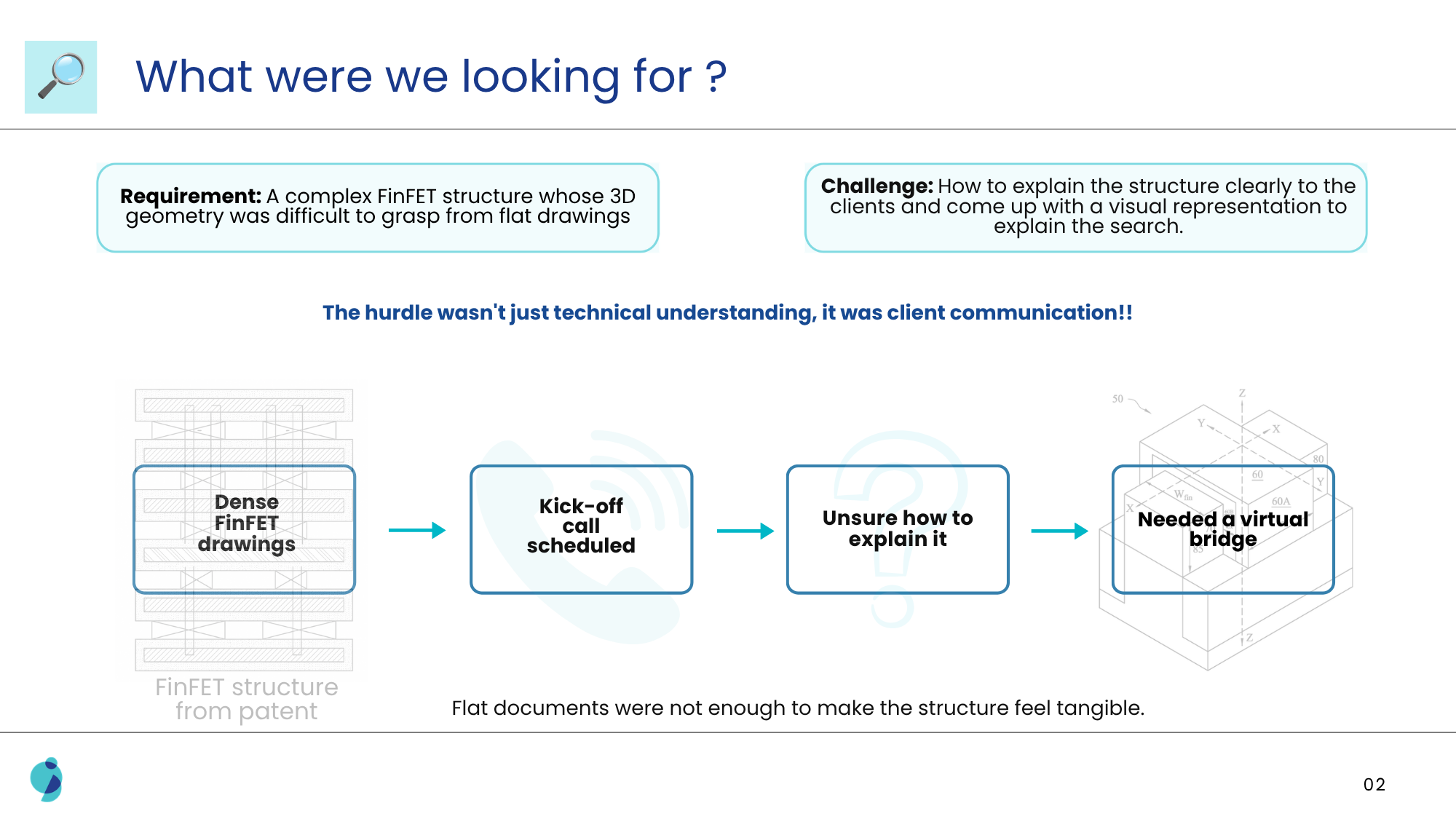
The challenge was finding prior art for a rotary visor mechanism involving a specific combination of structural elements. The challenge was not only understanding the technical details of the FinFET structure but also explaining the structure clearly to the client.

The patent contained dense FinFET drawings representing a complex three-dimensional geometry. However, flat patent figures were not sufficient to make the structure tangible or easy to explain during client communication.

The team needed a way to bridge the gap between:

  • Complex patent drawings.
  • Three-dimensional device structures.
  • Clear client-facing explanations.

The key challenge was converting a technical concept into a visual representation that could communicate the invention effectively.
Solution Offered

The team developed a 3D visualization workflow to represent the FinFET structure.

The approach involved:

  • Reviewing the patent claims and figures.
  • Creating a 3D visualization concept from the disclosed structure.
  • Using AI-assisted structure breakdown to develop a client-ready model.

The final model included interactive features that allowed users to:

  • Rotate the structure.
  • Zoom into different areas.
  • Hide or show components.
  • View labels for easier explanation.

The interactive model made it easier to explain the FinFET structure from multiple angles and helped transform a complex semiconductor design into an understandable visual representation.

Get the full case study to discover how visualizing a FinFET structure bridged the gap between drawings and understanding


Request Full Case Study

Request Full Case Study

Download in PDF Format and read anytime. Fill the form to get access to this article.​

The Researchers

Research Analyst
Shriya is a Research Analyst specializing in patent invalidation and prior art research. Her technical expertise spans semiconductors, telecommunications, 5G, wireless communication, video and audio coding, computer architecture, power management, and location-based technologies.
Invalidation Search-20+
Research Analyst
Simplifying telecommunications and semiconductor patent landscapes for business strategies with technical expertise.
Invalidation Search (15+) Strength Check (6+)
Research Analyst
Unlocking opportunities in Wireless Communications and Semiconductor electronics with precise patent research and analysis.
Invalidation – 1

Related Case Studies

Overcoming the Prior Art Challenges for JEDEC e-MMC Standards

Value Delivered The comprehensive investigation successfully identified relevant prior art, using the term “embedded security” as a key discovery. The findings helped build a robust case, addressing the search challenge

Invalidating a Semiconductor Patent Using TSMC and ITRI Publications

Value Delivered The discovery of significant prior art provided essential support in resolving the patent dispute. This evidence led to the subject patents, which the product was allegedly infringing, having

Innovative Patent Invalidity Strategy Leveraging IPR Findings as a Starting Point

Value Delivered The findings from this redirected approach led to uncovering prior art that significantly influenced the case outcome. The identified prior art provided a strong basis, steering the invalidation

Avoiding $7M in Licensing Fees Using Tier 1 Prior Art from PubChem

Value Delivered Tier-1 prior art was identified by validating the energy levels of the different compounds on PubChem. This enabled the client to secure a favorable out-of-court settlement, avoiding a

Facing A Roadblock On Your Project?

Our Experts Are Here To Help.