


Turning liquids into stable powders through spray drying consumes considerable energy in the food and beverage industry. Heat exposure can affect delicate flavors and nutrients. Although freeze drying is gentler, it is often more expensive and difficult to scale. These limitations become especially important when manufacturers work with volatile citrus flavors and heat-sensitive natural compounds that do not dissolve easily in water.
PXL8 Powders is addressing these challenges with a patent-pending technology that converts liquid ingredients into shelf-stable powders without relying on conventional heat or vacuum drying. The startup uses mechanical forces and a specialized formulation approach to preserve ingredient quality.
To better understand how they are doing it, we spoke to we spoke with PXL8 Powders co-founder Dr. Monica Odell and CEO Matthew Moden. This article contains notable highlights from our entire conversation.
This interview is part of our exclusive Scouted By GreyB series. Here, we speak with the founders of innovative startups to understand how their solutions address critical industry challenges and help ensure compliance with industry and government regulations. (Know more about startups scouted by GreyB!)
Also Read:


“I used to say we could offer freeze-dried flavor at spray-dried prices. But we’ve now found that we can actually be cheaper than spray drying.”
– Dr. Monica Odell

Dr. Monica Odell holds a Ph.D. in Pharmaceutical Sciences from KU Leuven, Belgium, and has over 20 years of experience in drug formulation and delivery. She has worked with Johnson & Johnson, Novartis, Genentech, and Nektar Therapeutics. She also founded Via Innovations, a pharmaceutical product development company.
In 2024, Odell co-founded PXL8 Powders, where she leads the development of a patent-pending technology that converts liquid ingredients into stable powders without heat or solvents. Her work focuses on applying pharmaceutical formulation expertise to food, nutrition, and wellness products.

Matthew Moden is a serial entrepreneur with experience in business development, manufacturing, and international expansion. In 2009, he co-founded Liberty Flights, a UK-based vaping company, growing it into a business with its own manufacturing facility and retail network. In 2022, the company was acquired by Supreme PLC in a deal valued at up to £14.75 million.
Moden is also a board member of the Independent British Vape Association. As CEO of PXL8 Powders, he leads business development, global expansion, and investor relations, focusing on bringing the company’s powder-processing technology to commercial markets.
PXL8’s Powder-Making Process Is 10x More Efficient Than Spray Drying
PXL8 Powders’ technology can produce powders with two to three times the ingredient strength of spray-dried alternatives. The also demonstrated tenfold efficiency and approximately one-third of the utility cost compared with spray drying.
The company’s initial focus is on food and beverage ingredients, particularly citrus extracts, honey, and ingredients used in oral delivery products. It is also exploring cosmetics, including sunscreen formulations. The startup plans to work with established manufacturers through ingredient supply, joint product development, and technology integration rather than building large manufacturing facilities of its own.
Beyond preservation, PXL8 is exploring controlled flavor release, taste masking, and applications ranging from powdered honey to advanced sunscreen formulations. These performance figures are company-reported, with commercial-scale validation still underway.
What are the most exciting developments happening at PXL8 right now?
Dr. Monica: We’re reaching an exciting stage because we’re beginning to identify where our technology can provide the greatest benefit. We’ve always viewed PXL8 as a platform that can serve different industries, but our recent product validation work has helped us narrow our focus.
The strongest opportunities we’re seeing involve ingredients that are sensitive to heat or difficult to dissolve in water. These are recurring challenges across food, cosmetics, and pharmaceuticals. We’re finding that our technology can make a meaningful difference in these areas, so we’re concentrating on applications where customers can see the greatest improvement.
Traditional powder-making methods rely heavily on spray drying or freeze drying. What has PXL8 figured out that makes its process different?
Dr. Monica: Spray drying and freeze drying are the two main technologies we’re competing with. Spray drying is widely established and can handle large production volumes, but it relies on heat. Freeze drying can produce high-quality powders, although it is expensive and difficult to scale. The vacuum conditions used in freeze drying can also remove some of the volatile components that give certain ingredients their distinctive properties.
When we first started, I described our approach as offering freeze-dried flavor at spray-dried prices. But as our development and modeling progressed, we realized our process could potentially be even cheaper than spray drying.
In our work so far, we’ve achieved higher yields, faster processing, and powders with approximately two to three times the potency of spray-dried ingredients. What excites me most is that we’re seeing opportunities to improve quality, processing efficiency, and sustainability together rather than having to compromise one to achieve another.
How does your technology achieve these improvements without using conventional heat or vacuum drying?
Dr. Monica: The main difference is that we’re relying on mechanical forces and naturally occurring physical forces rather than the heat used in spray drying or the vacuum conditions used in freeze drying.
I’ve spent over 15 years developing and refining this approach, drawing on my experience in pharmaceutical formulations and technologies that improve the behavior of ingredients that don’t dissolve easily in water. Many of the same challenges I encountered in pharmaceuticals also appeared when I began working with natural products and food ingredients.
The precise way we’ve engineered this process is proprietary. But the advantage comes from being able to process ingredients under gentler conditions, helping us preserve their original characteristics while reducing the energy and processing requirements associated with conventional methods.
PXL8 describes its technology as a platform for different liquid ingredients. Does every ingredient work the same way, or do formulations require customization?
Matt: One of the most exciting aspects of our technology is that we’re not limited to simply turning one particular liquid into a powder. We can also change the characteristics of that powder to suit what a customer wants to achieve.
For example, some ingredients have unpleasant tastes, even though consumers increasingly want them for their health and wellness benefits. We can explore masking those flavors. Other customers may want an ingredient to release immediately, while some want the release to happen gradually.
That’s why understanding the customer’s specific problem is so important. We’re not assuming every ingredient will behave identically or require the same formulation. We combine the technology with our formulation expertise to develop a solution around the required performance. That opens up opportunities in new product development that go well beyond conventional powder production.
Food companies are increasingly exploring multi-sensory experiences, where flavors change during consumption. Could PXL8 enable this kind of innovation?
Dr. Monica: Yes, and that’s something we’re actively exploring. One of the most interesting capabilities of our technology is that we can tailor how an ingredient is released. Instead of having an entire flavor released immediately, we can develop formulations that release it over a longer period.
My experience in pharmaceutical drug delivery is particularly useful here. In pharmaceuticals, we work with different release profiles depending on how and when an active ingredient needs to work. We’re now applying that same thinking to flavors, nootropics, adaptogens, and other food and wellness ingredients.
For example, we’re exploring the possibility of a flavor experience that begins with lime and gradually transitions into lemon. The same approach could be applied to other ingredients. It gives food developers more freedom to design how a product behaves during consumption, rather than focusing only on its initial taste.
Among food, beverages, pharmaceuticals, and cosmetics, which industries are showing the greatest interest in PXL8’s technology?
Matt: Food is our primary focus, and citrus is one of the most promising opportunities we’re pursuing. Through our conversations with companies around the world, we’ve learned that stabilizing citrus ingredients in powder form has been a persistent challenge.
We’re particularly excited because our technology could address stability and shelf-life problems while also introducing new capabilities such as flavor masking and controlled release. Oral delivery products are another interesting area, as they offer opportunities to improve how flavors and active ingredients behave in the mouth.
Dr. Monica: Beyond food, we’re beginning to explore applications in cosmetics. One area I’m particularly interested in is sunscreen formulation.
There are performance limitations with some natural sunscreens that I’d like to address using our technology. This work is still in the early R&D stage. Sunscreens require additional testing to establish safety and effectiveness, so our immediate priority remains food applications. Once those are established, we see opportunities to expand into cosmetics and other more regulated products.
Are there ingredients or product combinations that were previously difficult to manufacture but could become possible with PXL8?
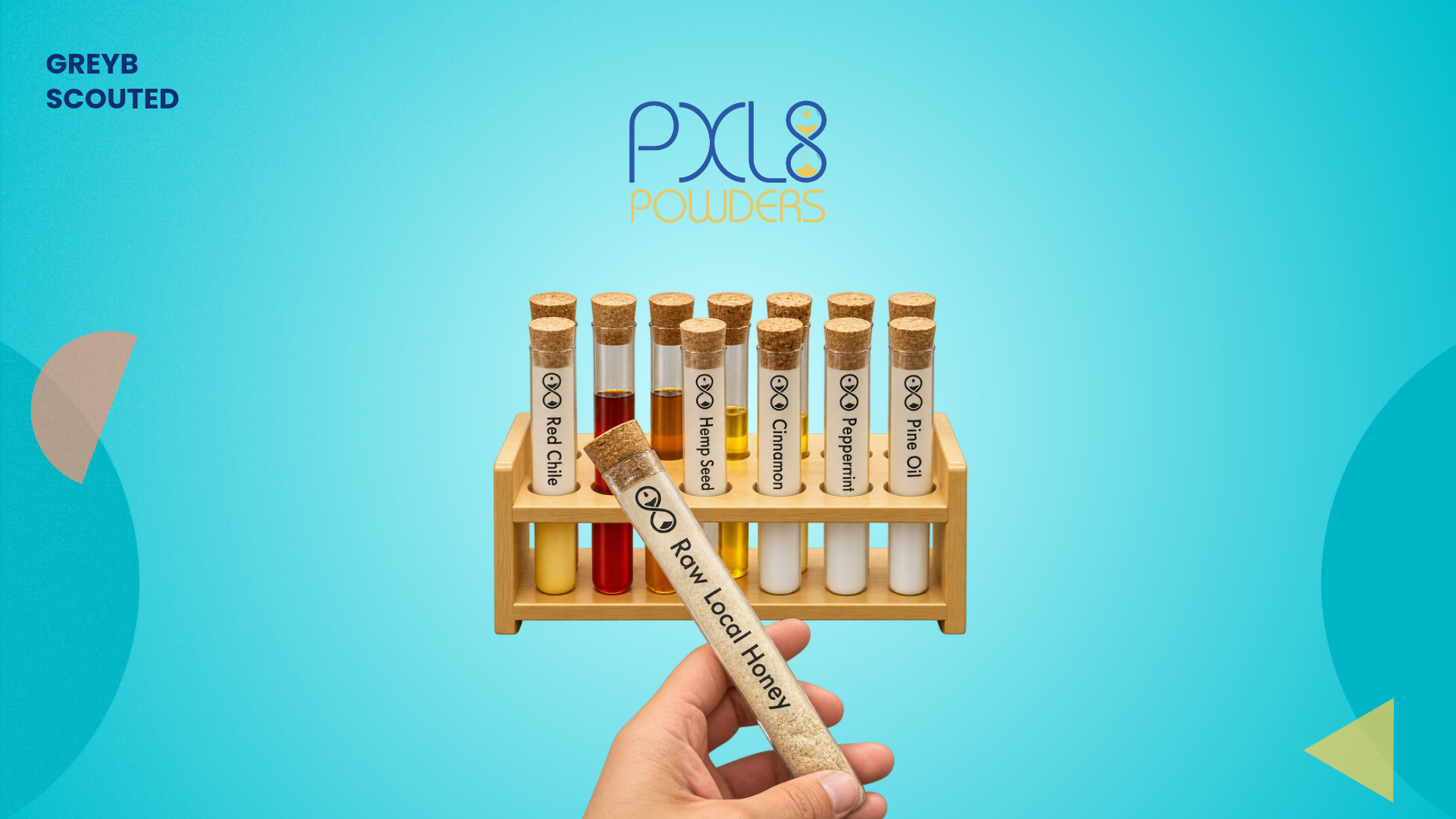
Matt: Honey is a great example. Turning raw honey into a powder is challenging because of its sticky nature, but we’ve been able to produce powdered honey using our technology.
That creates opportunities beyond simply making honey easier to transport or store. Manufacturers could consider using it in product formats where handling liquid honey would otherwise create problems.
I don’t necessarily think our technology will make existing ingredients disappear. Instead, it could allow manufacturers to revisit product ideas they previously abandoned because the ingredients were too unstable, difficult to handle, or unsuitable for their manufacturing processes.
When we speak with experts in different industries, they often understand their ingredient challenges better than anyone else. What excites me is seeing how our technology could help them overcome those limitations and develop products that weren’t previously practical.
Sustainability is becoming a major priority for ingredient manufacturers. What measurable improvements has PXL8 achieved compared with conventional drying?
Matt: We’ve carried out modeling to compare our technology directly with spray drying. In one particular model, our process was approximately ten times more efficient and had around one-third of the utility cost of conventional spray drying.
We’re also seeing opportunities to reduce ingredient waste. With conventional spray drying, valuable material can be lost during processing. We’ve discussed potential savings of around 30% in comparison with the losses associated with some conventional operations.
Those are encouraging figures, although the exact benefits will depend on the ingredient and manufacturing conditions. For us, it’s important that the technology makes sense commercially as well as environmentally.
Dr. Monica: Honey provides a good illustration of why reducing waste matters. Because it’s so sticky, a considerable amount can remain attached to equipment and surfaces during handling and manufacturing.
At an industrial scale, even relatively small losses can represent significant quantities of raw material. By reducing processing waste, we can potentially improve both environmental performance and production economics.
However, we’ve found that customers are usually more interested in energy savings and production costs than environmental benefits alone. That’s why much of our validation and modeling focuses on demonstrating those practical advantages.
With potentially significant efficiency and cost savings, how are established manufacturers responding? What challenges have you encountered in convincing them to adopt the technology?
Matt: The response has been encouraging, particularly when companies understand both the qualities of our powders and the potential production benefits.
However, we also recognize how deeply established processes such as spray drying are within the food industry. Large manufacturers have spent years developing production methods, standard procedures, and quality systems around their existing equipment. Introducing a new technology isn’t simply a question of showing better numbers.
We need to demonstrate that our approach can fit into their operations without creating unnecessary disruption. In some cases, the best starting point could be introducing one of our powders as an additional ingredient to strengthen flavor, improve shelf life, or reduce the amount of raw material required.
Once a customer sees those advantages in an existing product, larger changes become easier to consider. Adoption is ultimately about demonstrating both technical value and commercial practicality.
If a large food company wanted to work with PXL8, how would the partnership work? Would you supply ingredients, co-develop products, or integrate your technology into their manufacturing process?
Matt: All three approaches are possible, and we’re already having conversations across those different models.
In some cases, we’re doing proof-of-concept work and jointly developing a solution around a particular ingredient challenge. Other companies are interested in introducing our powders into existing products. We also have conversations with potential customers who are primarily interested in purchasing finished powder at commercial volumes.
Our approach is to understand the problem first and then decide what level of collaboration makes sense. Some companies may only need a finished ingredient, while others might want to work through several development stages with us.
We want to remain flexible because manufacturers have different priorities, production systems, and levels of willingness to change their existing processes.
Scaling a new process can be difficult, especially when manufacturers need tonnes of ingredients. How are you addressing this challenge, and what does your expansion strategy look like?
Dr. Monica: Our goal isn’t to become a large-scale powder manufacturer ourselves. We want to focus on solving formulation problems and developing applications for our technology, while working with contract manufacturers to handle larger production volumes.
We’re currently working with a contract manufacturing organization in the Netherlands to increase our scale. One of the things we’re investigating is how we can adapt the process to equipment already commonly used in manufacturing facilities.
That could make integration easier for customers because they wouldn’t necessarily need to invest in an entirely new production line. Even where dedicated equipment is needed, our development work suggests that the capital cost could be substantially lower than installing a spray dryer.
We are also speaking with larger companies that prefer a step-by-step development process. We typically begin with a prototype, allow the customer to test it, collect feedback, and refine the formulation through smaller R&D projects. That can eventually lead to a formal joint development agreement.
We’re not yet at the point where we can fulfill every large-volume request we receive. That’s one of the challenges we’re actively addressing through our manufacturing partnerships.
In the near term, we’re trying to strike a balance between selling powders that can bring revenue into the business sooner and pursuing longer-term R&D collaborations. Those joint projects are particularly exciting because they allow us to solve more complex challenges and demonstrate the full capabilities of the platform.
Meet our Interviewer – Shabaz Khan, Marketing Manager at GreyB

Shabaz Khan, Marketing Manager
Want to find other scalable startups working on healthcare technologies? Please fill out the form below to contact our experts.