


Developing a new coating, adhesive, or polymer often means working through a long list of trade-offs. Every new restriction, raw-material change, or customer requirement can send researchers back into another cycle of formulation and testing. And as the number of ingredients and processing variables grows, the possible combinations quickly become too large to investigate one by one.
AI promises a way out, but there is another problem: most R&D teams do not have millions of clean experimental records or dedicated data-science teams. Their knowledge often sits across spreadsheets, lab systems, technical documents, and years of experiments.
Citrine Informatics is approaching the problem differently. Its AI can start with as few as 10 experimental results, explore millions of possible formulations, and recommend which physical experiments are worth running next. Citrine says this has helped customers reduce the number of experiments required by 50% to 90%.
We spoke with Hannah Melia, Head of Marketing at Citrine Informatics, to understand how the technology works, where it delivers the most value, and what it takes to introduce AI into real-world materials R&D. This article highlights key takeaways from our conversation.
This interview is part of our exclusive Scouted By GreyB series. Here, we speak with the founders of innovative startups to understand how their solutions address critical industry challenges and help ensure compliance with industry and government regulations.
“The biggest mistake I’ve seen is companies thinking they need a huge data lake before they start AI. Let the AI tell you which data you actually need.”
– Hannah Melia

Hannah Melia is Head of Marketing at Citrine Informatics and has spent 18 years working where materials science meets software and the last 7 in AI.
She holds an MA in Materials Science and Metallurgy and a postgraduate diploma in Manufacturing Management both from the University of Cambridge.
In 2021, she co-authored a paper in Cambridge University Press’s Data-Centric Engineering on why the materials industry needs to adopt AI faster, naming sparse data as one of the main barriers.
Most AI needs huge datasets. Citrine Informatics builds AI for the small datasets R&D labs actually have, starting with as few as 10 lab results.
Citrine Informatics makes AI software that helps R&D teams in chemicals, materials, plastics, coatings, and adhesives decide which experiments to run. Founded in 2013, the company is based in Redwood City, California.
The software has three main tools. DataManager brings lab data from spreadsheets, notebooks, and databases into one place. VirtualLab builds AI models from that data. Teams set targets like cost or performance, plus limits like the number of ingredients.
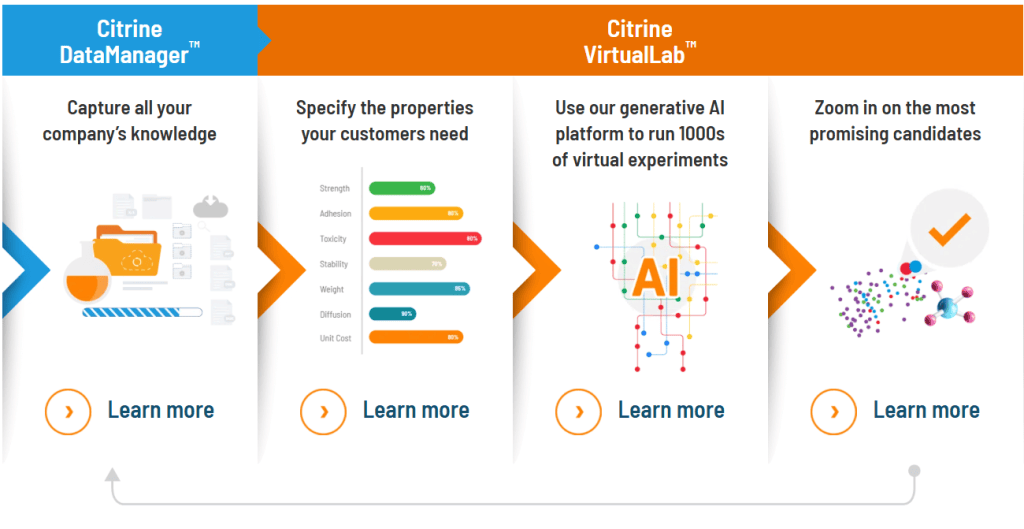
The model then screens millions of possible formulations, predicts how each will perform, and shows how confident it is in each prediction. Catalyst lets researchers search industry journals by asking questions in plain language.

Teams can start with as few as 10 data points. According to Citrine, customers typically cut the number of experiments needed by 50 to 90 percent.
The software works best on complex formulations with many ingredients and properties to balance. Its largest customer groups are in specialty chemicals, plastics, paints and coatings, and adhesives. Customers include TotalEnergies, LyondellBasell, and GM, and each one’s data is kept separate and protected under ISO 27001 security standards. Citrine is also running a BioMADE project, alongside the US Air Force Research Laboratory, to develop biologically produced cement.
Highlights From Our Conversation
What is Citrine doing with AI in the R&D space?
Hannah: We provide AI software for materials, chemicals, and CPG companies. They use it to optimize products, optimize how those products are processed, and support commercial opportunities.
These industries are in the middle of a storm. Consumers want different things, regulations are changing which ingredients can be used, and raw-material prices fluctuate. Companies therefore need to reformulate products quickly while still trying to create differentiated products that can command better margins.
AI lets researchers consider many more possible formulations than they could practically investigate themselves. It also allows them to optimize several things simultaneously,for example, cost, sustainability, and technical performance instead of treating each target separately.
How does Citrine actually work with an R&D team?
Hannah: We work directly with R&D teams, and the people supporting them understand both science and data. They might have a PhD in chemical engineering alongside data-science experience, for example. That means they can understand the scientific problem while also helping researchers use the platform.
To get started, we need relatively little data. Ten experimental data points can be enough, around 30 is great, and more than 30 gives us even more to work with. A data point includes information such as the formulation, processing conditions, and measured properties of the resulting material.
Researchers can upload this information through a spreadsheet, extract information from technical PDFs, or connect systems such as LIMS and ERP platforms. Creating the initial AI model is then straightforward. We have seen a product expert arrive with a spreadsheet they have worked with for years and leave roughly an hour and a half later with an AI model producing useful results.
Once the data is uploaded, how does the technology decide what researchers should test?
Hannah: Once we have a model, the researcher defines the search space. This is where scientific knowledge and real manufacturing constraints become important. If a mixing machine has a maximum RPM, for example, we can prevent the AI from suggesting anything above it. You might also specify that a formulation cannot contain more than ten ingredients or must remain within a certain water content.
The AI then searches potentially hundreds of thousands or millions of combinations. It predicts their properties and estimates the uncertainty around those predictions. Researchers can specify targets such as cost, recyclability, or tensile strength, and the platform produces experiments likely to achieve that combination.
That uncertainty information is important. Instead of every experiment being equally likely to succeed or fail, researchers have information that helps them choose between a safer experiment likely to hit a target and a more exploratory experiment that could teach the model something new.
Where does the AI’s “extra knowledge” come from if Citrine only works with each customer’s data?
Hannah: When I talk about extra information, I primarily mean uncertainty rather than knowledge taken from another customer’s data. We run models in different ways and examine how their results vary. That allows us to estimate how precise a prediction is likely to be.
Suppose you have 30 data points. If the model predicts a formulation very similar to something it has already seen, confidence will generally be higher. If you ask it to extrapolate into an unfamiliar part of the design space, uncertainty increases.
That uncertainty itself is useful. An uncertain region may be exactly where you want to run an experiment because the result will teach the model a lot. By balancing experiments that exploit what we already know with experiments that explore unknown areas, researchers can navigate the design space much more strategically.
How much can that reduce the amount of experimentation required?
Hannah: We’ve repeatedly seen reductions in the number of experiments required across different material types, including skincare formulations, plastics, and glasses. Depending on the project, we’ve seen reductions of roughly 50% to 90%.
The reason isn’t that AI eliminates experimentation. Physical experiments remain essential. The difference is that researchers can be much more strategic about which experiments they spend their time and resources running.
Failure data is valuable as well. If the AI has already seen that a particular approach failed, it can use that information instead of repeatedly sending scientists toward the same dead end. That can help teams create formulations that are not only technically strong but also practical to manufacture. Citrine publicly reports similar reductions in experimental effort across its customer projects.
Which industries and formulation problems are best suited to Citrine?
Hannah: Our largest group of customers is in specialty chemicals, plastics, paints and coatings, and adhesives.
What these applications have in common is complexity. Their formulations may contain many different ingredients or raw materials. Researchers are trying to optimize several properties simultaneously, and processing introduces another set of variables.
That creates a very large design space. That’s where AI can differentiate itself most clearly from traditional approaches: it can systematically explore combinations that would be impractical for a researcher to investigate one by one.
Why should an R&D organization buy a platform like Citrine instead of building its own AI system?
Hannah: You certainly can build internally if you have a long-term team of software engineers and data scientists. But you need to consider more than whether you can build an AI model. You also have to maintain it, make it usable, scale it across an organization, protect the data, and continuously update the technology.
Our software is designed for chemists and materials scientists rather than data scientists. We’ve invested heavily in making it possible for a scientist to arrive with a spreadsheet and start working with an AI model without writing code.
AI is also moving extremely quickly. With our Apex framework, we can benchmark emerging model types against our existing stack and introduce them rapidly when they provide an improvement. Maintaining that kind of continuous evaluation can be difficult for an internal R&D team whose main job is developing materials rather than developing AI software. Citrine announced Apex in July 2026 as part of an updated modeling framework intended to strengthen models used by product-development teams.
What happens when a company doesn’t have enough experimental data to begin with?
Hannah: It happens more often than we expected. You obviously cannot create a useful model with literally no data, so if a project starts from zero, we first suggest an initial set of experiments that gives us enough information to build a model.
The important part is that you don’t need to collect an enormous dataset before beginning. Once the first model exists, it can identify where it is uncertain and therefore tell researchers which additional data would be most valuable.
We’ve found it more efficient to begin with a small amount of useful data and let the model guide subsequent data collection. The platform was built for the relatively small, sparse datasets that are common in materials and chemicals R&D.
And what about companies that have years of experimental data scattered across different systems?
Hannah: That’s another common situation. Historical data might be spread across ERP systems, LIMS, spreadsheets, or different departments. Teams might use different names for the same property, and sometimes the person who generated the data has left, so nobody remembers the exact conditions or testing standard.
Some historical data is extremely valuable, while some isn’t useful anymore. That’s why I don’t recommend spending years putting every piece of company data into one giant data lake before attempting AI.
We can integrate with existing systems and also provide data-preparation support. But it should be done around a defined problem. Let the AI help identify which data is valuable rather than spending huge amounts of time and money collecting everything first.
How do you protect a company’s R&D data and intellectual property?
Hannah: There are two separate issues: IP ownership and data security. IP is straightforward for us. We’re a software company. We want to create software IP; we don’t want ownership of the materials our customers develop. The IP generated using a customer’s instance of the platform remains theirs.
On the security side, each customer has its own instance of the software with authorization controlling access. Our engineers cannot simply enter a customer’s environment and look at their data without permission. Customer data, models, and model results remain isolated from other customers.
We also don’t train one customer’s models using another customer’s data. Security is fundamental to our business, and we’re ISO 27001 certified. Large multinational customers put us through extensive security reviews, so these processes are a core part of how the platform operates.
Can companies deploy Citrine entirely on their own private servers?
Hannah: We don’t offer on-premises deployment; Citrine runs in the cloud. We experimented with on-premises approaches earlier in the company’s development but decided not to continue.
One reason is security maintenance. Keeping software and its security protections continuously updated becomes considerably harder when individual deployments are installed separately across customers’ infrastructure.
We believe we can protect customer data and IP more effectively through the cloud architecture while keeping customer environments separated and applying security updates consistently.
Meet our Interviewer – Shabaz Khan, Marketing Manager at GreyB

Shabaz Khan, Marketing Manager
Want to find other scalable startups providing AI solutions? Please fill out the form below to contact our experts.