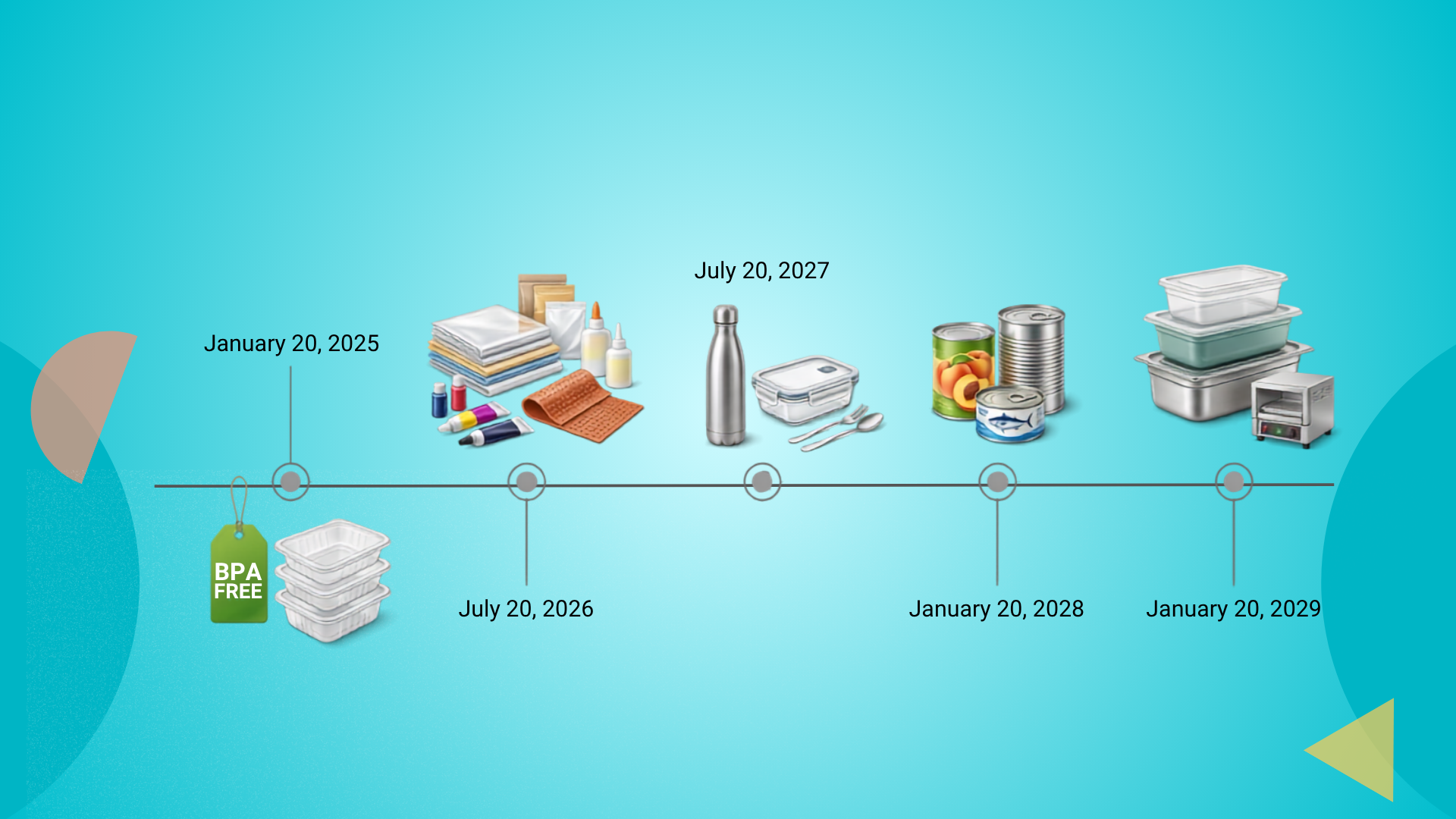




The EU BPA ban timeline for food packaging isn’t a single deadline. It’s a five-stage schedule, and most teams might be working from an incomplete version of it.
Most industry briefings reduced EU Regulation 2024/3190 to one message: remove BPA from your packaging by July 2026. That’s accurate for most single-use food contact materials. But this regulation creates different compliance windows for repeat-use articles, canned food categories, external metal coatings, and professional food-contact systems.
This matters because the wrong deadline can lead teams to act too early on low-priority formats, delay urgent ones, or build documents based on outdated rules.
A February 2026 correction clarified transition rules and document requirements. Teams that built their BPA compliance plans before this correction should review them before they finalize material choices, supplier declarations, or stock plans.
This article maps the full structure of EU Regulation 2024/3190 and highlights the main actions food packaging teams need to take before each deadline.
Key Takeaways
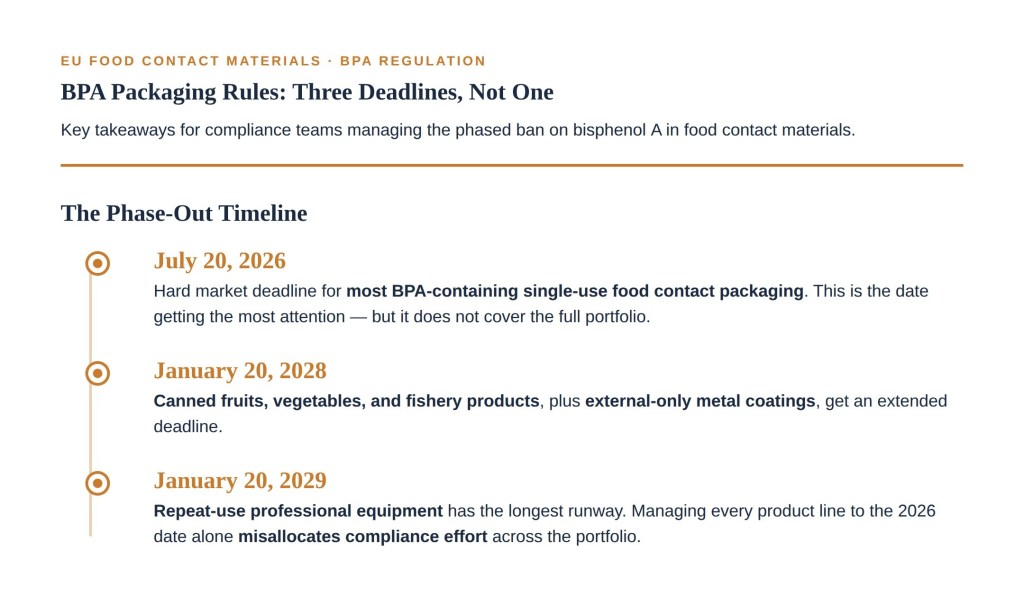
- July 20, 2026, is the hard market deadline for most BPA-containing single-use food contact packaging.
- Canned fruits, vegetables, and fishery products and external-only metal coatings have until January 20, 2028. Repeat-use professional equipment has until January 20, 2029. Managing to a single July 2026 date misallocates effort across the portfolio.
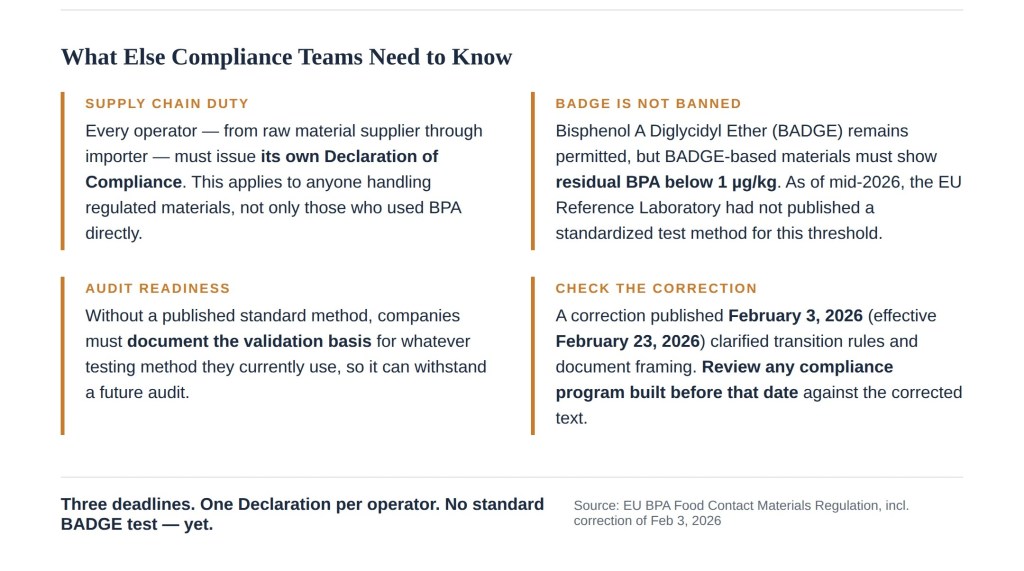
- Every operator in the supply chain, from raw material supplier through importer, must issue their own Declaration of Compliance. The obligation covers operators who handle regulated materials, not just those who have used BPA.
- Bisphenol A Diglycidyl Ether (BADGE) is not banned by default, but BADGE-based materials must show that residual BPA is not detectable at 1 µg/kg. The EU Reference Laboratory’s standardized test method for this threshold hadn’t been published as of mid-2026. So companies must document the validation basis for any method currently in use to withstand a future audit.
- A correction published on February 3, 2026, and effective from February 23, 2026, clarified transition rules and document framing. Compliance programs built before that date should be reviewed against the corrected text.
EU BPA Ban Compliance Deadlines: What Category You’re In Changes Everything
The regulation does not use the same deadline for every material. It sets transition tiers based on material type and use pattern.
| Tier | Material Category | Market Placement Deadline |
| Regulation in force | Prohibition on new BPA use in food contact manufacture | January 20, 2025 |
| General single-use | Plastics, coatings, adhesives, inks, silicones, and rubber for food contact | July 20, 2026 |
| Standard repeat-use | Reusable food contact articles (beverage bottles, kitchenware) | July 20, 2027 |
| Extended single-use | Canned fruits, vegetables, and fishery products. External-only coatings on metal packaging | January 20, 2028 |
| Professional repeat-use | Commercial and professional-grade reusable systems | January 20, 2029 |
July 20, 2026, is the date most food and beverage packaging teams are working toward. But food packaging teams should pay closer attention to these three categories as their extensions are easy to miss.
- Canned fruit, vegetable, and fishery products have until January 2028. That’s roughly a 20-month window to complete formulation work, get any new coating approved, and qualify suppliers. It’s a tight margin as replacing BPA-based epoxy can linings in high-acid, heat-processed formats is technically hard.
- External-only metal coatings also fall under the January 2028 tier. These coatings are used on the outside of metal packaging with no food contact and migration risk. Hence, the compliance action is simpler, but the documentation obligation still applies.
- Repeat-use professional equipment, including commercial catering systems and industrial food processing equipment, has the longest window, to January 2029. For compliance teams managing large portfolios, this is the lowest-urgency category. But it is in scope and must be documented.
Stocks of products that were compliant when placed on the market before the relevant deadline can still be sold until they run out. The deadline stops new market placement. It doesn’t force a recall. This sell-through right does not apply to new manufacturing after the deadline.
Declaration of Compliance: Who Must Issue One and What It Must Prove
One common misreading of EU Regulation 2024/3190 is that the Declaration of Compliance (DoC) rests solely with the brand owner or the final converter. It does not.
Every operator that puts a regulated food contact item, intermediate material, or final article on the EU market must issue its own DoC. That includes everyone from raw material suppliers and resin producers to coating formulators, converters, brand owners, and importers. A brand owner with a direct supplier’s BPA-free statement has documented one link, not the full supply chain.
Each DoC must show whether BPA, other bisphenols, or their derivatives were used or may be present as residuals. Imported food-contact materials require the same documentation from importers as EU-made materials.
The EU Note for Guidance, published December 17, 2025 (reference C/2025/6721), covers DoC in 40 Q&As across five topics: scope, other bisphenols and derivatives, testing, market placement, and transitional provisions.
The February 2026 correction also refined how documents should be framed. For example, DoC documents should state whether they cover an intermediate material or a final article. They should not treat both as the same subject.
Testing and Limits for Food Contact Materials
According to EU guidance, the testing method used by operators must be sensitive enough to detect BPA at the 1 µg/kg or 1 part per billion limit. The recent correction states that unless Annex II or an EU Reference Laboratory (EURL)-recommended method specifies a different value, the method used for this verification must have a detection limit of 1 µg/kg.
EURL is developing a standardized method for BPA testing in food-contact materials. As of mid-2026, that method hasn’t been published. Until it is available, operators must use their own validated methods that achieve the 1 µg/kg threshold. Testing laboratories are currently using liquid chromatography–mass spectrometry (LC-MS) to meet this requirement.
A company can issue a DoC citing its own validated method. However, the problem is that “validated” has no standard definition across Member States. If an audit questions the method, the DoC can be hard to defend, even when the product is BPA-free.
BADGE Compliance Is Not the Same as BPA Elimination
Bisphenol A Diglycidyl Ether (BADGE) is a widely used epoxy coating intermediate made from BPA. The regulation doesn’t treat it the same as BPA, BPS, or other restricted bisphenols. Hence, it’s not banned outright. This distinction matters for epoxy can coating suppliers and packaging teams.
However, BADGE-based food contact materials are not documentation-free or risk-free, as they are derived from BPA. A supplier must be able to prove that the BPA residual is absent in the final product.
A generic “BPA-free” statement is not enough if it does not address the residual BPA pathway.
| Substance / Claim | Status Under EU 2024/3190 | What It Means in Practice | What the Team Must Check |
| BPA | Prohibited in food contact manufacture, subject to phased transition deadlines | Main substance being phased out | Where BPA is still used, and which deadline applies |
| BADGE | Not automatically banned | Can remain in use only if residual BPA is not detectable | Test basis and proof of BPA absence at 1 µg/kg |
| BPS / BPF | Not a BADGE-type exception; subject to separate scrutiny | Not a simple safe replacement | Authorization status and forward regulatory risk |
| TMBPF | Current substitute under scrutiny | Usability today does not guarantee long-term stability | Toxicology signals and regulatory trajectory |
| “BPA-free” statement | Not enough on its own | Marketing claim does not equal compliance proof | DoC, testing method, supplier chain, and traceability |
The Grey Areas That Can Break an Otherwise Compliant Program
A compliance program that correctly addresses deadlines and DoC obligations can still fail at three points.
Grey area 1: Recycled content is not automatically exempt
Common assumption: Using recycled inputs means BPA presence is exempt.
Reality: The regulation allows an exemption where bisphenols are present only as unintentional contaminants from recycled inputs, such as recycled PET flakes or recycled paperboard. But this exemption depends on evidence. A company must show where the recycled input came from and why any BPA presence was unintentional.
Compliance risk: A recycled-content claim without sourcing records may not hold up during an audit or market surveillance review. If the material tests positive for BPA and the company cannot prove the source, the exemption becomes difficult to defend.
Action for packaging teams: Keep provenance documentation for recycled inputs. The file should connect the recycled material source, supplier declaration, test data where available, and the final packaging SKU.
Grey area 2: Multi-layer packaging is in scope when any regulated layer is present
Common assumption: If the food-contact surface is BPA-free, the whole packaging structure is compliant.
Reality: Multi-layer and composite packaging can still fall within scope when a regulated layer, coating, adhesive, or functional component contains BPA or another restricted bisphenol. A compliant external layer or clean food-contact surface does not automatically clear the full article.
Compliance risk: Laminates, coated paper, foil pouches, composite board, and adhesive-bonded structures can create hidden exposure if the compliance review stops at the inner food-contact layer. A missing declaration from one upstream layer supplier can weaken the entire documentation chain.
Action for packaging teams: Map the full packaging structure layer by layer. The compliance file should cover coatings, adhesives, inks, barriers, sealants, and other functional layers, not only the primary food-contact surface.
The same multi-layer structures are also under review for recyclability and recycled-content targets under the EU’s Packaging and Packaging Waste Regulation (PPWR), so a single missing layer declaration can create exposure under both regulations.
Grey area 3: Enforcement will not look the same across every EU market
Common assumption: Once the EU regulation applies, enforcement will be uniform across all Member States.
Reality: EU Regulation 2024/3190 sets the restriction, but penalties and enforcement practice sit with individual Member States. There is no EU-level penalty harmonization. Consequences can range from administrative fines to product withdrawal to criminal liability, depending on the jurisdiction.
Compliance risk: A program designed around the least demanding market may not survive review in a stricter one. For example, A brand operating across Germany, France, Italy, and Poland faces four different enforcement profiles. This creates uneven exposure across the same packaging portfolio.
Action for packaging teams: Build the compliance file for the highest expected level of scrutiny, not the lowest. Also, identify which Member States represent your highest distribution volume and benchmark your compliance program against that enforcement profile.
Prioritize clear supplier declarations, test-method rationale, batch traceability, and SKU-level documentation that can be defended across multiple Member States.
Grey area 3: Enforcement is not harmonized, and the asymmetry is material
Regulation 2024/3190 sets the prohibition, but sanctions are delegated to individual Member States. There is no EU-level penalty harmonization.
Consequences can range from administrative fines to product withdrawal to criminal liability, depending on the jurisdiction. No confirmed Member State enforcement actions against BPA non-compliance in food-contact materials have been declared as of mid-2026.
A brand operating across Germany, France, Italy, and Poland faces four different enforcement profiles. A compliance program designed to pass scrutiny in the most lenient market may not survive a review in a more aggressive one.
The substitute material carries its own future regulatory risk. BPS, BPF, and TMBPF are all under active scrutiny. It is a separate problem worth examining before the substitution is locked in.
Strategic Implications for Food Packaging R&D
BPA has been in food contact materials since the 1960s, with epoxy can linings the largest single use. EU Regulation 2024/3190 closes that chemistry off in five stages through January 2029. The 1 µg/kg detection limit and the per-operator Declaration of Compliance obligation apply across the full supply chain, not just the brand owner.
The replacement market is uneven. Polyester-based systems from PPG and AkzoNobel are in commercial use. Sherwin-Williams’ valPure V70, based on TMBPF, was the first non-BPA epoxy to receive FDA food contact substance notification. Acrylic and oleoresin linings are running in select categories. Each carries trade-offs against high-acid foods, retort tolerance, shelf life, or cost.
Brands like Eden Foods and Amy’s Kitchen were committed to BPA-free linings years before the regulation. Most large CPG brands are still working through portfolio-level reformulation, with internal targets that extend beyond July 2026 for specific SKUs.
The substitute decision carries forward regulatory risk. BPS and BPF are inside ECHA’s bisphenol group restriction discussion. TMBPF has open mutagenicity questions in peer-reviewed work. A coating chosen in 2026 to clear the deadline can sit inside the next restriction file by 2028.
Which BPA replacement fits your product format, your supplier base, and the next regulatory cycle?
Struggling to choose between BPA-free coating platforms without re-running reformulation in two years? Talk to our experts to get a vetted shortlist of materials and suppliers, along with forward regulatory signals tailored to your portfolio.