


The world relies heavily on polystyrene and foamed plastic for protective packaging. Around 15 million kilograms of polystyrene are produced every year for packaging alone. However, increasing regulations across regions like EUDR, PPWR, and the EU’s single-use plastics directive are starting to limit or ban its use entirely. These materials are cheap, lightweight, and widely used, but they are also among the most harmful to the environment.
Polystyrene is difficult to recycle, breaks down into microplastics, and accumulates in landfills, oceans, and even human bodies. At the same time, brands face pressure from consumers to adopt sustainable alternatives without compromising performance or cost.
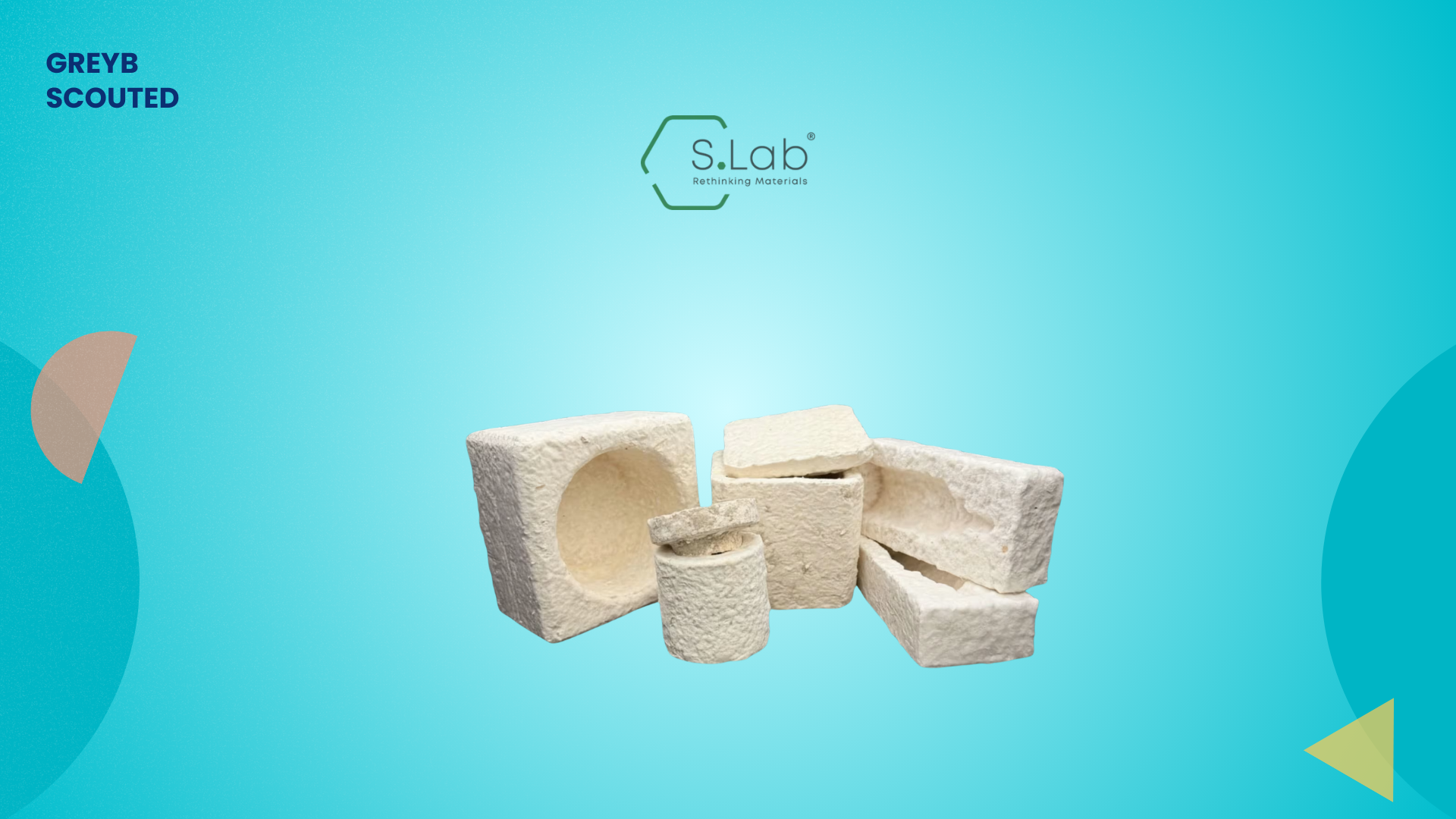
S.Lab addresses these packaging problems by replacing polystyrene with a fully plant-based, home-compostable packaging material made from agricultural waste and mycelium. Instead of synthetic foams, S.Lab grows packaging using leftover plant fibers bound together by mushroom roots.
This interview is part of our exclusive Scouted By GreyB series. Here, we speak with the founders of innovative startups to understand how their solutions address critical industry challenges and help ensure compliance with industry and government regulations. (Know more about startups scouted by GreyB!)
“The main learning that I have is just to keep going, because yes, it’s a challenge, but it does eventually work out.”
Julia Bialetska is the co-founder and CEO of S.Lab, a Ukrainian cleantech startup. She co-founded S.Lab after witnessing the devastating impact of plastic pollution while traveling in Southeast Asia and has since led the company through rapid growth, international grants, and multiple awards. Bialetska holds a Master’s in Biotechnology and over a decade of leadership experience in product management and innovation, skills she applies to scaling sustainable material technology globally.
Under her leadership, S.Lab has secured funding from the Morgan Stanley Inclusive & Sustainable Ventures program and Women TechEU. The startup is expanding production with modular, containerized factories to serve clients across Europe and beyond.
How plant waste and mycelium could eliminate polystyrene packaging
S.Lab is a sustainable packaging company developing plant-based protective packaging to replace polystyrene and foamed plastics. The company uses only two natural ingredients: agricultural plant waste and mycelium, the root-like network of mushrooms. These materials are grown and shaped into custom packaging forms without the use of molds or plastic additives. S.Lab’s packaging is waterproof, thermally insulating, safe for humans and animals, and fully biodegradable in home compost within 30 days.
The company primarily serves the cosmetics, personal care, electronics, and fragile goods industries. It plans to expand into food and pharmaceutical packaging.
Can you explain what S.Lab does and what problem you are solving?
Julia: We work in the packaging industry, specifically with plant-based packaging made from only two ingredients. One is plant waste, such as straws left in the fields after harvest. The second is mycelium, which is a network of mushroom roots with very strong binding properties. When we combine them, the mycelium binds all plant particles into a very strong, reliable material.
We are replacing polystyrene or styrofoam used in protective secondary packaging. This type of packaging generates significant waste and is extremely harmful to the environment, animals, and even humans. At the same time, regulations are limiting polystyrene use, and companies and consumers are actively seeking better alternatives.
How is your packaging made, and why doesn’t it require molds?
Julia: First, we collect plant waste from farmers and clean and sterilize it using our own patented process. In parallel, we cultivate mycelium in-house. We don’t buy it or collect it from nature. It’s a fully regenerative process inside our facilities.
Once both are ready, we mix them and allow the mycelium to grow and bind the plant fibers. This creates a semi-prepared material. We then shape it into its final form using a robotic process instead of molds. The shaped packaging is grown under controlled conditions for five days and then dried. That’s how it becomes ready to use.
Which industries are you currently working with?
Julia: We mainly work with cosmetics, beauty products, self-care items, electronics, devices, décor items, and anything fragile that requires protective secondary packaging. These industries rely heavily on cushioning materials today.
In the future, we want to work with food and pharmaceuticals as well. That requires additional certifications, especially for food-contact applications, and we are actively exploring that now.
How does your packaging compare in cost to traditional materials?
Julia: Price competitiveness was critical for us from the beginning. The raw materials are very inexpensive because they are agricultural leftovers. We also cultivate our own mycelium, so we don’t depend on external suppliers.
With full automation and decentralized mini-factories, we expect our pricing to reach the same level as polystyrene or molded pulp. We also save costs by not using injection molds, which are usually very expensive for custom packaging.
Speed is often a challenge with mycelium-based products. How do you handle that?
Julia: The growth speed of mycelium is a natural limitation. We can’t speed it up dramatically. It’s a biological process. What we can do is build a continuous production loop so we always have semi-prepared material ready.
Once an order is confirmed, it takes about 5 days for the packaging to be ready. From first contact to initial delivery, it usually takes two to three weeks, depending on approvals and design iterations.
Does your packaging require additional barrier films or coatings?
Julia: In most cases, no. The material is naturally waterproof and thermally insulating. It can protect products from humidity and temperature changes without any extra layers.
For food applications, certification is the main challenge, not performance. The material itself is safe, but regulatory approval is required before direct food contact.
How do you address logistics and shipping-related emissions?
Julia: Logistics is a major source of CO₂ emissions and cost. Shipping packaging alone can add 20–30% to total costs. That’s why we’re shifting to a decentralized model.
We plan to deploy automated mini-factories directly at customer facilities. Customers won’t need upfront investment. We provide the technology and charge a monthly service fee, similar to a licensing model. This eliminates shipping, reduces emissions, and simplifies supply chains.
Is your packaging edible or water-soluble?
Julia: Technically, it is edible. Nothing harmful would happen if someone ate it. It’s made only of mycelium and plant fibers. But it’s not meant to be food.
The packaging fully biodegrades within 30 days when placed in soil. It leaves no microplastics or residue. It simply returns to its natural state.
What has been your biggest challenge as a founder?
Julia: Honestly, the entire journey is challenging. We’re building new technology, creating a market, raising resources, and assembling the right team. All at the same time.
The biggest learning is just to keep going. It’s not easy, but with the support of mentors, partners, and early results, it does work out. And the journey ahead is even more interesting.
Meet our Interviewer – Anusha Srivastava, Senior Research Analyst

Anusha Srivastava, Senior Research Analyst
Want to find other scalable startups working on solar panel optimization? Please fill out the form below to contact our experts.