A large PET manufacturer was dealing with a persistent quality problem inside its polymerization lines. The catalyst used in PET production was being chemically reduced during the process, converting from its active ionic form into metallic particles.
These particles appeared as black and grey specks in the final polymer, increasing haze and reducing optical clarity batch after batch. As the catalyst was reduced, its activity also dropped. The manufacturer had to continuously add more catalyst to maintain productivity.
The constraints were strict. The polymer had to remain food-grade, FDA compliance was non-negotiable, and color, haze, and existing polymer properties had to remain within specification. Switching to a different catalyst was not an option. The manufacturer partnered with GreyB to identify viable ways to mitigate and control the catalyst reduction within these operating constraints.
20,000 Patents and 1,500+ Papers Exposed the Search Gap
The team began with a broad secondary research sweep across approximately 20,000 patents, over 1,500 scientific publications, and a global commercial market scan.
The bulk of the identified solutions pointed towards alternative catalyst systems. For this client, that was a non-starter. A large portion of the initial candidate pool had to be set aside before evaluation could begin.
Rather than treating this as a dead end, the team redirected the search. If published research was skewed towards catalyst replacement, the more useful question was what manufacturers already committed to antimony-based systems were doing in practice.
Competitor Outreach Narrowed the Landscape to 18 Solutions
The team reached out directly to PET producers to understand how they were managing black and grey specks in their own polymerization lines.
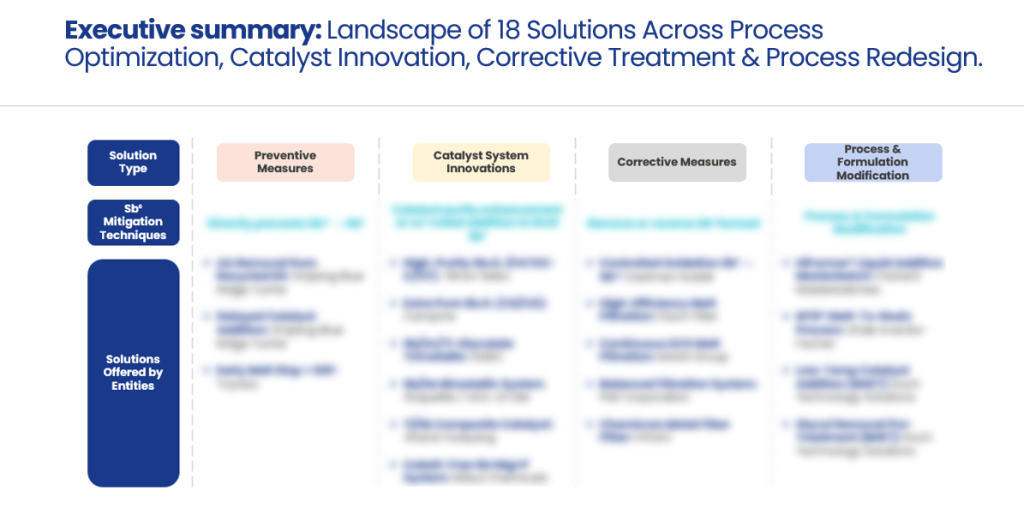
This outreach grounded the problem in operational reality and produced a tighter, more relevant shortlist of 18 candidate solutions across four categories:
- Preventive chemical measures
- Catalyst system innovations
- Corrective treatments
- Process and formulation modifications
The 18 solutions were then structured into a tiered action plan, and each solution was assessed against a weighted framework covering:
- Antimony specificity
- Demonstrated impact on polymer clarity
- FDA approval status
- Commercial readiness
For the leading solutions, the comparison also recorded whether they directly addressed the Sb³⁺ to Sb⁰ conversion, their food-contact status, commercialization status, achieved quality result, application target, and compatibility with antimony oxide.
Expert Input: Reset the Goal From Eradication to Control
A candidate pool built from research is a starting point. What turns it into a recommendation is knowing whether people who have actually operated these lines would reach for the same answers.
The team contacted the authors behind the most relevant patents and scientific publications. These experts had decades of hands-on industry experience. They were not shown the shortlist. Instead, they were asked open questions about the problem itself:
- How did they understand the chemistry?
- Where did they see the practical limits?
- What did they consider viable for a continuous industrial process under food-grade constraints?
Several experts made the same point first. Completely eliminating Sb⁰ formation on a continuous line is unrealistic. The right target was mitigation and control, not eradication.
This recalibration shaped how every candidate was subsequently evaluated before a single solution was scored.
Blind Expert Validation Confirmed the Same Solution Directions
The experts were then asked which directions they would explore. Their answers independently pointed to the same territory the research had already identified.
The convergence was not guided. It came from asking experienced practitioners open questions and letting their answers speak for themselves.
This validation showed that the recommended directions had been independently reached by people who had developed the underlying science and practitioners who had faced the same problem at scale.
Three Options Showed Different Commercial and Application Fit
The final comparison assessed three shortlisted options against the client’s technical, regulatory, quality, and application requirements.
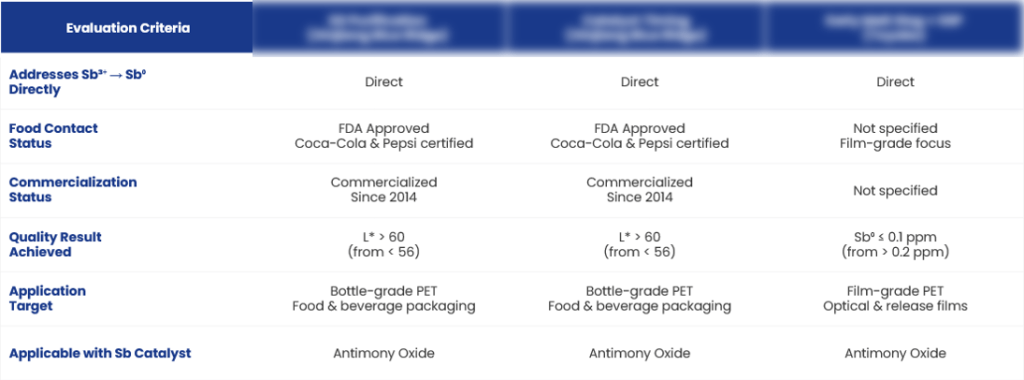
The comparison separated solutions that already met food-contact and commercial-readiness requirements from an option focused on film-grade PET. It also allowed the manufacturer to compare improvements in polymer clarity with direct reductions in metallic antimony formation.
A Tiered Action Plan Strengthened the Final Recommendation
The client received a validated landscape of 18 solutions across four categories, structured into a tiered action plan.
The more durable contribution was methodological. Combining secondary research with direct competitor outreach and blind expert validation provided something a literature review alone could not: confidence that practitioners who had faced the same problem at scale had independently reached the recommended directions.
The client came in with a quality problem and a constraint-heavy brief. What they left with was not just a list of solutions. It was a set of recommendations independently confirmed by people who had developed the underlying science and by practitioners who had faced the same problem in real production environments.
For technically complex, constraint-heavy problems, the gap between a research finding and a credible recommendation is crossed not by conducting more research, but by asking the right people the right questions and letting their answers speak for themselves.
How Can PET Manufacturers Mitigate Antimony Reduction Without Changing the Catalyst?
For manufacturers committed to antimony-based systems, technology scouting must extend across patents, scientific publications, commercial solutions, and real production practices. The search must also filter out alternatives that require catalyst replacement or fail to meet food-grade, clarity, color, and polymer-property requirements.
Technology analysis can then evaluate each candidate against antimony specificity, polymer clarity, FDA approval status, and commercial readiness. Competitor outreach and blind expert validation help determine whether the shortlisted directions remain viable in a continuous industrial process.
GreyB helps teams move from broad research and patent noise to validated, commercially viable recommendations through open innovation consulting.
Fill out the form below and connect with our expert today: