5G-Advanced and 6G networks increasingly require optimization that can respond as conditions change. Recent patent activity shows digital twins evolving accordingly: from virtual replicas used for monitoring to systems that can support prediction, simulation, strategy learning, and automated action.
GreyB reviewed 1,000+ patent documents across US, EP, and CN jurisdictions to examine how this shift is appearing in recent inventions around autonomous network optimization.
The Digital Twin Is Moving Inside the Decision Loop
The change is larger than better network simulation.
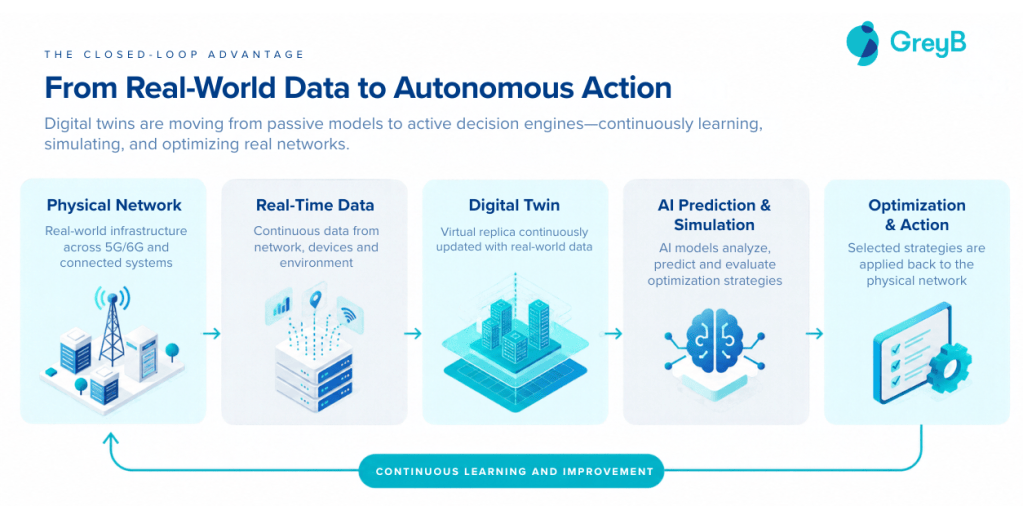
Across the patents highlighted in the report, real-world operating data continuously updates the digital twin. AI uses that environment to predict conditions or evaluate strategies. The selected strategy can then be applied back to the physical system.
That creates a closed loop between observation, prediction, decision, and action.
The result is a digital twin that does not simply describe network behavior. It increasingly participates in optimizing it.
Four Patent Signals Showing How Autonomous Optimization Is Taking Shape
| Patent signal | What the invention changes |
|---|---|
| China Mobile: AI-driven 6G resource orchestration | Twin-modeling data is continuously analyzed to generate and update resource-allocation strategies across network functions. |
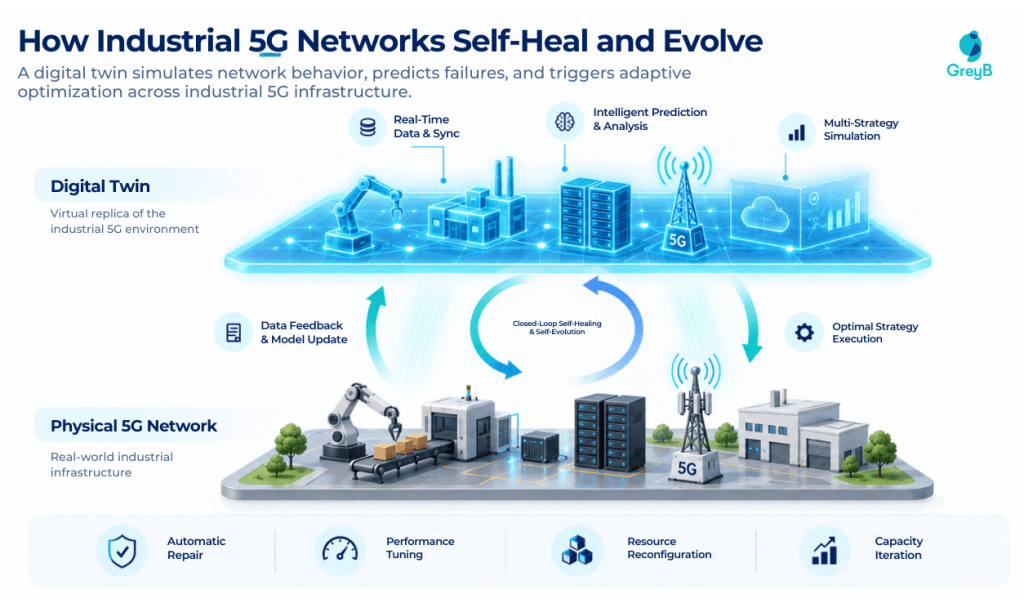
| Yushu: Self-healing industrial 5G | The digital twin simulates network behavior, predicts failures, and triggers adaptive optimization actions through a closed-loop mechanism. |
| China Telecom: AI-native network orchestration | Digital twin-assisted strategy learning dynamically adjusts AI-resource allocation and network-orchestration policies. |
| Yancheng: Hybrid-energy optimization | Continuously synchronized operational data and predictive models allow power-allocation strategies to be simulated, verified, and deployed. |
Together, the four examples show the same architectural direction appearing across different systems: digital twins are being connected directly to the mechanisms that make operational decisions.
What the Report Covers
The report examines patent-backed approaches to AI-native 6G optimization, autonomous industrial 5G self-healing, intelligent resource orchestration, and closed-loop digital-twin optimization in adjacent infrastructure.
Each highlighted innovation is broken down into the problem being addressed, the role of the digital twin, the autonomous mechanism introduced by the patent, and the resulting change in how the system is managed.
The final analysis connects these examples to the broader move from passive digital twins toward closed-loop intelligence.
From Prediction to Autonomous Action
The recurring innovation pattern is increasingly clear:
Synchronize the real system → simulate the possible outcomes → learn or select an optimization strategy → execute the change → repeat.
That loop is what separates a digital representation of a network from a digital twin capable of supporting autonomous operation. The report examines how recent patents are beginning to build that loop into 5G, 6G, and connected infrastructure.