


Patients often wait days or even weeks to receive their biopsy results for diagnosing cancer. This delay not only exacerbates anxiety but can also impact treatment outcomes. Studies show that even a four-week delay in cancer treatment can reduce survival rates. Moreover, 80% of breast biopsies turn out benign. Yet, all patients undergo the same nerve-wracking wait, straining both their mental health and the healthcare system’s efficiency.
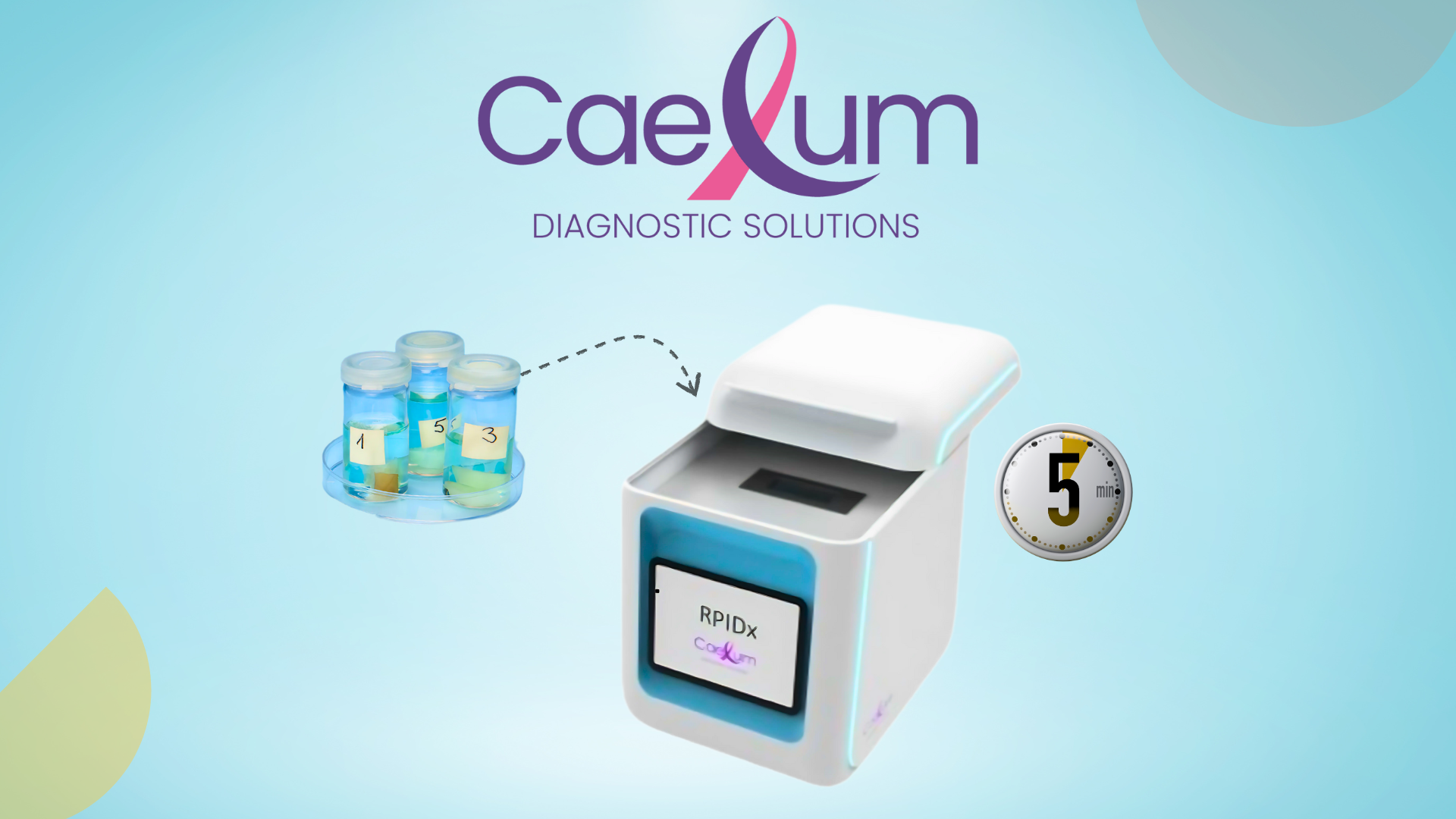
To improve this experience, Caelum Diagnostic Solutions, a Los Angeles based startup, developed RapidX, an AI-powered imaging system. RapidX aims to provide near-instant analysis of tissue biopsies by detecting cancerous activity and presenting results in minutes. The device integrates smoothly into clinical workflows and requires minimal technical training.
To better understand how their technology works, we spoke to Rachel Wellner, CEO of Caelum Diagnostic Solutions. This article contains notable highlights from our entire conversation.
This interview is part of our exclusive Scouted By GreyB series. Here, we speak with the founders of innovative startups to understand how their solutions address critical industry challenges and help ensure compliance with industry and government regulations. (Know more about startups scouted by GreyB!)
“We took a research lab technology that needed anti-vibration tables and made it usable in a busy clinic, where even a student can run a scan and get results in minutes.”
– Dr. Rachel Wellner

Dr. Rachel Wellner is the CEO of Caelum Diagnostic Solutions. Dr. Wellner is a board-certified breast surgical oncologist with 20 years of experience in cancer treatment and diagnostics. She has held professorships at institutions such as Mount Sinai Hospital, Beth Israel, and Hackensack University Medical Center, where she served as Chief of Oncoplastic Surgery. She founded Caelum Diagnostic Solutions to develop cutting-edge digital biopsy technologies, aiming to improve cancer detection and reduce patient anxiety.
How Caelum Diagnostic Solutions Is Ending the Biopsy Waiting Game
Caelum Diagnostic Solutions is redefining cancer diagnostics with RapidX, a desktop tool that delivers pathology-level insights from tissue biopsies in minutes. By adapting fluorescent lifetime imaging microscopy (FLIM) — a technology nearly a century old — and coupling it with AI, founder Dr. Rachel Wellner has created a tool that doesn’t just image tissue but evaluates its metabolic activity to detect malignancy with high accuracy. Their mission? To eliminate the anxious waiting period between a biopsy and diagnosis, and get patients treated faster, potentially improving outcomes and saving lives.
What does Caelum Diagnostic Solutions do?
Rachel: We’ve built a device called RapidX that can analyze a tissue biopsy right after it’s taken and tell us, in about five minutes, whether the tissue is cancerous or not. Traditionally, you wait days or even weeks to hear back from pathology labs. That wait causes a tremendous amount of anxiety for patients and even delays treatment. We’re solving that by using a type of imaging called FLIM — it reads how cells process energy, which helps us distinguish between healthy and cancerous cells in real time.
What made implementing FLIM into diagnostics so complicated before?
Rachel: Great question. FLIM is not new — it’s been around since the 1930s. However, until now, it was bulky, sensitive to the slightest vibrations, and entirely impractical in a hospital setting. You needed anti-vibration tables and trained engineers to operate them. Our challenge was to engineer a compact and robust version of FLIM that could operate effectively in busy clinical settings. And we did it. We found a way to shrink it, stabilize it, and make it simple enough that even a med student can run it. That’s a giant leap.
How do clinics and patients react when they hear this can be done in five minutes?
Rachel: At first, there’s disbelief. They ask, “Is it accurate?” And yes — we’ve consistently seen 94–99% accuracy, which matches traditional FLIM results. Even with just 32 specimens so far, that gave us over 420 million data points for training our AI. Patients and key opinion leaders are excited — we’ve got surveys, letters of support. Of course, some in the medical field are cautious, but most see how seamlessly this fits into clinical flow. It doesn’t replace pathology — it supports it. We’re simply providing patients with answers faster and helping hospitals act sooner.
What’s the most significant barrier to getting RapidX into more clinics?
Rachel: Right now, it’s building out the prototypes and running large-scale clinical studies. We’re collaborating with MD Anderson for this, but these studies require hundreds of specimens and are expensive. That data will also help us with FDA approval, which we’re expecting to go through the 510(k) pathway. We’re not adding risk — the tissue’s already out, we’re just reading it differently. But even with that, there’s still the challenge of raising funds to build and deploy these units and generate the robust data we need.
How does AI factor into RapidX?
Rachel: It’s crucial. Historically, FLIM data required a biomedical engineer for interpretation. Now, we’re creating an AI-powered database that can analyze the metabolic activity of tissues automatically. Even with just 32 specimens, we’ve got hundreds of millions of data points. Eventually, we want to have a model that not only says “cancer or not” but tells us what type, how aggressive, and whether the patient might need chemo — all within minutes. That’s the future, and AI makes it possible.
What stage are you at with FDA approvals and reimbursement?
Rachel: We’re gearing up for clinical trials that will supply data for FDA submission. Based on current FDA activity in digital pathology, we anticipate a 510(k) pathway, possibly even a breakthrough designation. For reimbursement, we’re lucky — rapid pathology already has a CPT code. So we’re not inventing a new billing process. That makes adoption easier once the device is clinically validated.
What technical challenges lie ahead for you?
Rachel: One is imaging depth. Currently, we achieve fantastic XY resolution — surface imaging. But to visualize deeper layers, we’ll need to integrate a new modality, like optical sectioning or even ultrasound. That’s our next big R&D push. We’re also continuing to refine the AI. And, of course, everything must be scalable, durable, and easy for clinicians to use.
How are you protecting your innovation?
Rachel: We’ve filed a broad “super patent” that covers around 20 subclaims — hardware, software, workflows, everything. Beyond that, we have trade secrets and trademarks. But our approach is very IP-focused. We understand the disruption this causes, and we’re taking protective measures accordingly.
Finally, what advice do you have for fellow healthcare entrepreneurs?
Rachel: Expect the road to be more challenging, longer, and more expensive than you think. If you’re building something truly disruptive, it will test you. But if you believe in what you’re doing — believe — don’t let go. There were nights I wanted to give up, and moments that felt like our moon landing when we first saw a tumor light up under RapidX. So hold on. Don’t self-sabotage. If it’s real, and you know it, just keep going.
Meet our Interviewer – Shabaz Khan, Marketing Manager at GreyB

Shabaz Khan, Marketing Manager
Want to find other scalable startups innovating in digital health and patient care? Please fill out the form below to contact our experts.