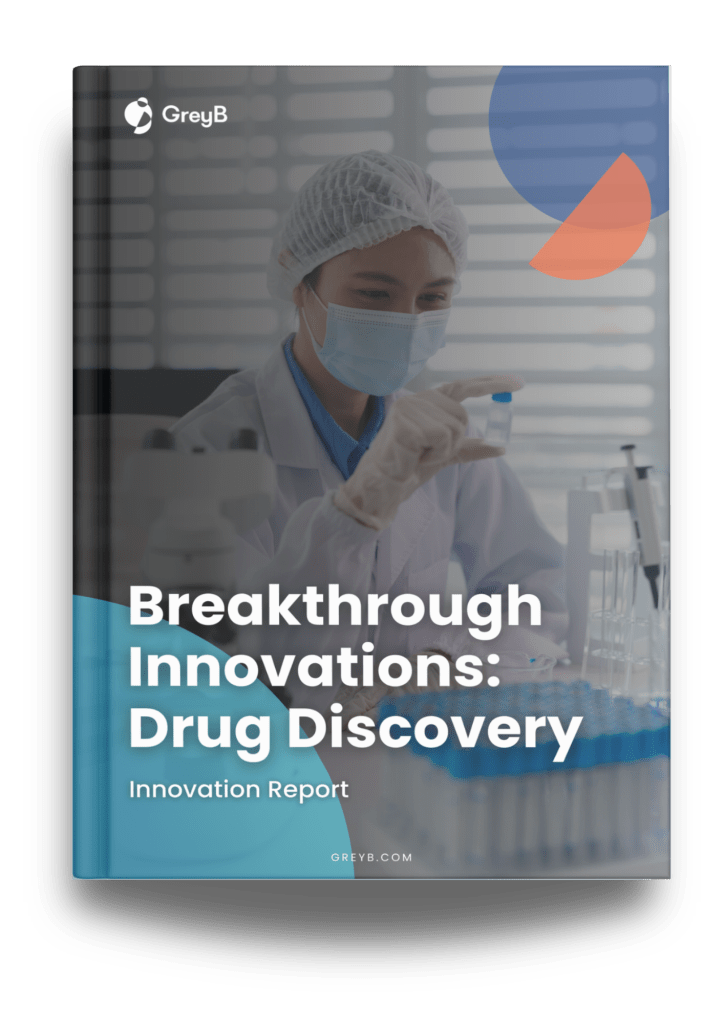
Drug development can take more than 12 years, cost billions of dollars, and still face failure rates above 90%. New patented approaches are targeting specific points in this process: an ML model from Khumbu.ai and Helmholtz Munich improves molecular docking by mapping where different ligand atoms are likely to interact with a target. Fujifilm is using image-prioritization technology to help researchers review thousands of tissue specimens more efficiently. Huawei has developed an AI-based model for generating target molecules from protein structures and molecular data.
We traced patent activity from startups, research organizations, and technology companies including Khumbu.ai, Helmholtz Munich, Fujifilm, Huawei, Deep Rx, and Deargen to map how new computational approaches are being applied across drug discovery and development.
What’s Inside the Report?
Breakthrough Innovation – Discover how emerging technologies are addressing key challenges in drug discovery and development, including lead optimization, candidate evaluation, molecule design, drug-target interaction prediction, and treatment selection.
Innovative Technologies – Explore new approaches including 3D structure-guided molecular modeling, AI-based drug design, intelligent tissue imaging, predictive ML models, and biological data augmentation.
Real-World Applications – See how these innovations are being applied to reduce the time and effort involved in drug design, prioritize tissue samples for analysis, improve prediction of drug-target interactions, and support personalized treatment decisions.
Patent & Innovation Insights – Examine the organizations behind these developments and the patent activity protecting their approaches, including innovations from startups, biomedical research institutions, and companies outside traditional drug discovery.
Fill out the form to access the report and explore breakthrough innovations in drug discovery and development.