

Value Delivered
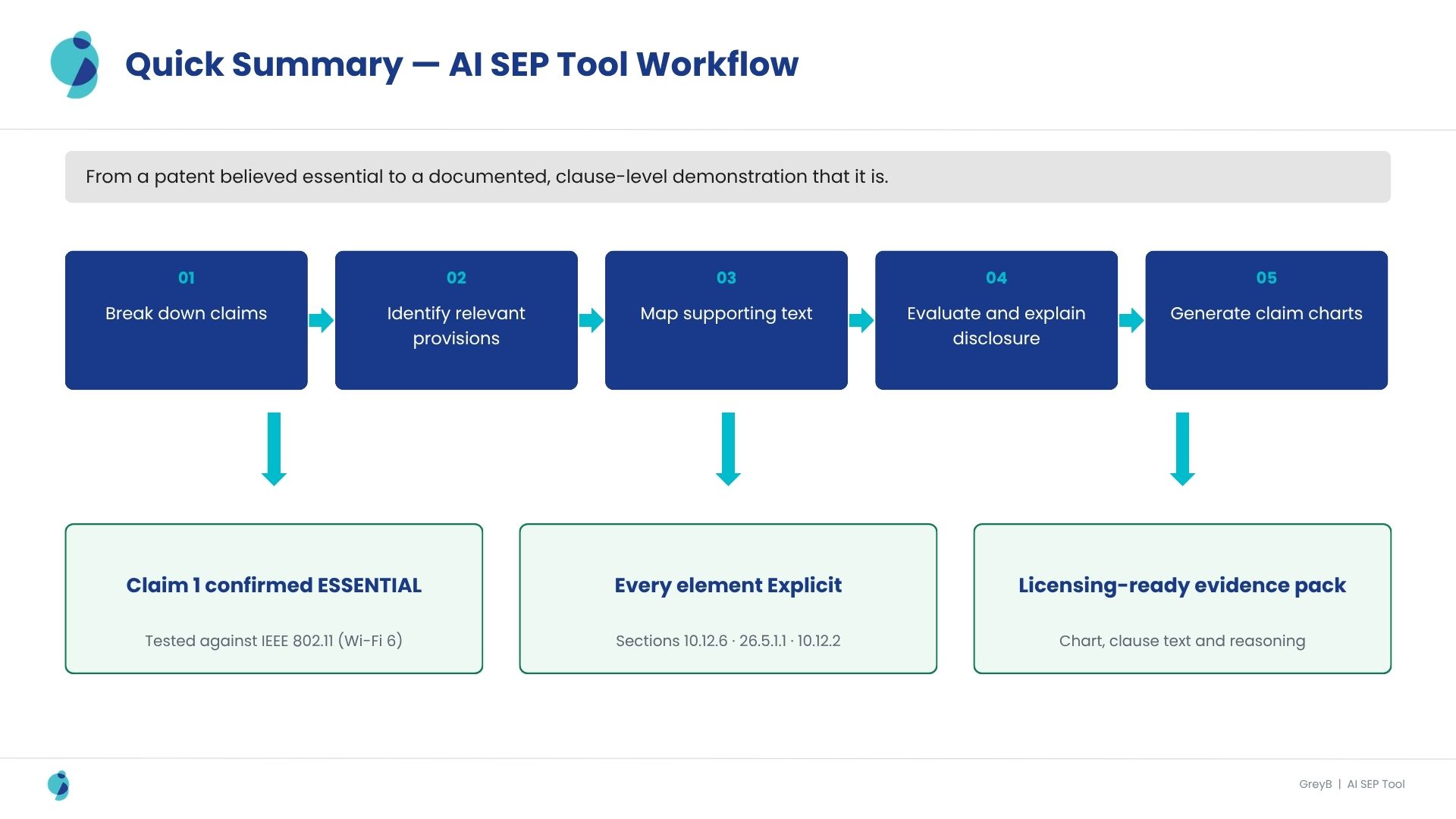
Before submitting a Wi-Fi 6 pool, a patent owner needed to know which of their patents read on the standard. Running that claim through GreyB’s SEP Checking Tool produced a clause-cited, element-by-element essentiality mapping in minutes. A senior analyst then reviewed and confirmed the tool’s clause mapping, so the patent owner walked out with a verified essentiality position – already knowing which limitations rested on explicit standard language versus which would need to be defended as implicit.
Problem Solved
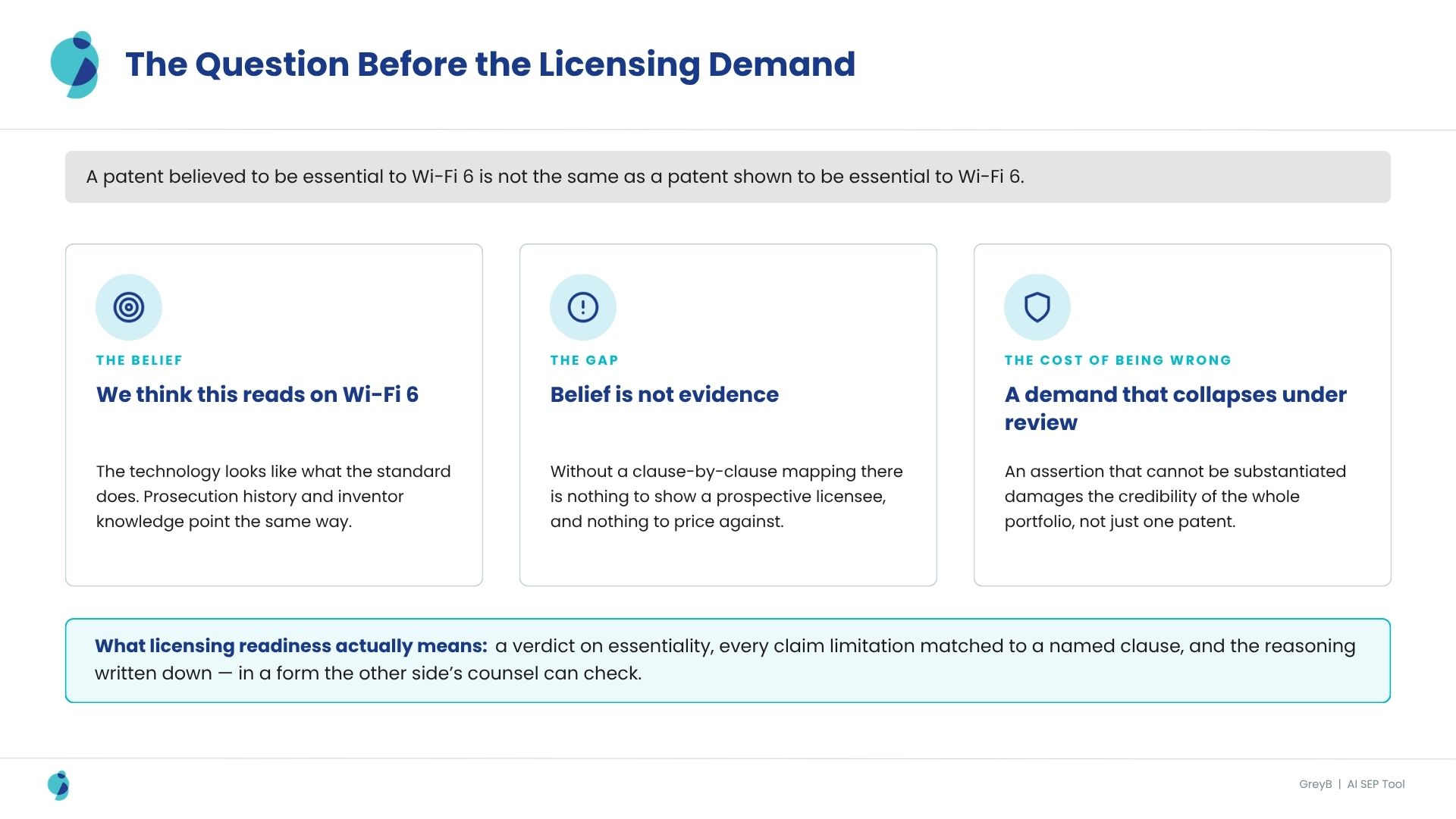
A company holding wireless patents rarely has trouble finding candidates that mention Wi-Fi 6 technology. The harder question is which of those claims actually read on IEEE 802.11ax/the consolidated IEEE 802.11‑2024 revision.
Declaring a patent against the standard doesn’t answer that question. IEEE’s own Letter of Assurance process does not investigate the validity, scope, or true essentiality of anything declared through it; a declaration is a starting signal, not a finding.
Getting a real answer, the traditional way, means an analyst working claim-by-claim through the normative text, tracing cross-references and definitions across a standard that runs to thousands of pages. That’s the 6–7 hour-per-patent baseline. It’s workable for one asset. It doesn’t scale to a portfolio review that has to finish before licensing starts.
Solution Offered
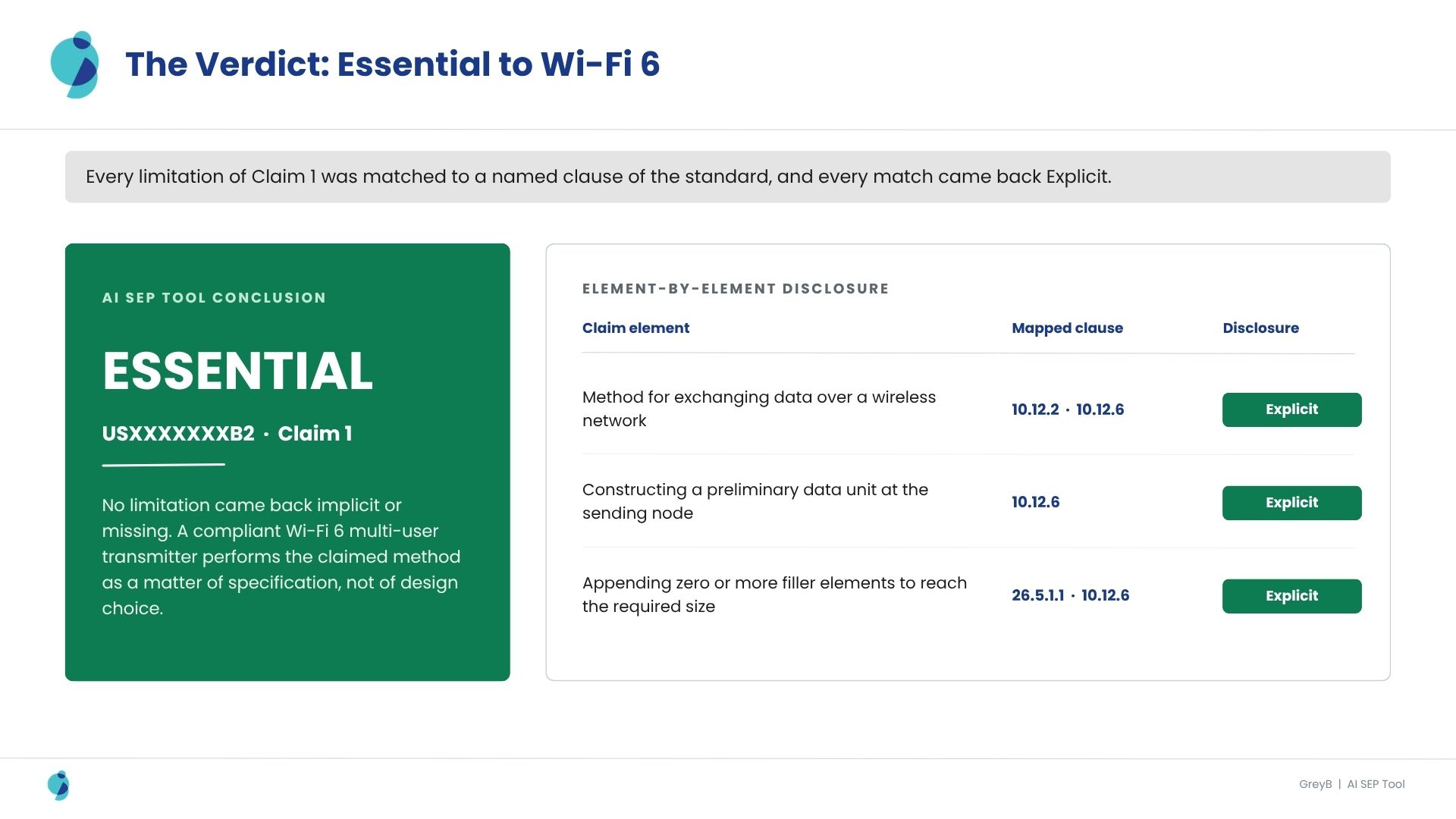
To show how the screening step works, we ran one claim from Wi-Fi 6 patent USXXXX891B2 through the SEP Checking Tool against IEEE Std 802.11‑2024.
The claim covers a padding method used when a transmitter builds an A-MPDU (aggregated MAC protocol data unit) for wireless LAN communication, specifically, how padding is added in two stages, using two differently sized padding units, until the resulting data block reaches a required target length.
Rather than returning a single ESSENTIAL / NOT ESSENTIAL label, the tool broke the claim into its individual limitations. For each one, it cited the exact IEEE clause, explained the correspondence, and classified the support as explicit (the standard states the requirement directly) or implicit (the requirement follows necessarily from other mandatory provisions, even though no single sentence states it in those terms). That distinction is the part a keyword search can’t produce, and it’s the part a licensing team actually needs because “implicit” support is exactly where a licensee will push back first.
Get the Full Case Study and See the Claim Chart Behind the Verdict