

The study helped the client identify commercially scalable production options, uncover differentiation opportunities, and avoid potential overlap with a protected process in the target market.
Value Delivered
The client received a clearer and lower-risk pathway for entering a target European market with a process for producing high-quality, intact exosomes from dairy streams.
The findings enabled the client to:
- Prioritize commercially relevant technologies: Focus on production techniques offering a practical balance among yield, purity, scalability, extraction complexity, and economic viability.
- Move beyond laboratory-scale solutions: Avoid relying on techniques that may produce highly purified exosomes but are difficult or uneconomical to implement at a commercial scale.
- Identify differentiation opportunities: Locate less-explored production approaches and application areas where the client could develop a distinct market position.
- Recognize potential patent risk: Identify a protected exosome-isolation process in the target jurisdiction that was associated with an organization collaborating with one of the client’s competitors.
- Support risk-mitigation decisions: Provide an early warning that could inform process selection, design-around analysis, licensing evaluation, or further legal review before market entry.
Problem Solved
The client was evaluating an opportunity to enter a new market using a scalable process to produce high-quality, intact exosomes from dairy streams. However, determining which production technologies were commercially suitable required more than identifying methods that could isolate exosomes.
Many known techniques were developed primarily for laboratory-scale research. Some provided high purity but resulted in low yield, involved complex processing, required expensive equipment, or created a risk of rupturing or degrading the exosomes. Consequently, a technically effective method was not necessarily a commercially viable manufacturing solution.
The client also needed to understand:
- Which production techniques offered the most suitable balance between yield and purity;
- Whether those techniques could be scaled for commercial manufacturing;
- Which production or application areas remained comparatively underexplored;
- How the client could differentiate its offering in an evolving technology landscape; and
- Whether existing patent rights in the target market could restrict the proposed entry strategy.
The information required to answer these questions was fragmented across patents, scientific literature, industry publications, technical demonstrations, and market activity. In addition, a relevant patent could appear commercially significant only after considering the patent owner’s collaborations and competitive relationships.

Solution Offered
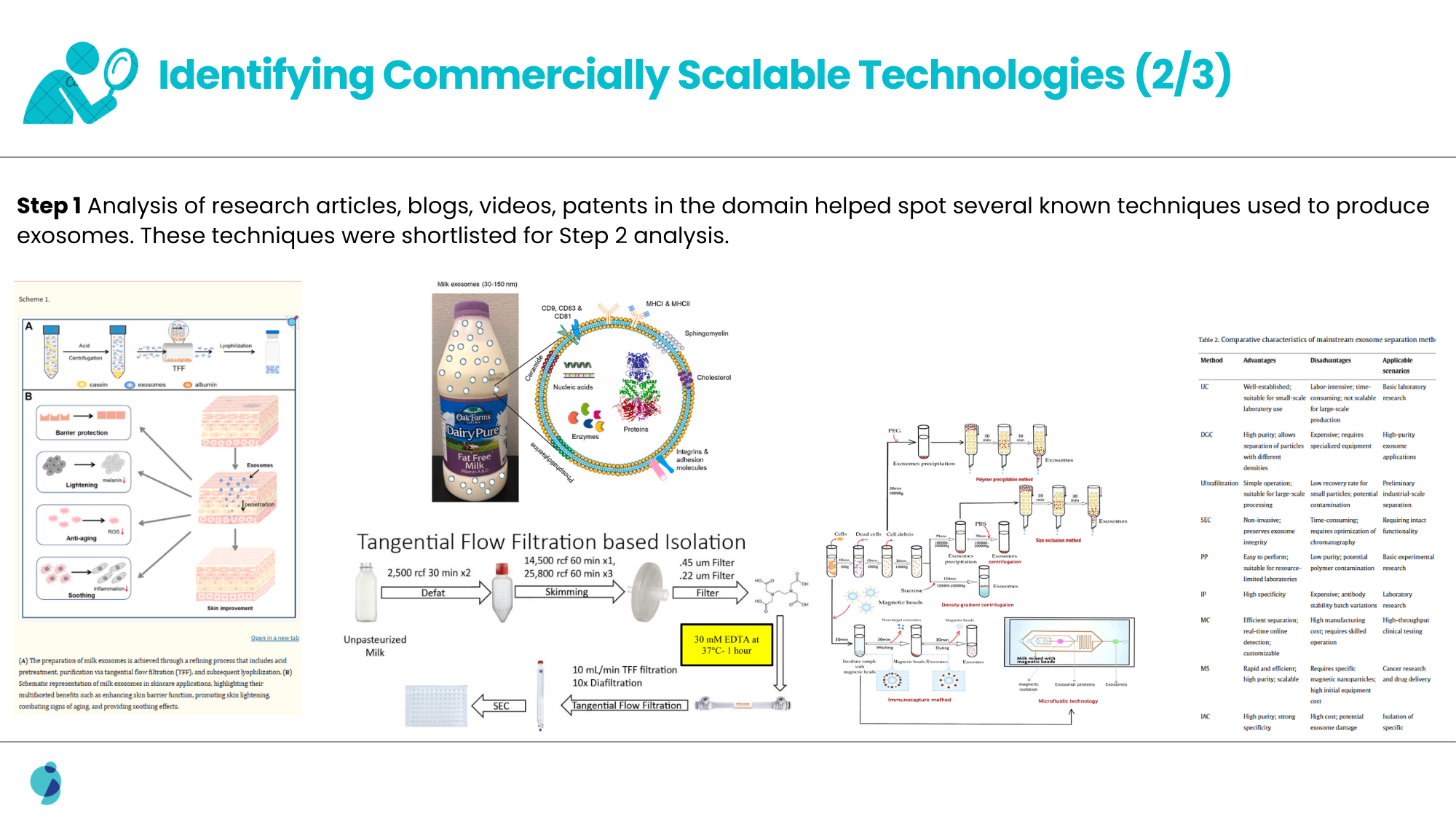
The research evaluated the available exosome-production landscape from both technical and commercial perspectives. Technologies were assessed according to factors such as yield, purity, scalability, ease of extraction, preservation of exosome integrity, and economic practicality.
The assessment covered production approaches involving:
- Precipitation-based separation;
- Filtration and ultrafiltration;
- Centrifugation-based techniques;
- Chromatographic separation;
- Affinity-based isolation;
- Magnetic separation;
- Microfluidic systems; and
- Integrated or hybrid production techniques.
The analysis distinguished methods that provided high yield with comparatively lower purity from those providing higher purity at the expense of yield or scalability. This helped narrow the landscape to the technology categories most relevant to commercial production rather than treating every known isolation technique as equally suitable.
The study also examined the application landscape for exosomes and identified comparatively less-explored opportunities across areas such as therapeutic delivery, oncology, musculoskeletal health, immune-related conditions, infectious diseases, neurological applications, gut and skin health, and wound healing. These findings gave the client potential directions for product differentiation and future innovation.
During the market-specific patent review, the research identified a patent covering a process for isolating purified extracellular vesicles. Further commercial assessment indicated that the patent owner had a relationship with an organization operating in the client’s competitive environment. This created a potential overlap concern, and the client was advised to exercise caution before adopting a similar production route.
The client ultimately received:
- A commercially oriented technology shortlist based on production performance and scalability;
- A structured comparison of exosome-production approaches across yield, purity, operational complexity, and economic considerations;
- A whitespace assessment identifying less-crowded production and application opportunities;
- A potential patent-risk alert concerning a protected process in the target jurisdiction; and
- A strategic foundation for market entry that combined technical feasibility, differentiation potential, and intellectual-property risk awareness.
Get the full case study to discover how technology assessment, whitespace identification, and patent-risk analysis supported market entry planning for dairy-derived exosome production.