

Two clinical-trial records disclosed the claim’s key limitations separately, while historical version data confirmed that the critical disclosure was publicly available before the cut-off date.
Value Delivered
The client received a stronger invalidity position against a patent claim covering the treatment of a particular category of cancer patients with an anti-PD-1 antibody.
The research identified two pre-cutoff clinical-trial records that collectively supported the claim’s principal limitations:
- Administration of an anti-PD-1 antibody to patients whose tumors exhibited the required level of membrane PD-L1 expression; and
- Administration of an anti-PD-1 antibody to patients with cancer refractory to platinum-based chemotherapy.
The findings enabled the client to:
- Develop a combination-based invalidity position: Use two complementary clinical-trial records to address limitations that had not been identified together in a single pre-cutoff publication.
- Strengthen the priority-date analysis: Confirm that the chemotherapy-refractory disclosure appeared in the original pre-cutoff version of the relevant trial record and was not introduced through a later modification.
- Reduce evidentiary uncertainty: Establish a documented publication history for the critical clinical-trial disclosure.
- Expand the available prior-art pool: Use clinical-trial records and legacy scientific terminology that were not readily visible through conventional patent and literature searches.
- Support counsel review: Provide a clear separation between the disclosures of the two references and explain how they could be used together in the broader invalidity strategy.
Problem Solved
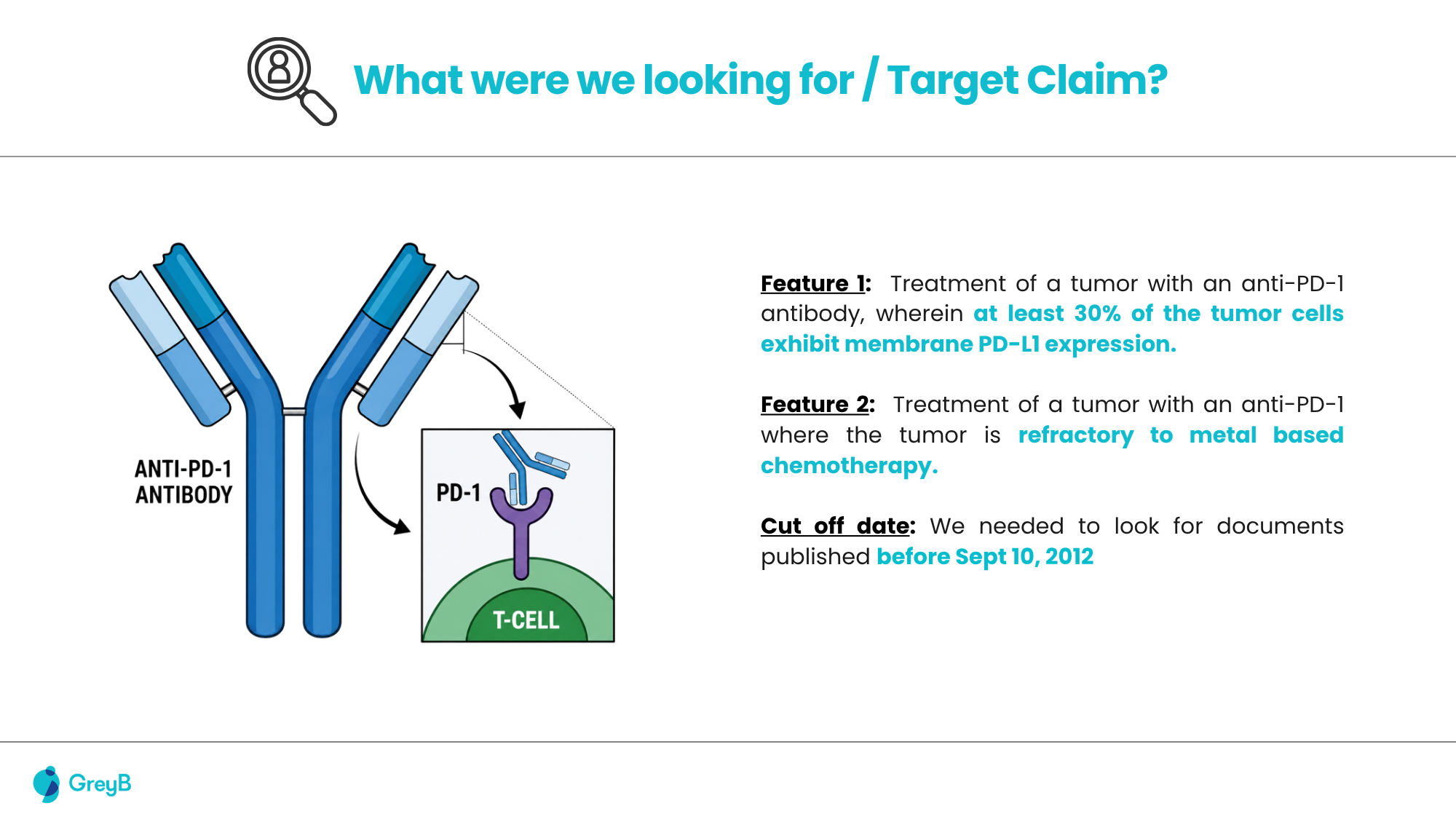
The target claim required treatment with an anti-PD-1 antibody under two specific clinical conditions:
- At least a specified percentage of the tumor cells exhibited membrane PD-L1 expression; and
- The tumor was refractory to metal-based chemotherapy.
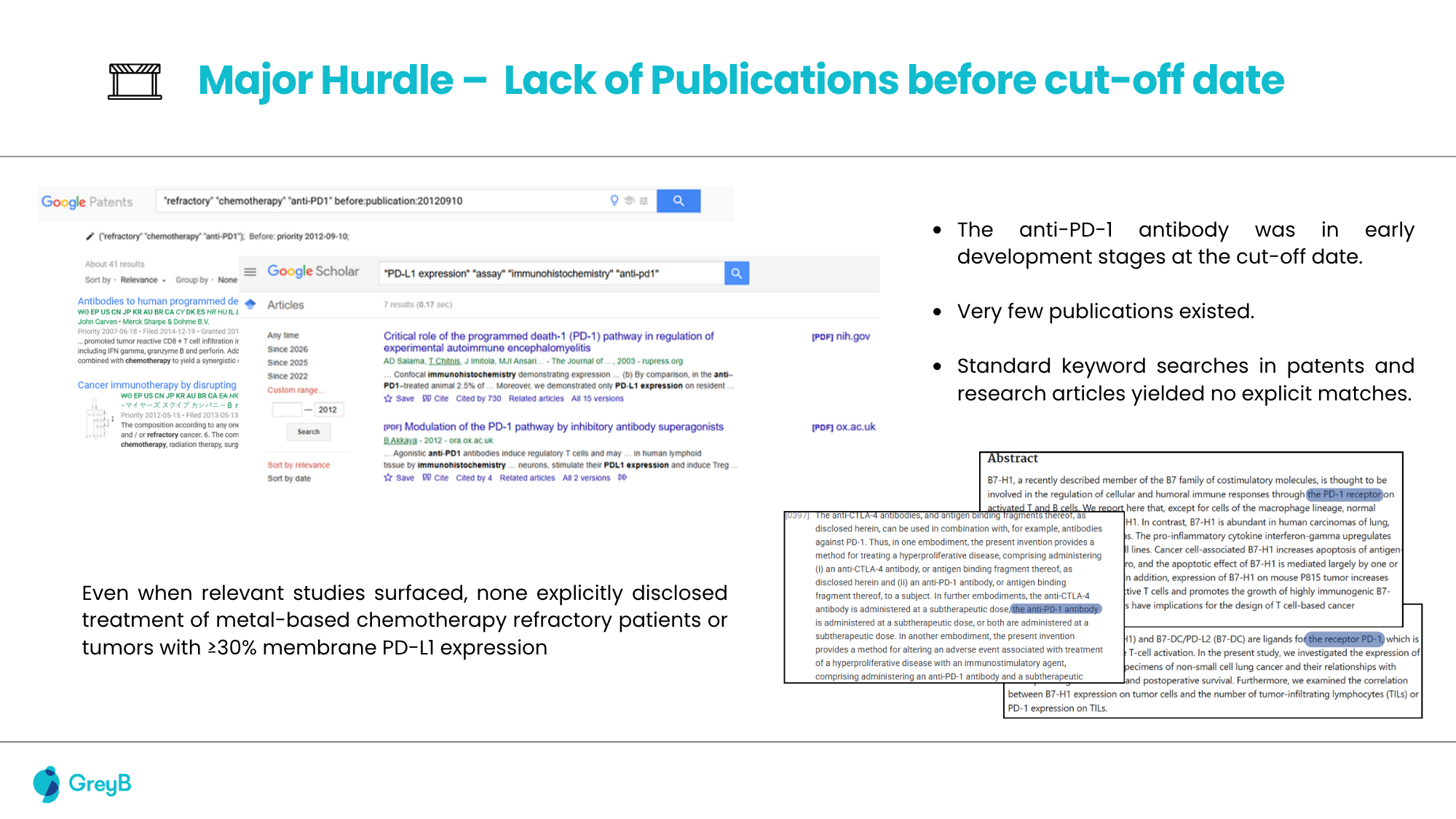
The cut-off date presented a significant challenge because anti-PD-1 therapies were still in the early stages of development. Few relevant publications existed, and conventional searches across patents and scientific articles did not identify a single reference expressly disclosing both claim limitations.
Even when relevant studies were located, they generally disclosed only one part of the claimed treatment. Some records addressed PD-L1 expression, while others discussed chemotherapy-resistant cancers. Moreover, potentially relevant disclosures associated with the subject patent’s own organization raised grace-period concerns and were less useful as independent prior art.
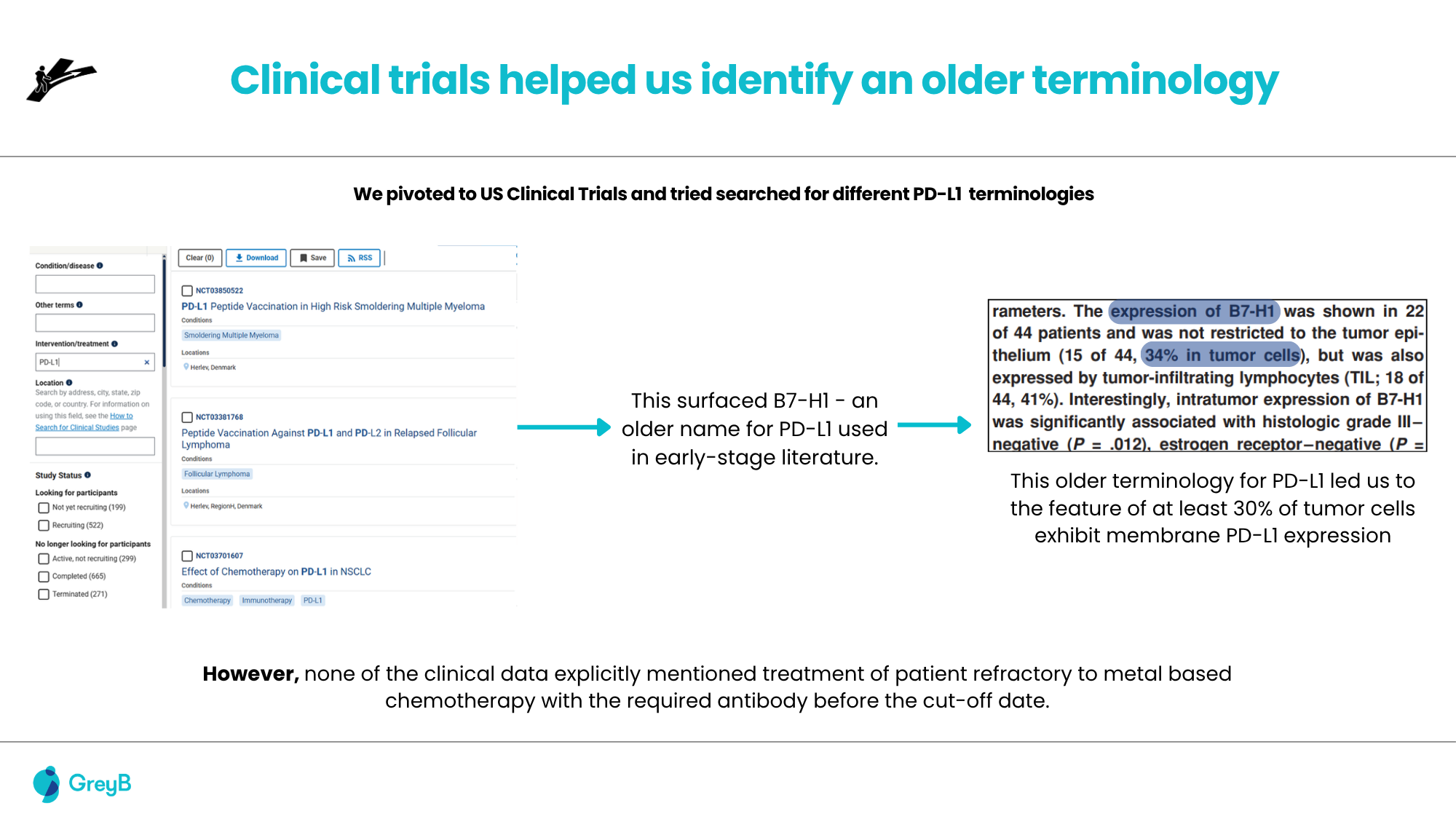
Terminology created another obstacle. Earlier clinical literature did not always use the term “PD-L1.” Instead, it sometimes referred to the same biological marker using an older name. Searches limited to the modern terminology therefore risked overlooking relevant pre-cutoff evidence.
A further date-related issue arose when one clinical-trial record showed an original registration before the cut-off date but a later modification date. It was necessary to determine whether the relevant platinum-refractory limitation appeared in the original record or had been added only after the critical date.
Solution Offered
The research expanded beyond conventional patent and journal searching to include clinical-trial evidence, historical terminology, non-English registry records, and archived version information.
The analysis identified an older scientific term used for PD-L1 in early-stage literature. This terminology led to a clinical-trial record disclosing administration of an anti-PD-1 antibody to patients whose tumors satisfied the required threshold of membrane PD-L1 expression.
However, this first record did not expressly disclose treatment of patients with tumors refractory to metal-based chemotherapy.
A separate pre-cutoff clinical-trial record was then identified. It disclosed administration of an anti-PD-1 antibody to patients with platinum-refractory ovarian cancer. Because platinum-based chemotherapy is a form of metal-based chemotherapy, this record addressed the second claim limitation.
The second trial record displayed both an early registration date and a later modification date. Historical versions of the registry entry were therefore reviewed to determine when the relevant information first appeared. The version history confirmed that the platinum-refractory disclosure was already present before the applicable cut-off date and had not been introduced through the later update.
The client ultimately received:
- A clinical-trial reference addressing the PD-L1-expression limitation;
- A separate pre-cutoff clinical-trial reference addressing platinum-refractory cancer treatment;
- Historical version evidence confirming the timing of the critical disclosure;
- A combination-based invalidity rationale connecting the complementary disclosures; and
- A clear disclosure assessment identifying which claim limitation was supported by each reference.
The result did not depend on treating either clinical-trial record as individually disclosing the complete claim. Instead, the two records provided complementary evidence that could support a combined invalidity position, subject to the applicable legal standard.
Get the full case study to discover how pre-cutoff clinical-trial records provided a combination-based invalidity pathway for a difficult cancer-treatment claim