
Value Delivered
The client received a stronger position against a potential label carve-out strategy by establishing that the claimed therapeutic effect was biologically inseparable from the drug’s mechanism of action.
The research demonstrated that treating Fibrodysplasia Ossificans Progressiva (FOP) with Retinoic Acid Receptor Gamma (RARγ) agonists inherently affects muscle regeneration pathways. The findings showed that “treating FOP” and “repairing muscle” are not separate clinical outcomes, but natural consequences of the same biological mechanism.
This provided the client with technical evidence to argue that a carve-out based on separating the claimed muscle repair effect from FOP treatment would not be technically or clinically feasible.
Problem Solved
The challenge was establishing inherency between the mechanism of action of RARγ agonists and muscle regeneration in FOP treatment.
The objective was to show that the Mechanism of Action (MoA) of RARγ agonists in FOP treatment was biologically inseparable from muscle regeneration before the September 01, 2010 cutoff date.
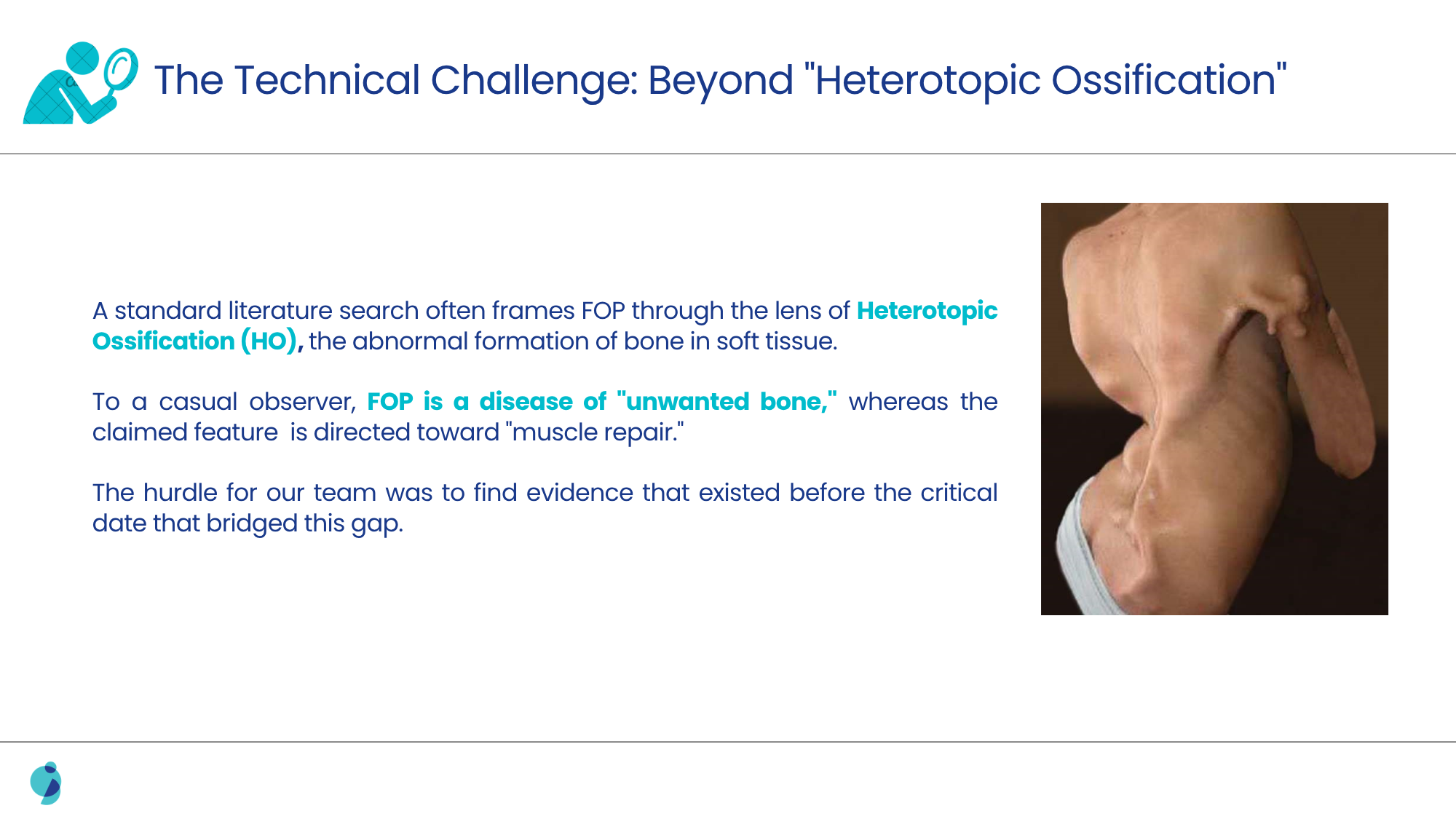
Initial searches focused on FOP treatment in the context of muscle repair. However, most search results described FOP primarily through heterotopic ossification (HO), which focuses on abnormal bone formation in soft tissue. This created a gap because the claimed feature focused on muscle repair rather than bone formation.
The challenge was finding evidence that connected these two perspectives and demonstrated why a treatment targeting FOP would inherently influence muscle repair pathways.e similar physical designs using inconsistent terminology, making traditional text-based searching ineffective.


Solution Offered
The research team changed the search strategy from looking for the claimed outcome to understanding the biological prerequisites behind the disease.
Instead of searching only for “muscle repair” in FOP treatment, the team investigated:
- Cellular mechanisms of RARγ agonists.
- Disease pathology during FOP flare-ups.
- The role of Fibro/Adipogenic Progenitors (FAPs) in muscle regeneration and bone formation.
- RARγ signaling pathways affecting Bone Morphogenetic Protein (BMP) signaling.
The team identified evidence showing:
- FOP flare-ups are preceded by muscle injury and degradation.
- Muscle injury activates FAPs, which can contribute either to pathological bone formation or normal muscle regeneration.
- RARγ agonists inhibit BMP signaling and redirect cellular behavior toward muscle regeneration pathways.
By reconstructing the biological pathway, the research established the inherent connection between FOP treatment and muscle repair. This provided a technical foundation to challenge carve-out strategies and strengthen the prior-art position.ation-based approaches can provide structural certainty and uncover prior-art opportunities that text-based methods miss.
Get the full case study to discover how establishing biological inherency strengthened the position against carve-out threats