
With sustainability commitments accelerating and operational constraints tightening, a leading dairy giant needed credible, near-term pathways for material reductions across its primary packaging.
The company’s sustainability manager reached out to Grey to quickly understand which technologies work, why they work, and where they fit within their portfolio.
The mandate was twofold:
- Identify material-reduction solutions that were technologically proven yet commercially scalable.
- Translate a complex innovation landscape into a decision-ready shortlist aligned with operational realities, including financial constraints, barrier requirements, and regulatory thresholds.
50+ Global Suppliers Were Screened Across Material Reduction Pathways
The engagement began with a scan of more than 50 global suppliers across polymers, hybrid structures, coatings, and lightweighting enablers.
This effort did not aim to simply catalog technologies. Instead, it focused on building a comparative framework that could differentiate between what looked promising in theory and what was deployable in practice.
It covered forming processes, polymer-morphology enhancers, multilayer systems, and resin-efficiency tools with credible evidence of delivering physical material reduction.
A Multi-Step Funnel Helped Separate Deployable Solutions From Supplier Noise
A multi-step funnel was designed to assess each candidate solution across three layers:
- Technical deconstruction: How exactly the material is reduced, the physics behind layer optimization, resin behavior under stress, and dependencies on fillers, coatings, or additives.
- Compatibility mapping: Alignment with bottle format, ISBM/EBM, and oxygen-conducive lines relative to dairy hygiene and throughput constraints.
- Sustainability benchmarking: Recyclability, PPWR compatibility, and alignment with European RecyClass guidelines.
These layers created a single, comparable view across fundamentally different innovation models.
SACMI’s Compression Blow Forming Stood Out for Process-Led Material Reduction
SACMI’s Compression Blow Forming emerged as one of the most compelling technologies in the scan.
The process transforms resin pellets directly into bottles through a continuous extrusion-compression blow-forming sequence, essentially merging two stages into a single, tightly controlled workflow.
In practice, this eliminates trimming scrap and bottom-gate waste while giving the operator precise control over wall thickness and preform mass. These are two levers that directly influence how much resin a bottle ultimately consumes.
Its maturity also became evident quickly.
For a category like dairy, where precision forming and inline quality control are non-negotiable, CBF naturally surfaced as a strong candidate for weight-optimized bottles without compromising mechanical strength or line reliability.
FENIC Offered a Polymer Morphology Route to Thinner-Walled Containers
Keiryo Packaging’s FENIC technology offered a different pathway to material reduction.
Instead of modifying the forming process, FENIC enhances the polymer structure itself. By applying controlled flow-induced deformation during melt processing, the technology realigns polymer chains and accelerates crystallization, resulting in a more ordered and efficient polymer morphology.
In simple terms, it helps achieve the same performance with less material.
FENIC was also attractive because of its claimed compatibility with standard PET, PP, and similar commodity polymers. It layers onto existing blow-molding infrastructure without requiring major retrofits.
The promise lies in unlocking thinner-walled containers that still meet the load-bearing, barrier, and handling requirements of a high-throughput dairy system, something only a handful of technologies manage to balance.
Mature Packaging-Equipment Providers Had the Strongest Realistic Fit
One notable trend from the scan was clear: most viable, deployable solutions are supplied by mature, established packaging-equipment or technology providers.
Very few early-stage startups or speculative-tech vendors emerged with realistic fit.
The core reason is that meaningful material reduction in dairy packaging demands a rare combination of scale, process control, regulatory readiness, and line reliability. These constraints create high barriers for new entrants.
As a result, the landscape was led by scale-backed incumbents rather than early-stage disruptors.
The final list skewed strongly toward providers with commercial deployments and a global support footprint, which aligns with what is expected for dairy: significant impact at scale.
Assessment Approach: How GreyB Did it?
1. Technology Screening
More than 50 global suppliers were screened across forming processes, polymer-morphology enhancers, multilayer systems, and resin-efficiency tools.
The screening focused on technologies with credible evidence of delivering physical material reduction.
This systematic filtering helped the client to move from a broad, noisy technology space to a sharply curated landscape of solutions that were truly relevant for dairy applications.
It also ensured the final shortlist represented only those mechanisms with demonstrable reduction potential, operational feasibility, and commercial depth.
2. Technical Mechanism Deconstruction
For every candidate solution, the team unpacked how the solution reduces material.
This included optimized container forming, strain-hardening polymer morphology, micro-cellular foaming, and structural redistribution.
Supplier disclosures, patents, videos, and technical papers were broken down into simple mechanism visuals.
This created a deeper, intuitive understanding of why certain technologies outperform others. Instead of viewing suppliers as black boxes, the client had a clear, evidence-based interpretation of the physics behind reduction, making cross-technology comparisons far more robust.
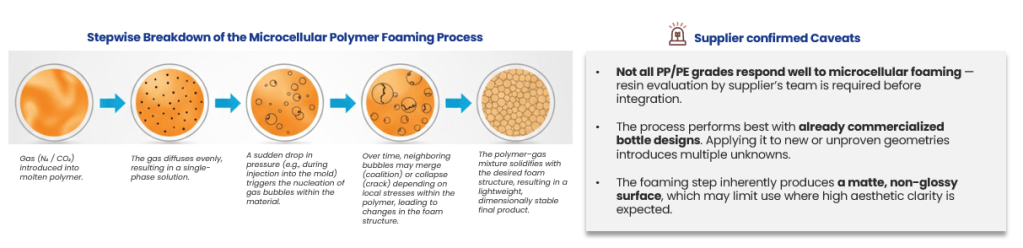
For microcellular polymer foaming, the mechanism was broken down step by step:
- Gas such as N2 or CO2 is introduced into the molten polymer.
- The gas diffuses evenly, resulting in a single-phase solution.
- A sudden drop in pressure, such as during injection into the mold, triggers the nucleation of tiny gas bubbles within the material.
- Over time, neighboring bubbles may merge, coalesce, or collapse locally depending on local stresses within the polymer.
- The polymer-gas mixture solidifies with the desired foam structure, resulting in a lightweight, dimensionally stable final product.
Supplier-confirmed caveats were also captured:
- Not all PP/PE grades respond well to microcellular foaming, so resin evaluation by the supplier’s team is required before integration.
- The process performs best with already commercialized bottle designs.
- Applying it to new or unproven geometries introduces multiple unknowns.
- The foaming step inherently produces a matte, non-glossy surface, which may limit use where high aesthetic clarity is expected.
3. Feasibility and Risk Mapping
Each technology was evaluated across operational fit, sustainability considerations, and maturity.
The operational fit assessment covered polymer, format, and material compatibility.
The sustainability assessment covered recyclability, additive load, and multilayer complexity.
The maturity assessment covered track record, deployment readiness, and level of financial investment.
This part of the analysis was mainly validated by directly reaching out to suppliers.
The output helped the client understand not only the technical promise, but also the practical adoption pathway. It showed which solutions were plug-and-play, which demanded line retooling, and which required co-development or multi-year scale-up.
4. Recommendations and Roadmap for Adoption
A structured pathway was recommended for engaging the top five shortlisted suppliers.
Rather than converging too early on one or two “best” solutions, the roadmap retained optionality across suppliers that represented different material-reduction mechanisms, maturity levels, and operational requirements.
The approach outlined actionable next steps for each supplier. It emphasized what a near-term pilot could look like, what data would be generated, and how those learnings would de-risk later decisions.
This ensured every shortlisted supplier had a clear, testable hypothesis rather than a static evaluation score.
The Client Received Action Pointers for the Top Five Suppliers
The final roadmap mapped the top suppliers across level of financial investment and level of disruption.
The action pointers included:
- Run a 4-6 week simulation on a representative SKU to benchmark each supplier’s achievable material-reduction percentage against the client’s standards.
- Request grade-level data on material-reduction percentage, then use modeling to predict real material reduction versus resin cost trade-offs before resin qualification trials.
- Progress with selected suppliers only under a structured joint development plan that defines mechanical, barrier, and recyclability acceptance thresholds, including top-load, drop-test, and OTR requirements.
- Request a 6-layer architecture proposal covering layer weight percentage, OTR/WVTR forecast, and tie-layer use.
- Check recyclability compatibility, including less than 6% barrier layer and risky additives, before committing to a retrofit pilot.
Technologies Were Mapped Across the Rigid-Packaging Value Chain
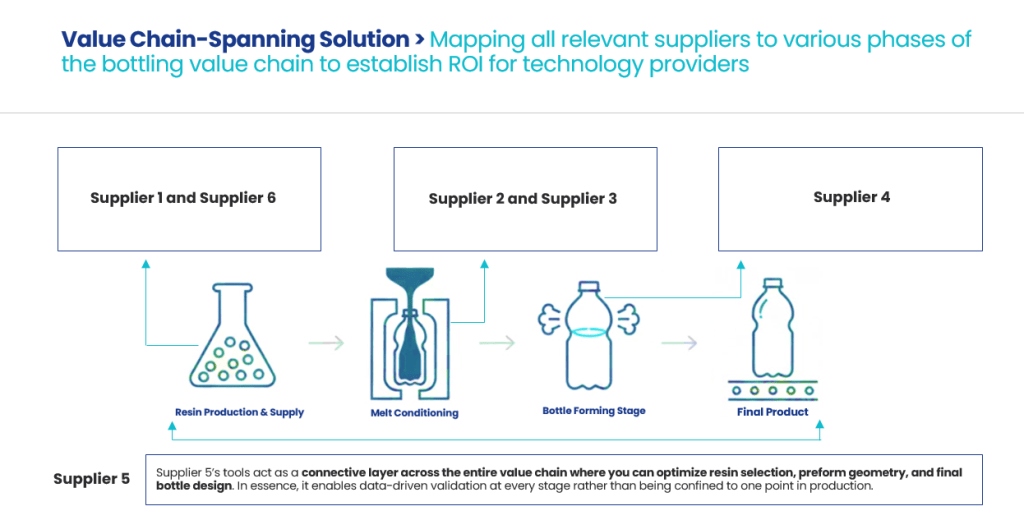
To move beyond supplier-level comparison, all top solutions were mapped across the entire rigid-packaging value chain.
The mapping covered resin morphology and melt behavior through to final bottle forming.
The value chain included:
- Resin production and supply
- Melt conditioning
- Bottle forming stage
- Final product
This mapping revealed exactly which part of the value chain each technology influenced and how that influence translated into thickness reduction, stiffness enhancement, or redistribution of material.
It also showed that some tools acted as a connective layer across the entire value chain. These tools helped optimize resin selection, preform geometry, and final bottle design. In essence, they allowed data-driven validation at every stage rather than being confined to one point in production.
The Client Could Move Forward With a Decision-Ready Shortlist
Lightweighting in dairy packaging brings its own set of challenges: tight forming windows, strict performance requirements, and suppliers whose readiness levels vary dramatically.
Without the right guidance, it is easy to invest in the wrong direction or overlook high-impact opportunities.
By cutting through noise and focusing on validated, scalable solutions, the client could make confident choices that move sustainability goals forward without disrupting operations.
The engagement helped the client move from a broad supplier universe to a high-confidence shortlist of partner-ready technology providers.
How Can Dairy Packaging Teams Identify Scalable Material Reduction Technologies?
Dairy packaging teams need to evaluate lightweighting options beyond supplier claims. They need to understand the mechanism behind material reduction, the impact on line reliability, the fit with bottle formats, and the risk created by additives, multilayer complexity, or retrofit requirements.
For teams facing similar decisions, packaging innovation consulting can help compare material-reduction technologies across performance, recyclability, and manufacturing fit. A focused technology scouting approach can also help identify proven, scalable solutions before teams commit to costly pilots.
Supplier readiness matters as much as the technology itself. Supplier scouting helps teams assess which providers are ready for engagement, which need structured development plans, and which require further validation. For teams working under European packaging requirements, PPWR consulting can support decisions where recyclability, material use, and regulatory thresholds affect adoption.
GreyB helps clients move from broad research, patent noise, supplier claims, and early-stage concepts to validated, commercially viable solutions.