


Creating complex tissues and organs in the lab is a big challenge in tissue engineering. The lack of high-quality biomaterials for stem cell growth only adds to the difficulty. This slows progress in developing treatments for conditions like neurodegenerative diseases and spinal cord injuries, leaving millions of patients waiting for solutions.
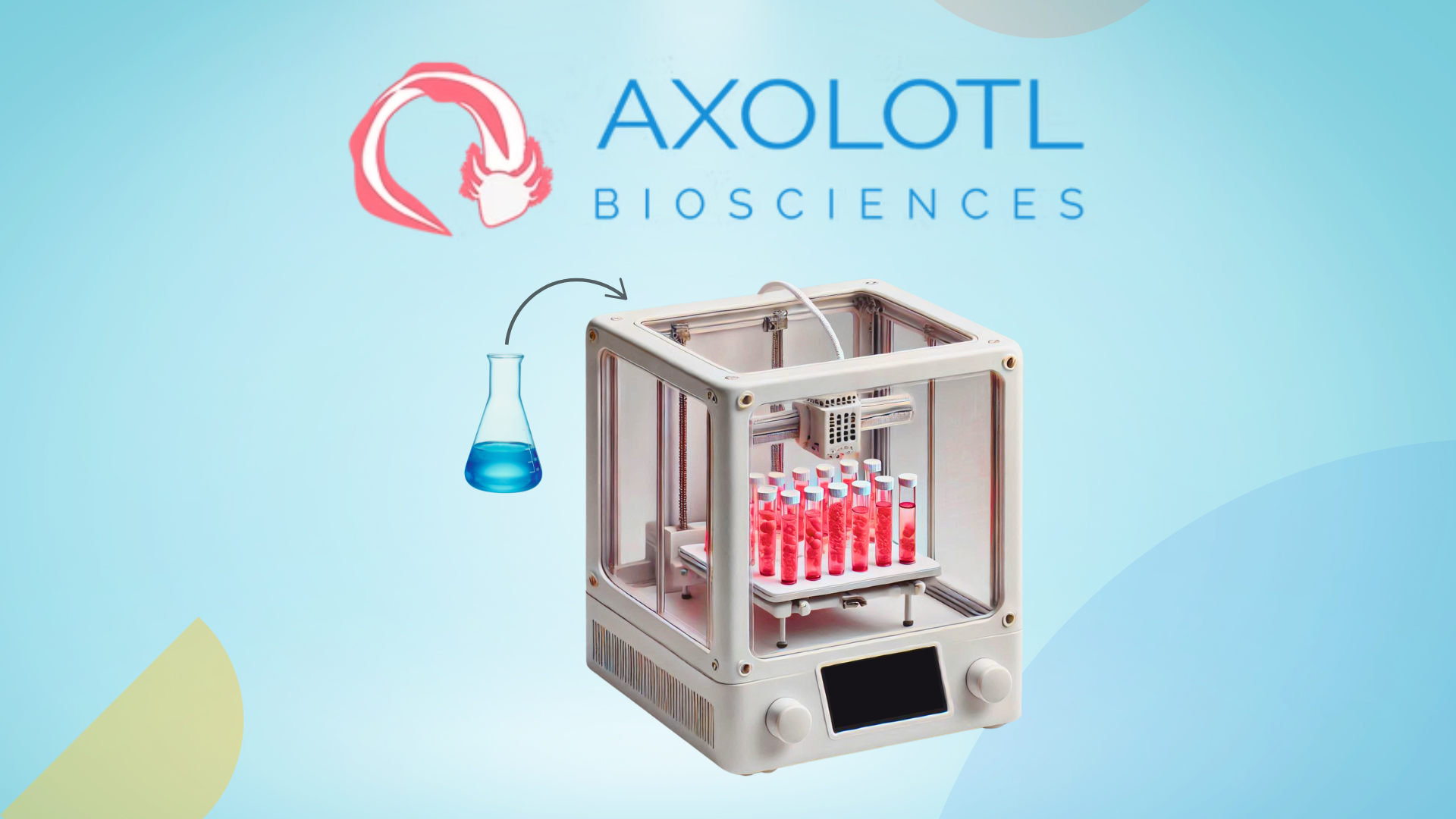
A Canadian startup, Axolotl Biosciences, solves these issues with its advanced materials and tools for 3D bioprinting. These help scientists print human tissue models more effectively. Their products, like bio-inks, support cell growth and survival, making studying and developing new medical treatments easier.
This interview is part of GreyB’s Scouted series. In this series, we spotlight innovative startups and speak to their founders about how their solutions can be implemented to solve critical challenges and comply with industry and sustainability regulations. You can find all those interviews here.
“Stem cells are often delicate and tend not to like the bioprinting process. Our ink is good at keeping stem cells alive and differentiable into different tissue types.”
– Stephanie Willerth

Dr. Stephanie Willerth is the Co-founder & CEO of Axolotl Biosciences. Dr. Willerth has an extensive background in biomedical engineering and stem cell research. She is a full professor at the University of Victoria, where she runs an active research group focused on engineering neural tissue from pluripotent stem cells. Dr. Willerth’s expertise and passion for bioprinting and tissue engineering have helped her build Axolotl Biosciences to make neural tissues easily accessible to scientists and engineers from diverse backgrounds.
Overview: Why Axolotl Biosciences uses bio-inks with living cells rather than plastic
Axolotl Biosciences is a Canadian biotechnology company specializing in developing bio-inks for 3D bioprinting. Its innovative materials enable the creation of complex tissue structures using stem cells, with applications ranging from drug screening to personalized medicine. The company’s flagship products include a versatile base tissue printing ink and its patented BrainPrint solution, which contains drug-releasing particles designed for neural tissue development.
Watch the full interview here.
Here’s a quick summary of the conversation:
Can you explain what Axolotl Biosciences does in simple terms?
Stephanie: Traditional 3D printing involves heating plastic to create objects. We do something similar, but we use specialized bio-inks containing living cells instead of plastic. Our innovation is creating inks that keep delicate stem cells alive during printing and help them develop into different tissue types.
Our inks are particularly effective at creating complex structures like neural tissues for drug screening. For example, we’ve developed Alzheimer’s disease models that allow researchers to test potential treatments in a dish before trying them on patients. We’ve also successfully printed skin, cardiac tissue, and blood vessels using our base ink.
What are your plans for expansion and market growth?
Stephanie: While we’re based in Canada, our primary market is the United States, with strong potential in Asia, particularly Korea and Europe. We’re discussing potential collaborations with significant biotech companies and exploring overseas distribution partnerships for our inks. We’re also preparing to launch our BrainPrint product commercially and develop a specialized cardiac bioink in collaboration with doctors at the University of British Columbia.
How do you protect your intellectual property and innovations?
Stephanie: We use a combination of patents and trade secrets to protect our technology. Our base ink formula is a trade secret, similar to cell culture media for stem cells. While the recipe is published, the complexity of manufacturing makes it more practical for customers to purchase from us directly. We also have a patent awarded in Europe for our smart bio-inks with drug-releasing microspheres, and we’re finalizing patent applications in the U.S. and Canada. Additionally, we’re working on patenting our tissue models.
What challenges have you faced, and how did you overcome them?
Stephanie: Our fundraising journey has been particularly challenging, especially since we started fundraising when Silicon Valley Bank failed and the biotech sector experienced a significant downturn. However, we’ve managed to maintain operations through grant funding and customer revenue without giving up equity. We’ve also faced practical challenges in scaling up production and ensuring consistent quality control of our products, which we’ve addressed through collaborations with partners like Starfish Medical, a medical device consulting firm.
The regulatory landscape has been manageable since we only sell our products for research. While we haven’t pursued FDA approval yet, our ink formulation is potentially suitable for clinical applications, and we’re exploring partnerships for possible therapeutic applications in the future.
Meet our Interviewer – Shabaz Khan, Marketing Manager at GreyB

Shabaz Khan is an experienced market researcher who is leading GreyB’s Scouted campaign. With nearly a decade of experience working with innovation managers and leaders, Shabaz stays current with the ever-evolving tech landscape. His leadership and problem-solving skills make him a valuable resource in R&D and IP research environments.
Contact our startup scouting experts below to gain deeper insights into engineering and producing lab-grown tissues at scale for widespread clinical use. For more information, please explore GreyB’s startup scouting services.