
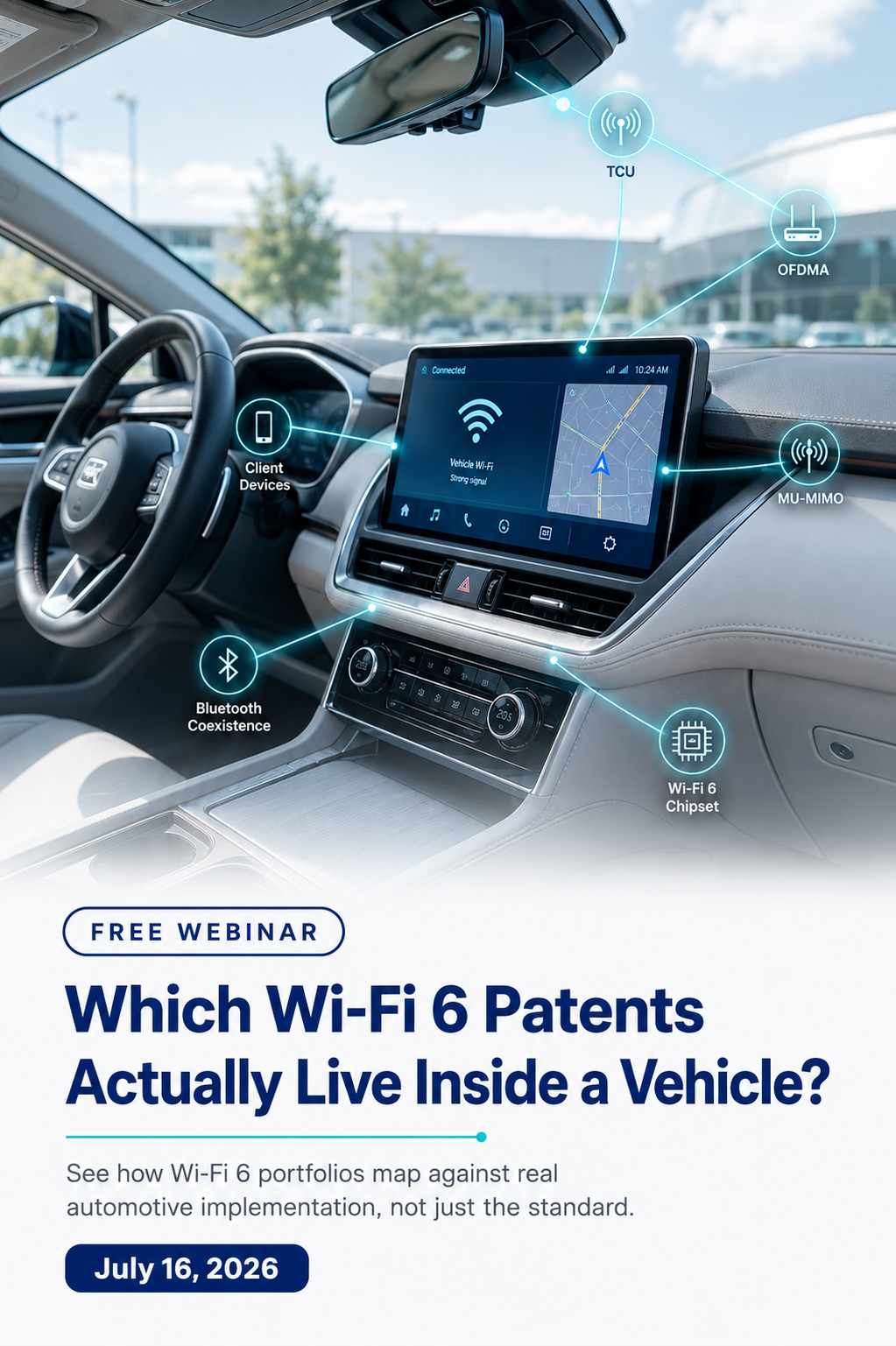
Modern vehicles run wireless projection, passenger connectivity, infotainment, and over-the-air updates through Wi-Fi 6, but not every Wi-Fi 6 feature makes it into a car. Automotive products implement a narrower, more selective stack than the standard itself, which means portfolio size alone says little about automotive relevance.
A large Wi-Fi 6 portfolio does not automatically translate into automotive value. The real question is whether a patent maps to a feature that TCUs, IVIs, AVN units, or cockpit modules, often supplied by third parties like Panasonic Automotive, LG, or Bosch, actually implement.
In this webinar, GreyB explains how a feature-level taxonomy, product mapping, and portfolio analysis reveal which Wi-Fi 6 patents genuinely apply to automotive products, and which ones only look strong on paper.
23%
of sampled patent families were both core SEPs and had high commercial adoption in automotive products.
300+
certified automotive products analyzed across 17 suppliers to build the implementation dataset.
9
Wi-Fi 6 features found in roughly 95% of automotive models, forming the core “must-have” stack
You’ll get answers to
- Why patent count alone doesn’t indicate automotive relevance
- Which Wi-Fi 6 features are actually implemented in vehicles, and which stay on the standard’s page
- How supplier modules from companies like Panasonic Automotive, LG, and Bosch shape what enters a vehicle
- Why a broad standard-based view misses the real, narrower automotive product stack
- How GreyB’s methodology moves from taxonomy to product mapping to portfolio analysis to decision intelligence
- What separates high, medium, and low implementation tiers, and why that distinction changes negotiation leverage
- Why essentiality alone isn’t enough without implementation evidence
- How licensors can prioritize their strongest automotive-facing patent families, and how OEMs can identify their real licensing exposure
Join the webinar to see how Wi-Fi 6 portfolios can be checked against real automotive product data before licensing conversations begin.
We’ll show how patent families are mapped to specific vehicle features, how implementation data separates the highest-value assets from the rest, and how both licensors and OEMs can negotiate from evidence instead of assumptions.