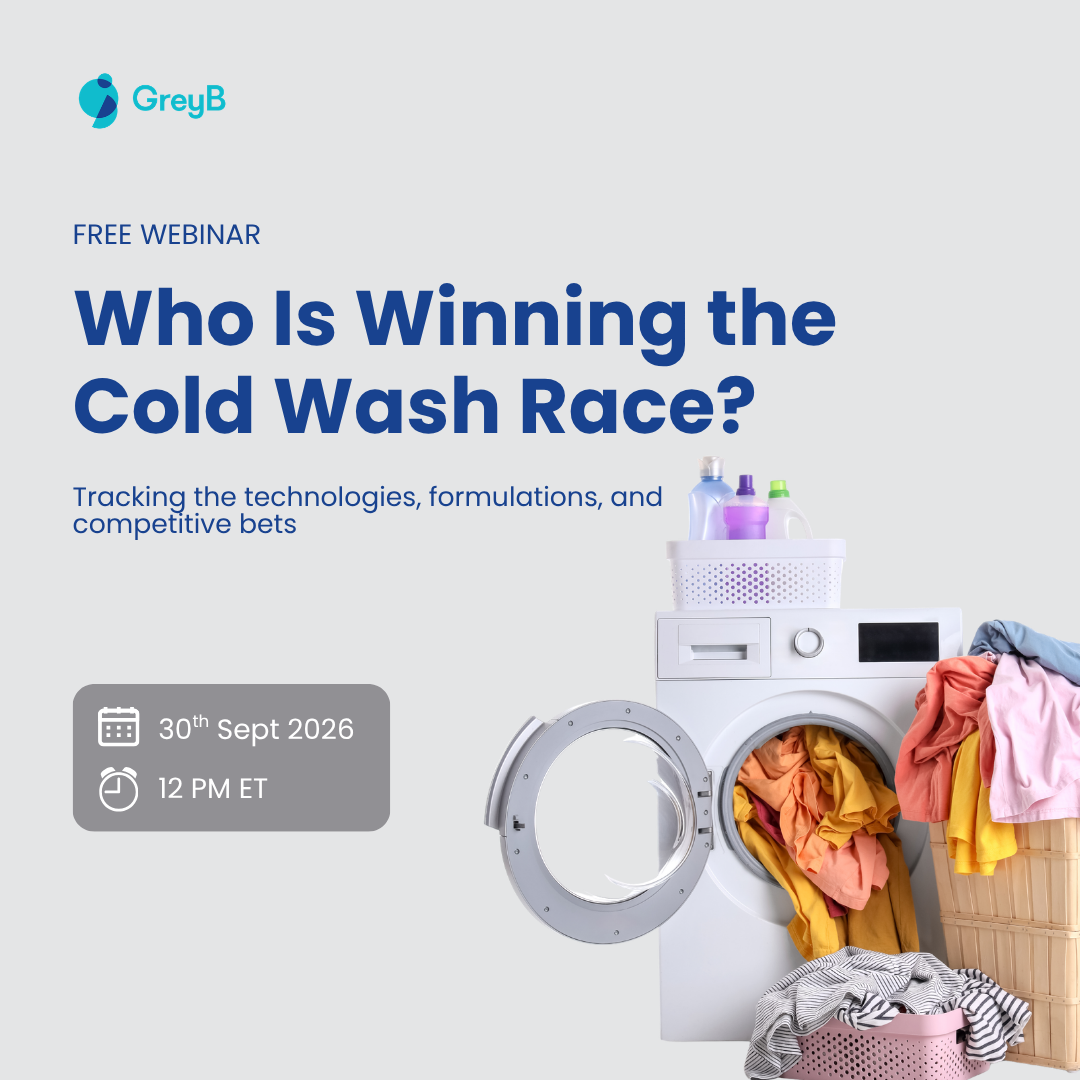
Consumer demands and regulatory requirements for short cold-wash cycles are forcing detergent companies to rethink more than temperature in laundry-care innovation.
P&G is shifting to a fiber-based format designed for cold-water cleaning. Unilever is reformulating around 15-minute cycles. Henkel is connecting detergent performance with appliance programs. Ingredient suppliers are simultaneously engineering enzymes that can work at 20°C in 20-minute cycles while remaining stable alongside other detergent ingredients.
The result is a fragmented technical race with no single route emerging as the answer. R&D teams need to understand which approaches can maintain performance at 20–30°C and shorter cycles without creating new trade-offs in stability, dosage, cost, or fabric care.
This webinar will cover the bottlenecks each approach solves, the trade-offs that remain, and the performance gaps in laundry care innovation competitors have not yet closed.
78%
of consumers use a short wash cycle at least once a week
54%
report stubborn stains remaining after rapid washes
~90%
of washer energy can go into heating water
You’ll get answers to
- Where does detergent performance still break at 20°C and in 15–30 minute cycles?
- From enzymes and surfactants to soil-release polymers and detergent-appliance integration, which technologies are actually closing the performance gaps?
- Which solutions are ready to use, and which are still emerging from scale-up technologies, patents, and early research?
- Among formulation compatibility, shelf stability, concentrated formats, dosage, cost, fabric care, and low-temperature performance, what trade-offs remain unresolved?
- Where are major companies, suppliers, startups, and research groups focused, and where does technical white space remain?
Find out how detergent and ingredient R&D teams are solving stain removal, malodor, hygiene, and fabric care at 20–30°C and in shorter wash cycles, and where opportunities are still open for you.
Register for the webinar to join us live.