
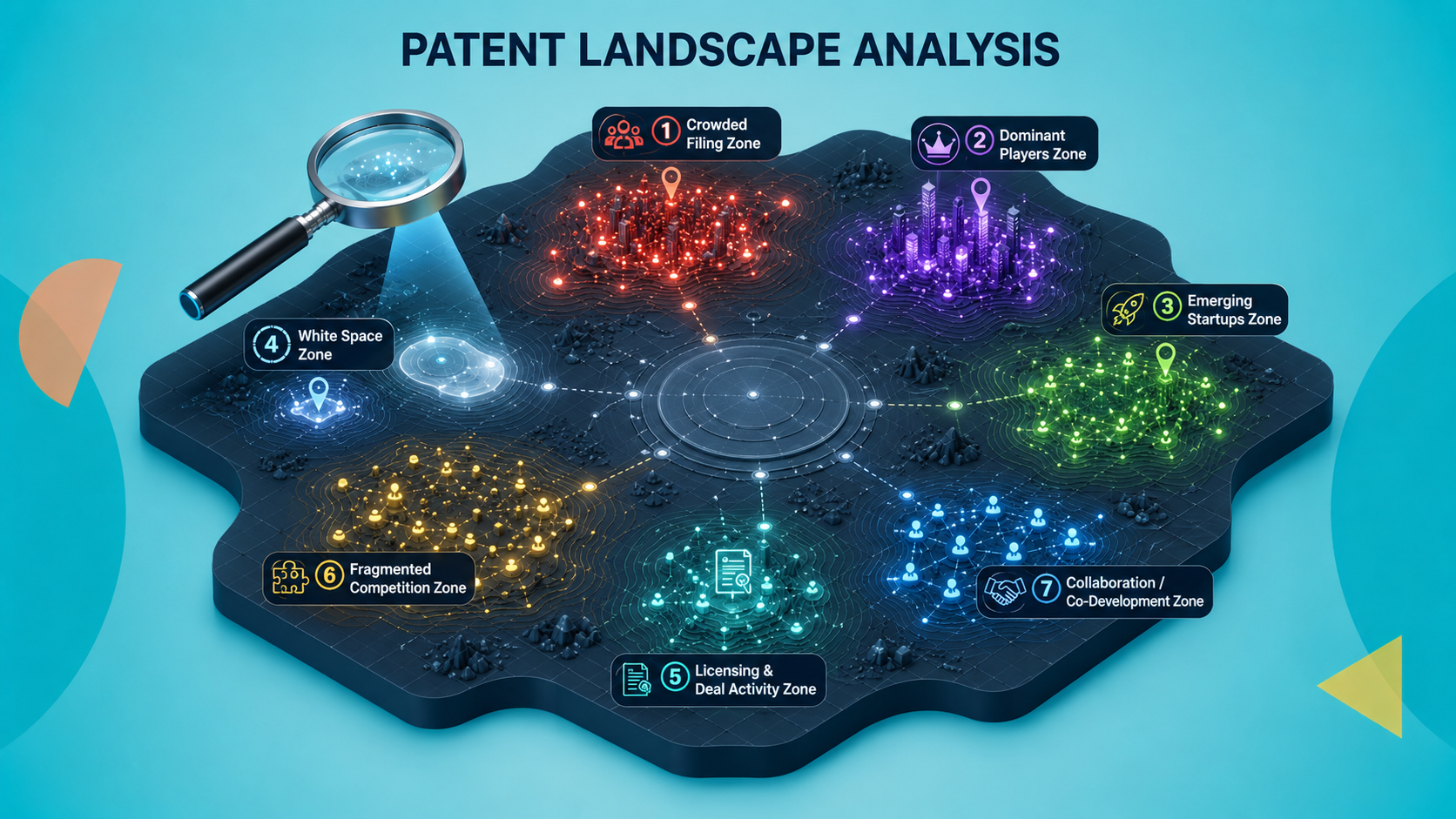




Patent landscape analysis is a macro-level intelligence exercise that tells R&D leaders not just what is protected, but where innovation is clustering, who is driving it, and what is about to emerge.
For R&D and innovation leaders navigating increasingly competitive technology landscapes, this discipline delivers five distinct strategic advantages:
- Sharper portfolio prioritization
- real-time competitive intelligence
- informed licensing and partnership decisions
- pre-emptive infringement avoidance
- early-signal M&A scouting
Yet the majority of R&D organizations engage with patent intelligence only reactively, such as when litigation looms or a competitor files a blocking patent. This is the equivalent of reading a chessboard only after your opponent has declared check.
| $1.3T+ Global R&D spend annually — much of it duplicating work already patented | 97M+ Patent documents in global databases — a largely untapped intelligence resource | 18 months Average lag between filing and publication — a window landscape analysis can close | 5x Typical ROI multiplier cited by IP-mature firms on landscape-driven portfolio decisions |
These numbers show how crucial it is for patent landscape analysis to move from the legal department’s back office into the R&D leadership team’s strategic toolkit.
The Innovation Blind Spot
Companies spend heavily to innovate. They spend very little to understand the innovation landscape they are entering.
Global R&D investment has grown consistently for two decades, driven by the acceleration of technology development across sectors from biotechnology and semiconductors to clean energy and artificial intelligence. The race to file, protect, and commercialize new technology has intensified accordingly. The number of patent applications filed annually with the world’s major IP offices has more than doubled over the past twenty years.
Yet most R&D organizations operate with a striking paradox: they invest enormous resources in creating new technology while investing comparatively little in understanding where that technology sits within the broader innovation ecosystem.
Market research tracks customer needs. Competitive intelligence monitors product launches. But the richest source of forward-looking technology intelligence, i.e., patent filings, remains largely unread by the people making R&D investment decisions.
“Your competitors are publishing their technology roadmaps. They just call them patent applications.”
Traditional competitive intelligence has a structural limitation: it is largely backward-looking. It captures what has been announced, launched, or reported. Patent data, by contrast, captures what organizations are actively working on, typically 12 to 36 months before any product or publication appears. A sustained increase in a competitor’s patent filings in a specific technology sub-domain is not a coincidence. It is a signal.
The consequences of ignoring these signals are concrete and costly. R&D resources allocated to technology domains already densely protected by competitors; engineering investment sunk into approaches that infringe existing claims; white spaces in the landscape left open for rivals to occupy; and licensing opportunities with complementary IP holders missed entirely.
Most R&D leaders, if they are being candid, would answer no. Patent landscape analysis exists precisely to change that answer.
Decoding Patent Landscape Analysis
Patent landscape analysis is not a legal exercise. It is a strategic intelligence discipline, and R&D leaders should own it.
What is Patent Landscape Analysis?
A patent landscape analysis is a structured, large-scale examination of patent data across a defined technology domain, competitive set, geography, and time window.
Its purpose is to generate strategic insight:
- Where is innovation concentrated?
- Who are the dominant players?
- Where are the white spaces?
- Where are the emerging trajectories?
It is important to distinguish this from two other common patent exercises that R&D teams encounter. A freedom-to-operate (FTO) search is a granular legal assessment of whether a specific product or process infringes existing claims.
A prior art search examines whether a proposed invention is novel relative to existing patents. A patent landscape analysis operates at the macro level, examining patterns, trends, and competitive positioning across thousands of documents, rather than the claim-by-claim analysis of a handful.
The key inputs
Landscape analyses draw on global patent databases, i.e., the USPTO (United States), EPO (Europe), WIPO (international filings under the PCT system), JPO (Japan), CNIPA (China), and others, using aggregated data through platforms such as Derwent Innovation, PatSnap, Orbit, or Lens.org.
These databases contain not just the patent text but also rich metadata: applicant names, filing dates, citation relationships between patents, classification codes (IPC and CPC), legal status, and family data that groups related applications across jurisdictions.
What a landscape analysis produces
A well-executed landscape analysis delivers a set of analytical outputs that are directly actionable for R&D strategy:
- Technology heat maps: where innovation is clustering across sub-domains
- Filing trend curves: trajectories of emerging versus declining technologies
- Competitive assignee profiles: who owns what, and how aggressively
- White space maps: unprotected areas ripe for R&D investment
- Citation network analysis: identifying foundational versus derivative technologies
- Geographic coverage maps: where rights exist and where they do not
Together, these outputs constitute a genuine intelligence picture; one that no other data source can provide.
The Strategic Value Proposition for R&D Leaders
Patent landscape analysis is not a single tool with a single use case. It is a platform for five distinct, high-value strategic decisions.
1. R&D Portfolio Prioritization
R&D investment decisions are among the highest-stakes choices an innovation leader makes. Landscape analysis provides a critical input typically absent from portfolio reviews: a clear picture of how crowded or open each candidate technology domain is. A domain with dense, active, well-resourced patent coverage from multiple competitors presents a fundamentally different risk-reward profile than one with sparse, aging, or narrowly-held IP.
Allocating budget to white spaces is only possible if you know where they are. Landscape analysis makes them visible.
Illustrative scenario: A medtech R&D head reviewing five candidate investment areas discovers that three are dominated by two large incumbents with broad claim coverage, while two show significant activity from startups with narrow, design-around-able patents and several unprotected adjacent sub-domains. The portfolio allocation shifts substantially — and defensibly.
2. Competitive Intelligence: Reading Roadmaps Before They Are Published
Patent filings are, in effect, a structured disclosure of R&D intent. A company filing a sustained, accelerating sequence of patents in a specific technology sub-domain is signaling a strategic investment. Tracking competitors’ filing patterns over time allows R&D leaders to anticipate competitive moves, identify technology bets, and respond proactively rather than reactively.
Illustrative scenario: A semiconductor firm’s patent landscape team identifies a sharp increase in filings from a previously dormant competitor in a specific memory architecture domain. Eighteen months later, that competitor announces a product in the space. The firm’s R&D team, having seen the signal early, had already accelerated its own program in the adjacent domain.
3. Partnership, Licensing & Open Innovation Strategy
Identifying organizations with complementary patent portfolios is a high-value outcome of landscape analysis. This intelligence directly informs licensing strategy (both in-licensing and out-licensing), joint development agreements, and open innovation partnerships. In technology domains where cross-licensing is common, understanding who holds what is a prerequisite for effective negotiation.
Illustrative scenario: A clean energy company’s landscape analysis reveals a university research group with a cluster of foundational patents in a material science area that the company needs for its next-generation product. A licensing conversation that would otherwise have been missed is initiated two years before the blocking risk becomes acute.
4. Avoiding Costly Infringement: Designing Around Before Sunk Costs Accumulate
Infringement risk is far more manageable at the design stage than at product launch. Understanding the claim landscape in a technology domain before committing engineering investment enables R&D teams to make conscious design-around decisions, selecting technical approaches that achieve the product objective while navigating the IP terrain.
The alternative — discovering infringement risk after significant development investment — is expensive in every dimension: legal cost, engineering rework, delayed launch, and potential damages. Landscape analysis is, among other things, a form of early-stage risk management.
Illustrative scenario: A consumer electronics R&D team considering two candidate technical approaches to a wireless charging mechanism conducts a landscape review and identifies that one approach is surrounded by strong, recently granted claims from a well-resourced competitor known for active enforcement. The team selects the alternative approach at week two of the program, not week fifty-two.
5. Acquisition Scouting & M&A Signal Detection
Patent filing activity is one of the earliest indicators of an emerging technology company’s innovation trajectory. Organizations building significant, coherent patent portfolios in strategically relevant domains are, in many cases, acquisition targets before they are widely recognized as such. R&D leaders who monitor landscape data can identify these companies early, before they attract venture capital at high valuations or, worse, before a competitor acquires them.
Illustrative scenario: An industrial automation firm’s regular landscape monitoring flags a small firm with an unusually coherent and technically sophisticated cluster of patents in a robotics sub-domain. The BD team initiates contact. The eventual acquisition price is a fraction of what it would have been two years later, after the firm’s second funding round and a competitive bidding situation.
Translating IP Insight into ROI
The question is not whether patent landscape analysis is valuable. The question is how to quantify that value compellingly enough to invest in the capability.
The cost of ignorance
The costs of operating without patent intelligence are real but often invisible until they crystallize. Patent litigation in the United States alone costs defendants an average of $3–5 million per case through trial, and that figure excludes business disruption, delayed product launches, and management distraction.
R&D duplication, such as pursuing a technology approach already well-covered by competitor IP, is even more costly when measured across the full program investment. However, it almost never appears as a line item in post-mortems. Missed licensing income from a portfolio that is not actively managed or monetized constitutes another category of value leakage that landscape analysis can address.
Benchmarking against IP-mature industries
The pharmaceutical, semiconductor, and consumer electronics industries have operated with sophisticated patent intelligence functions for decades. In these sectors, the technology development cycles are long, the IP landscapes are dense, and the cost of late discovery of a blocking patent is existential.
The standard practice in these industries — continuous landscape monitoring, integrated into stage-gate development processes — is precisely the model that other sectors would benefit from adopting.
Pharma companies routinely commission landscape analyses before entering a new therapeutic area, investing in the intelligence upfront precisely because the cost of an uninformed decision downstream, whether in R&D duplication, licensing negotiation, or litigation, dwarfs the cost of the analysis many times over.
“The cost of a patent landscape analysis is measured in thousands of dollars. The cost of the decisions it informs is measured in millions.”
The cost-benefit framing
A comprehensive patent landscape analysis for a single technology domain typically costs between $15,000 and $80,000, depending on scope, depth, and whether it is conducted in-house or by a specialist firm. As a fraction of the R&D program budget, it is a modest investment. The decision leverage it provides is, by any reasonable measure, disproportionate to its cost. The business case almost always closes.
How to do Patent Landscape Analysis in 6 Steps?
Understanding the process demystifies the discipline and makes R&D leaders better commissioners, interpreters, and consumers of landscape intelligence.
Step 1: Scope Definition
The single most important step in a landscape analysis is clearly defining its boundaries. This means specifying the technology domain (narrow enough to be actionable, broad enough to capture adjacencies), the competitor set to benchmark against, the geographic jurisdictions of interest, and the time window.
A scope that is too broad produces an overwhelming volume of undifferentiated data; too narrow, and key signals are missed. This is a strategic conversation, not a technical one, where R&D leaders should be directly involved.
Step 2: Search Query Construction
Patent databases are queried using a combination of classification codes (IPC and CPC, which define technology categories), keyword logic applied to titles, abstracts, and claims, and assignee filters for specific companies. Building a query set that achieves high recall (capturing relevant patents) while minimizing noise (excluding irrelevant ones) requires both technical expertise and domain understanding. This is where the collaboration between IP specialists and R&D subject matter experts is most critical.
Step 3: Data Retrieval & Cleaning
Raw search results require significant processing before they can be analyzed. Patent family deduplication groups related applications (the same invention filed across multiple jurisdictions) to avoid overcounting. Legal status filtering separates applications into active, granted, lapsed, abandoned, and pending categories. Assignee normalization reconciles the multiple name variations under which a single company may appear across global databases.
Step 4: Analytical Workstreams
The cleaned dataset is then analyzed across multiple dimensions simultaneously: filing trend analysis plots patent volume over time and by technology sub-domain; assignee benchmarking compares portfolio sizes, growth rates, and technology focus areas across competitors; citation analysis identifies the most foundational patents in the landscape; and claim-level mapping for selected key patents identifies the specific technical scope being protected.
Step 5: Synthesis & Strategic Interpretation
Data without interpretation is information; information without strategic context is noise. The most valuable step in a landscape analysis is to convert analytical outputs into actionable strategic insight. This requires both IP expertise and a genuine understanding of the business context: the R&D strategy, the competitive dynamics, and the investment decisions the analysis is intended to inform.
Step 6: Output Formats
Effective landscape outputs are structured for their audience. Executive summaries with clear strategic implications for the R&D leadership team; technology heat maps and filing trend charts for portfolio planning workshops; competitive dossiers for business development and M&A teams; and detailed claim analysis reports for engineering teams making design decisions.
| BUILD VS. BUY CONSIDERATION: When to use in-house teams, specialist firms, or AI-assisted tools. In-house IP teams are well-suited for ongoing monitoring and routine landscape updates in familiar technology domains. Specialist firms add value for high-stakes analyses — major portfolio decisions, litigation-adjacent questions, or new domain entries — where depth of expertise and methodological defensibility matter. AI-assisted patent analytics platforms (PatSnap, Orbit Intelligence, Derwent Innovation) are increasingly capable of automating retrieval and basic visualization, but the strategic interpretation layer remains a human function. Most organizations will benefit from a hybrid approach. |
Common Pitfalls and How to Avoid Them
The value of a landscape analysis is only as good as the quality of the questions it is designed to answer and the rigor with which findings are integrated into decisions.
Treating it as a legal exercise rather than a strategic one
The most common and consequential mistake is allowing patent landscape analysis to live exclusively in the legal or IP department, disconnected from R&D strategy. When landscape work is initiated by counsel and presented to R&D as a compliance artifact rather than a strategic input, its value is dramatically curtailed. The remedy is structural: landscape analysis should be commissioned and consumed by R&D leadership, with legal teams in a supporting rather than driving role.
Scoping too narrowly
Technology disruption rarely comes from within the obvious boundaries of an existing domain. A landscape analysis scoped too narrowly will miss emerging threats from adjacent or enabling technologies. Effective landscape analyses deliberately extend their scope to include adjacencies and build in a structured exercise to consider what technologies from outside the current domain could achieve the same functional outcome.
Confusing patent volume with innovation quality
Patent count is a noisy proxy for innovation quality. Some large filers build broad portfolios of narrow, incremental claims. Some highly innovative organizations file selectively, protecting only genuinely foundational inventions. Effective landscape analysis uses citation metrics, claim scope assessment, and litigation history as quality filters.
Acting on stale data
In fast-moving technology domains — AI, gene editing, quantum computing, advanced materials — a landscape analysis that is more than 18 months old may be materially misleading. Filing rates in these domains can be extremely high, and the competitive positions of key players can shift substantially within a single year.
Failing to integrate findings into R&D planning cycles
A landscape analysis that is commissioned, delivered, filed, and never acted upon is a wasted investment. The most common reason this happens is that the analysis is not timed to align with the decision cycles it should inform — portfolio review, stage-gate go/no-go decisions, technology strategy planning.
How to Build a Patent Intelligence Capability
The question for most R&D organizations is not whether to build this capability, but how to start, and how quickly to scale.
Patent intelligence capability exists on a spectrum. Most organizations sit at the reactive end; the most sophisticated operate at a level of integration that makes patent data a genuine input to every significant R&D decision. The maturity model below provides a practical framework for understanding where an organization is and what it would take to advance.
| Stage | Description & Trigger | Key Actions to Advance |
| Stage 1 — Reactive | Integrate landscape outputs into the formal stage-gate process. Establish a recurring landscape review cadence. Begin building an in-house capability or establishing a preferred relationship with a specialist firm. | Commission a first landscape analysis in the most strategically active technology domain. Use it to demonstrate value. Build internal literacy about what patent data can reveal. |
| Stage 2 — Informed | Periodic landscape analyses are commissioned for major technology domains, typically annually or at key portfolio decision points. Findings inform but do not systematically drive R&D planning. | Deploy a patent analytics platform for real-time monitoring. Train R&D leadership to interpret and commission landscape intelligence directly. Build a patent strategy into the innovation governance framework. |
| Stage 3 — Proactive | Patent intelligence is embedded in R&D strategy. Continuous monitoring covers key domains and competitor portfolios. Landscape findings are a standard input to portfolio reviews, technology selection, and partnership decisions. | Deploy a patent analytics platform for real-time monitoring. Train R&D leadership to interpret and commission landscape intelligence directly. Build patent strategy into the innovation governance framework. |
The transition from Stage 1 to Stage 2 typically requires one successful, visibly impactful landscape analysis and an internal champion with the authority to institutionalize the practice. The transition from Stage 2 to Stage 3 requires structural integration. It reinforces the idea to make landscape review a formal part of the R&D governance calendar, not an optional or ad hoc exercise.
The Future of Patent Intelligence with AI and Open Data
The capability is becoming more accessible, more powerful, and more real-time. The strategic imperative to use it is only intensifying.
Generative AI is transforming patent analytics
Large language models are beginning to materially change what is possible in patent analysis. Tasks that previously required significant manual effort, such as reading and categorizing thousands of patent abstracts, identifying claim scope, and mapping technology relationships across a large corpus, are increasingly automated with high accuracy.
AI-assisted landscape tools can now produce in hours what previously required weeks of analyst time. This does not eliminate the need for strategic interpretation; it dramatically increases the volume and granularity of intelligence that can be generated and considered.
Open data initiatives are lowering the barrier to entry
The global patent data landscape is becoming significantly more accessible. Lens.org provides free access to over 100 million patent documents. Google Patents and Espacenet offer powerful free search interfaces. EPO’s Open Patent Services API allows programmatic access to patent data at scale.
These initiatives mean that organizations previously deterred by the cost of commercial patent databases now have meaningful access to the underlying data. The remaining cost and value lie in the analytical and interpretive layers.
Real-time monitoring is becoming the new standard
The traditional model of periodic, point-in-time landscape analysis is being supplemented by continuous monitoring platforms that alert R&D teams to new filings from specific competitors or in specific technology domains in near real time. For organizations operating in fast-moving domains, this shift from periodic to continuous intelligence is a significant capability upgrade.
What R&D leaders should watch in the next 18–24 months
Three developments are worth tracking closely: the integration of patent analytics with other R&D intelligence data sources (academic literature, clinical trial registries, regulatory filings) into unified innovation intelligence platforms; the increasing use of AI to automate the claim-scope assessment layer that currently requires significant human expertise; and the expansion of open data initiatives in major jurisdictions, particularly China, which currently holds the world’s largest patent filing volume.
Final Thoughts
“Your competitors are reading the patent landscape. The question is not whether this intelligence matters. The question is whether you are using it.”
Patent landscape analysis is not a niche discipline for IP attorneys. It is a strategic intelligence capability that belongs at the center of R&D leadership decision-making. It tells R&D leaders things that no other data source can: where innovation is happening, who is driving it, where the white spaces are, and what is coming next. Organizations that use this intelligence make better portfolio decisions, avoid expensive surprises, and find strategic opportunities that their competitors miss.
The technology, data access, and analytical tools have never been more capable or accessible. The remaining gap is not a matter of capability but of awareness and commitment. This report is intended to close the former. The latter is a leadership decision.