





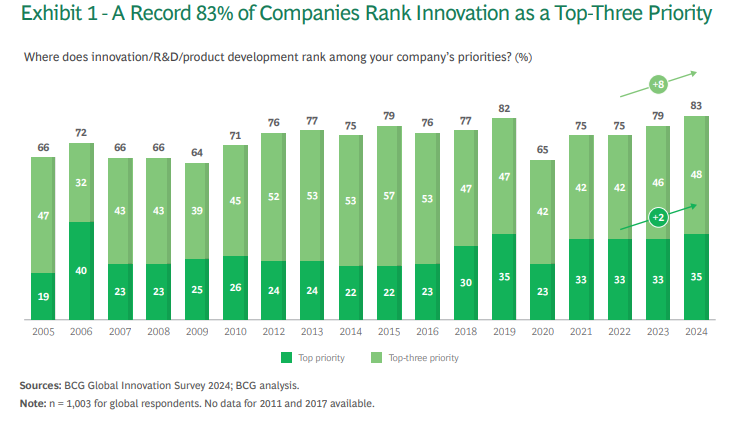
BCG’s 2024 global survey found that 83% of companies rank innovation as a top-three priority, yet only 3% are in the “ready” zone, and 52% cite an unclear or overly broad strategy as a top-three challenge. McKinsey’s 2025 survey similarly shows a harsher funding environment: nearly 60% of respondents were freezing or cutting innovation spending, another 30% were holding it flat, and many companies still expected significant future growth from offerings not yet on the market.
For R&D leaders, white space analysis is primarily a way to decide which technical problems deserve scarce scientists, engineers, prototypes, and validation budgets. For innovation leaders, it is a way to decide which themes should enter the 12–36-month pipeline, where to pilot them, and where external ecosystems are mature enough to accelerate progress.
What is White Space Analysis?
White space analysis is a process to identify opportunities that are either entirely unserved or significantly underserved by current products, technologies, or business models. For R&D and innovation leaders, it is the discipline of finding where meaningful investment can create disproportionate value, before competitors do.
The important distinction is between white space and what might be called grey space or dead space. White space is a genuine gap where a customer need exists, but no adequate solution is available. Grey space is where competition is sparse, but need is also unclear, often because the market itself is nascent or poorly understood.
Dead space is where nobody plays because nobody should, as the demand simply isn’t there, or the economics will never work. Most R&D teams conflate all three, which is how large R&D budgets end up funding projects that generate patents but no measurable value.
How is white space different from adjacent space?
Adjacent space is competitive, with existing players and known solutions. White space, by contrast, is territory that nobody has meaningfully claimed. The distinction matters because the strategy to enter adjacent space is fundamentally different: it requires displacement, differentiation, and positioning against incumbents. White space entry, if done correctly, allows you to define the rules before others arrive.
When a competitor launches a new product, and you respond by building something similar, you have entered adjacent space, not white space. White space thinking requires a fundamentally different starting point. It does not answer “what are others doing?” but “what are customers struggling with that no technology or product currently solves well?”
Why R&D Teams Get This Wrong?
The most common failure mode is equating the absence of competition with the presence of opportunity. A space can be empty because no one has tried, or because everyone who tried has failed. Before you treat silence as a signal, you need to understand why it exists.
R&D teams also tend to anchor heavily on technological possibilities. The question becomes “what can we build?” rather than “what should we build?” The result is a portfolio of technically impressive projects that fail to connect with real, fundable demand.
Genuine white space sits at the intersection of what customers need, what technology can deliver, and what economics can support. Miss any one of these three, and you are not in white space but in a wishful-thinking zone.
How to Find A White Space?
Unmet Needs Hiding in Plain Sight
The richest source of white space signals is not market research reports or competitor filings; it is your existing customer base. Specifically, it is the friction they experience and the workarounds they have invented to manage it. A workaround is a customer telling you exactly where your product or your industry has failed them. When a customer builds their own solution using spreadsheets, manual processes, or a patchwork of unrelated tools, that is a white space signal worth taking seriously.
Customer complaints are equally revealing, but only when you read them at the right level. A complaint about a specific feature is a feature request. But a pattern of complaints that points to an underlying problem no product is solving, that is a white space. The discipline is in aggregating signals and asking, “What systemic gap is this pattern pointing to?” rather than treating each complaint as an isolated incident.
Failed products are another underutilized source. When a product had genuine customer interest and still failed, the question worth asking is whether the failure was due to execution, timing, or technology readiness, and not to the opportunity itself. Some of today’s biggest market opportunities exist in spaces where early movers were simply ahead of the enabling technology. The opportunity was real; the moment was not.
Google Glass is a really fitting example of this.
Technology Capability Gaps vs. Market Demand Gaps
R&D and innovation leaders need to hold two different maps simultaneously. The first is a map of technology capability, that is, knowing “what is now possible that was not possible two or three years ago?”
The second is a map of market demand that answers the question: “What customers urgently need that they currently cannot get?” White space lives at the intersection of these two maps, but the nature of the opportunity differs depending on which gap is the primary driver.
When technology capability is the primary gap, the market may exist, and demand may be real, but no current solution works well enough. The strategic move is to close the technology gap faster than anyone else.
When demand is the primary gap, meaning the technology exists, but adoption hasn’t followed, the problem is usually one of awareness, economics, or behavior change. These are very different innovation challenges requiring very different R&D approaches.
Most R&D teams are naturally good at identifying technology capability gaps because that is their domain. The harder discipline is developing equal fluency in reading market demand signals, which requires deliberate engagement with customers, commercial teams, and market data.
What white space opportunities are already sitting inside our own portfolio?
One of the most overlooked sources of white space is your own R&D portfolio. Most innovation portfolios contain capabilities, platform technologies, or half-completed projects that could address entirely new problems if applied differently. The challenge is that R&D work tends to be siloed by project or program, limiting cross-portfolio visibility.
A structured internal portfolio review often reveals surprising white-space opportunities. The question to ask is: “What capabilities do we have that we are currently applying to one problem, but that could solve a meaningfully different and underserved problem?” This is the logic behind many successful platform extension strategies, in which a core technology built for one application is redeployed to capture an entirely different market.
Related Read
What does an analytical process look like?
Which axes should we be mapping, and which ones are misleading us?
The visual output of white space analysis is a map, but its value depends entirely on the choice of axes. The most common mistake is mapping “market size” on one axis and “growth rate” on another. It tells you where the money is, not where the gap is. For R&D leaders, the axes need to reflect the two dimensions that govern investment decisions: desirability and feasibility.
Desirability captures how acutely and broadly a need is felt. It asks: how many customers have this problem, how frequently they encounter it, and how much they would pay to have it solved? Feasibility assesses how achievable a solution is given current or foreseeable technology, and at what cost and within what timeline.
The most attractive white space is high desirability and high feasibility, but that is also where competition will arrive fastest. The strategically interesting zone is often high desirability with moderate-to-emerging feasibility: the need is real and urgent, but the technology is only now becoming viable enough to address it.
A useful refinement is to add a third dimension, i.e., strategic fit, which captures how well the white space aligns with your organization’s existing capabilities, platform technologies, and long-term direction. This prevents the common error of pursuing white space that is genuinely attractive but requires capabilities you do not have and cannot build in time to make a difference.
What signals are worth tracking, and where do we find them?
Patent filings are among the most reliable leading indicators of where R&D investment is concentrated. A sudden surge in patent applications in a specific technology domain signals that multiple players see something promising.
But the real insight comes from patent clusters that are adjacent to existing markets — not yet commercialized, not yet competing with anything, but pointing toward a new capability. The question to ask is: if these patents become viable products, what problem do they solve that no current product addresses?
Research publication velocity is the upstream version of the same signal. When academic and industrial research publications in a specific domain spike, it typically precedes commercial application by three to five years. For R&D leaders, monitoring publication trends in adjacent scientific domains is a form of early intelligence that most commercial functions simply don’t have access to. This is an edge worth protecting.
Funding trends in venture capital and corporate venture arms reveal where sophisticated investors are betting on emerging demand. This is not about following the money blindly — plenty of well-funded spaces are overcrowded.
But when a specific problem domain attracts consistent funding across multiple rounds and multiple investors, it is a strong signal that the demand is real, even if the winning solution has not yet been found.
How to spot a space that looks open but is already crowded?
One of the most dangerous traps in white space analysis is the crowded-but-quiet zone. It’s a space where significant R&D activity is happening across multiple organizations, but nobody is talking about it publicly. This pattern appears most often in competitive technology domains where players are aggressively filing patents and quietly funding research, but no products have yet reached the market. From the outside, it can look like white space because there are no visible competitors and no clear market leader.
A particularly fitting example here is GreyB’s analysis of smartwatch patents, which showed that tech companies were filing for smartwatch patents. And later, the smartwatch industry was flooded by tech players rather than traditional watchmakers.
The diagnostic here is cross-referencing your patent intelligence with conference presentations, published research, and job postings. If a technology domain is generating lots of patents but almost no academic publications or conference talks, and you can see companies quietly hiring specific technical experts in that area, you are likely in a crowded-but-quiet zone.
This does not necessarily mean you should not enter, but it does mean you need to move with urgency rather than treat it as open territory.
How to move from a map to an actual decision?
How to prioritize white spaces that survive a boardroom conversation?
The output of a white space analysis is of no value if it cannot withstand scrutiny in a resource-allocation conversation at the senior leadership level. R&D leaders who bring white space findings to the boardroom often fail not because their analysis was wrong, but because they have not translated the findings into the language of business risk and return.
Prioritization needs to happen along three dimensions simultaneously.
- The first is opportunity magnitude: how big is this, and what share could we realistically capture?
- The second is time sensitivity: how quickly is this window closing, and what is the cost of waiting 1 or 2 years?
- The third is organizational readiness: do we have the technology, the talent, and the adjacency to compete in this space, or would we be starting from scratch?
Mapping these three dimensions against each other gives you a prioritized set of opportunities that can be defended with logic, not just intuition. The spaces that score high on all three are your immediate bets. Those that score high on magnitude but low on readiness are your partnership or acquisition targets. Those that are high on magnitude but low on time sensitivity can be monitored rather than funded today.
What are the three questions every white space must answer?
Before any white space opportunity receives meaningful R&D resources, it must be able to answer three questions clearly:
- First: who exactly has this problem, and how do we know the problem is real rather than hypothetical?
- Second: what would a credible solution look like, and is the enabling technology within reach in a timeframe that matters commercially?
- Third: why us — what right do we have to win in this space, given our current capabilities and strategic position?
The third question is the one most R&D teams skip. It is also the most important. White space analysis can identify dozens of genuine gaps, but pursuing spaces where you have no distinctive capability or strategic advantage is not innovation.
The discipline of asking “why us?” is what separates a portfolio of interesting ideas from a portfolio of executable bets. It is the question that forces honest self-assessment and prevents the organizational equivalent of chasing every shiny object. It should be asked early, asked often, and answered rigorously.
How to choose between Stage-Gate and Open Innovation Model?
The mechanism through which you enter a white space should be matched to the nature of the opportunity and your current readiness. For white spaces that require deep technology development over a multi-year horizon, particularly where the core capability needs to be proprietary, a disciplined stage-gate approach is appropriate.
This means structured investment milestones, clear go/no-go criteria at each stage, and resource commitment that scales with proof of concept.
For white spaces where speed matters more than proprietary depth, where the opportunity is time-sensitive, and others are closing in, open innovation approaches are more appropriate. This might mean partnering with a startup that has already developed a core enabling technology, co-developing with a research institution, or investing via corporate venture to secure access without requiring a full internal capability build.
The decision should be driven entirely by the speed-versus-depth trade-off inherent in the specific whitespace.
What does honest execution require?
Build, Partner, or Acquire
One of the most consequential decisions in white space execution is how to enter the market. The choice between building internally, partnering externally, or acquiring a player in the space is not simply a financial decision. It is a strategic one that determines your speed of entry, the depth of your capabilities, and your competitive position over a five- to ten-year horizon.
Building internally is appropriate when the white space requires a capability that must be deeply integrated with your existing technology platform and when you have the time to develop it. The advantage is full control and deep proprietary ownership. The disadvantage is speed: internal builds sometimes take longer than markets allow.
Partnering is appropriate when a complementary capability already exists externally and would take too long or cost too much to replicate internally. The best partnerships in white space entry are those where each party brings something the other cannot easily replicate: you bring scale, market access, or existing platform; the partner brings enabling technology or specialized expertise. What matters is that the partnership is structured around clear value exchange, not goodwill alone.
Acquisition makes sense when a startup or smaller player has already validated the core technology or business model in a white space you have independently identified as strategically important. Here, you are buying proof of concept and a shortcut to capability. The risk is integration: acquired capabilities that get absorbed into existing organizational structures often lose the agility that made them valuable in the first place.
How much R&D budget should chase white space?
One of the most consistently debated questions in R&D leadership is how much of the budget should be allocated to white-space exploration versus core-business optimization. There is no universal answer, but the rough benchmark that holds across most mature R&D organizations is a 70/20/10 split: 70% on core products and existing technology roadmaps, 20% on adjacent innovation in spaces close to your existing business, and 10% on genuinely new white-space bets.
The ten percent for white space is not a rounding error — it is an option portfolio. The logic is that white space investments are high-risk, high-return, and the right approach is to fund multiple small bets rather than one large bet that consumes a significant portion of the budget. The organizational discipline required is to treat this ten percent as structurally protected and not the first thing cut when core business pressures emerge, because it always will be.
The One Metric That Matters
In white space work, most conventional R&D metrics are misleading at early stages. Revenue, ROI, and margin are irrelevant until you have something to sell. Patent counts tell you about activity, not about direction. The one metric that genuinely matters in early white space execution is learning velocity: how fast are you moving from hypothesis to validated learning?
The goal of the earliest stage of white space investment is to answer the three foundational questions with increasing confidence and decreasing assumptions. Each dollar spent should be buying a clearer answer to a question that, if answered differently, would change your decision to invest.
When teams can articulate what they learned last quarter and how it changed their view of the opportunity, the R&D leadership has a functioning white space program. When teams can only report on completed activities and hit milestones, the program is likely drifting toward bureaucratic output rather than genuine learning.
How to stay ahead once the analysis is done?
Why make white space analysis a continuous discipline?
The biggest structural failure in white space analysis is treating it as a periodic event rather than a continuous organizational capability. In most companies, white space work happens once a year as part of a strategic planning cycle. It gets treated as a concentrated effort that produces a presentation, generates discussion, and then sits largely untouched until the next cycle begins. By the time the next cycle arrives, the map has changed, and the analysis is stale.
R&D and innovation leaders who are serious about white space build it as a repeating process with three components. The first is a standing intelligence function: a small group responsible for continuously scanning patent databases, research publications, funding announcements, and customer insights for new signals.
This does not require a large team but a disciplined process and clear ownership.
The second is a quarterly synthesis: a structured conversation among R&D leadership to review new signals, update the white space map, and assess whether existing bets remain valid.
The third is an annual strategic review that connects the white space map to actual resource allocation decisions.
The organizations that consistently identify and capture white space opportunities are not the ones with the most sophisticated analysis tools, but the ones that have made this a repeating, funded, and led process.
What signals tell us a white space window is beginning to close?
White space does not stay open indefinitely. The signals that a window is beginning to close are often visible six to eighteen months before a competitor announces a product or a space becomes crowded. R&D leaders who monitor these signals can either accelerate their entry or make a conscious decision to exit before investing too deeply.
The first signal is a sudden increase in competitive hiring in a specific technical domain. When multiple companies begin advertising for specialists in a particular technology area, it indicates that the technology has crossed from “interesting” to “investible” in the eyes of multiple organizations.
The second signal is the appearance of a cohort of startups independently trying to solve the same problem. When multiple startups converge on a problem, the demand is real, and the technology window is opening.
The third and most urgent signal is the first commercial announcement in a space you have been watching as white. That announcement compresses your remaining window significantly, not to zero, but from years to months.
When to Abandon a White Space Pursuit?
Walking away from a white-space investment is one of the most difficult decisions in R&D leadership, precisely because sunk-cost bias is strongest in innovation work. The team has invested time and belief; the idea still seems sound in principle; there is always a reason to believe the next experiment will be the breakthrough. This is how organizations end up funding projects long past the point of honest assessment.
The discipline of structured exit requires establishing clear conditions for withdrawal before you begin investing, not after. These conditions should be tied to specific learning milestones: if we have not validated customer demand by a specific date, we stop. If the technology feasibility assessment shows a cost at scale more than twice our target, we stop. If a well-resourced competitor announces a credible solution before we have reached proof of concept, we reassess immediately.
Abandoning a white-space pursuit is the system working correctly. What matters is what you do with the learning. The teams and organizations that extract structured lessons from abandoned projects, i.e., what signal was misread, what assumption was wrong, what we now know about that space, are the ones that get better at white space identification over time.
Final Thoughts
The final discipline of white space analysis is honesty about what your organization can actually execute. Identifying a genuinely exciting, genuinely unserved market gap has no value if your R&D organization lacks the capability, the funding, or the organizational commitment to pursue it seriously. A white space found but not pursued still costs you. It consumes analytical bandwidth, creates false confidence, and often leads to reactive half-measures when a competitor eventually fills it.
The best R&D leaders use white space analysis to make sharper resource-allocation decisions, not to expand their portfolios indefinitely. They use it to say no to things clearly and yes to the right things boldly.
If you are an R&D or innovation leader asking any of the following, it is time to talk:
- We see opportunity in a new technology space, but we don’t know how crowded it really is.
- Our innovation pipeline feels reactive rather than forward-looking.
- We want to find white space before our competitors do, and not after their patent gets filed.
Let’s identify where your next breakthrough should come from.