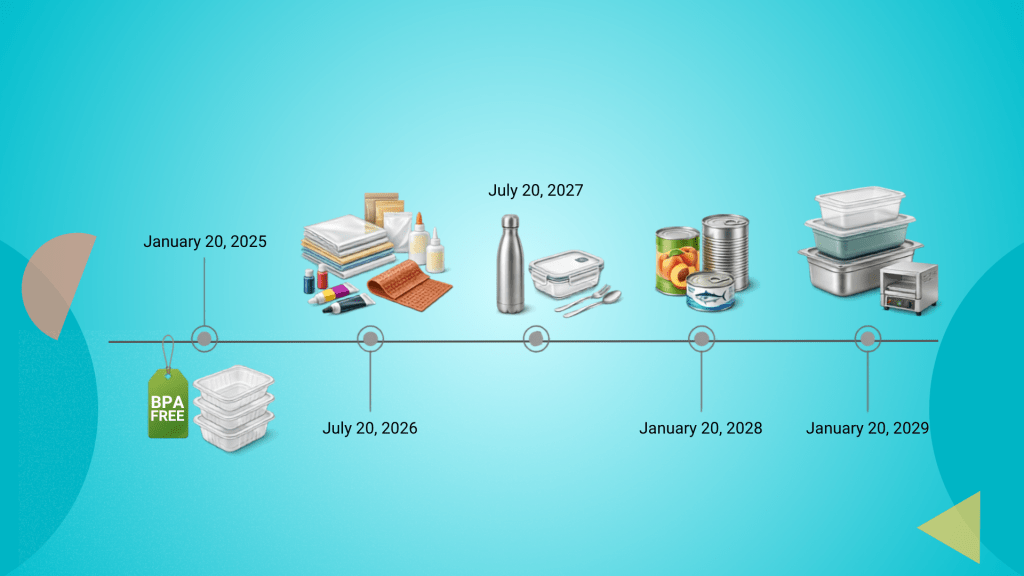





Food companies have until August 2026 to find a functional replacement for PFAS in food packaging. After that, packaging with fluorinated grease and water-resistant coatings cannot be placed on the EU market. No grandfathering, no phase-in for existing stock.
Among the chemistries being evaluated to fill that gap, nanocomposites have moved fastest from lab to specification sheet. Nanocellulose, chitosan, and metal-oxide systems deliver real barrier performance against oxygen, moisture, and microbial spoilage. In fact, sometimes matching what fluorinated coatings did, on bio-based substrates that work with recycling streams.
The catch is the second compliance question. Nanoparticle migration into food is now actively governed under EFSA’s risk-assessment guidance for food-contact materials, with updated rules being phased in through 2029. Solving the PFAS problem doesn’t mean compliance is over. It means a different conversation has started.

So, how are nanocomposites being used in packaging? Which companies are leading the research? Who is collaborating to develop new packaging solutions? Which countries are supporting this initiative?
Interested in more Packaging Trends? Fill out the form to get our Packaging Industry Trends Report:
Who is Working on Nanocomposites for Food Packaging?

Significant Industry Collaborations in Nanocomposite Food Packaging


Haydale, a British tech and materials group, supplies functionalized Graphene Nano-platelets (GNPs) to NeoEnpla, a startup, for creating food-storage zipper bags and biodegradable plastic bags.
We also saw cross-industry collaborations in this domain. One such collaboration involved Nanocor and Mitsubishi Gas Chemical.


They developed nylon nanocomposites as a barrier layer for multi-layer PET bottles. These bottles can be used to package liquors, such as beer, and small carbonated soft drink beverages.
With a focus on improving biodegradability to simplify the post-consumption management of packaging materials and not cause adverse environmental impact.
Let’s take a look at the industry’s changing trends.
More Packaging Related Reads

Nanocomposite Materials Approved by UK and EU Regulators
Monolayer Packaging Films
Since using multiple layers in current packaging products makes the recycling process more complex, there has been a noticeable increase in both interest and funding for innovation projects to create monolayer packaging films.
Biopolymer-Based Nanoparticles
Previously, research in nano-enabled packaging was focused on Ag (silver) and TiO2 (Titanium Dioxide) nanoparticles in polymer matrices of LDPE (Low-density Polyethylene), PVC, and so on.
In recent years, research has shifted to bio-based nanoparticles, such as nanocellulose and Chitin/chitosan-based nanoparticles, to form nanocomposites with desired properties.
Functional Advancement: Barrier and Strength
With a significant focus on the material’s functional advancements, barrier properties, strength, and resistance to logistical stresses are among the sought-after qualities, especially in food and beverage packaging.
Since food preservation is a top priority, researchers at Shanghai Ocean University have developed an esterified nanocomposite film with preservation properties.
Let’s have a look at their research.
Maintaining Nutritional Value: Carboxymethyl Nanocellulose Films
The film is made from modified carboxymethyl nano cellulose (CMNC), which is antibacterial and oxidation-resistant.
The base material is a degradable polymer called polybutylene adipate/terephthalate (PBAT), which also confers antibacterial and antioxidant properties to the film.
Moreover, this film is eco-friendly, safe, and reliable.
These researchers have also filed a patent (CN114410077A) to protect their innovation.
More on Food Packaging
Strategic Implications for Food Packaging R&D
Nanocomposites are no longer a research curiosity in food-grade packaging. They are a leading replacement chemistry for fluorinated barrier systems, and the August 2026 PFAS deadline has compressed the evaluation window from years to quarters. But the path from patent activity to commercial deployment runs through migration-safety data, scale-up economics, and recyclability — and most published research only addresses the first of those.
R&D teams evaluating nanocomposite adoption are working through similar questions:
- Which nanocomposite chemistries: silver, ZnO, nanocellulose, montmorillonite, and chitosan have migration data robust enough to clear EFSA’s updated guidance, and which still depend on lab-scale assumptions?
- How does barrier performance translate from coupon-level testing to high-speed food-grade packaging lines without changing the bonding chemistry?
- Who is collaborating on commercialization right now? Which materials companies, which startups, which research institutions, and what does that signal about pipeline depth?
- Where does nanocomposite adoption fit alongside PPWR compliance requirements for recyclability and recycled content, given that some nanofillers complicate end-of-life sorting?
- What patent activity needs to be tracked to anticipate freedom-to-operate constraints before product launch?
Finding answers to these questions requires deep technology scouting, competitive patent analysis, and the ability to map emerging material chemistries against regulatory trajectories.
That’s exactly where GreyB comes in.
Whether you are evaluating new barrier chemistries, scouting startups commercializing nanocomposite films, or building a freedom-to-operate view of patent activity in this space, our team helps food-packaging R&D leaders filter the signal from the noise and focus on what works at scale.