
The Q2 data points to a PTAB process where pre-filing timing, venue exposure, claim mapping, campaign focus, and counsel selection now shape outcomes alongside the merits.
Discretionary denials exceeded merit-based denials, with parallel-court timing driving most of the discretionary outcomes.
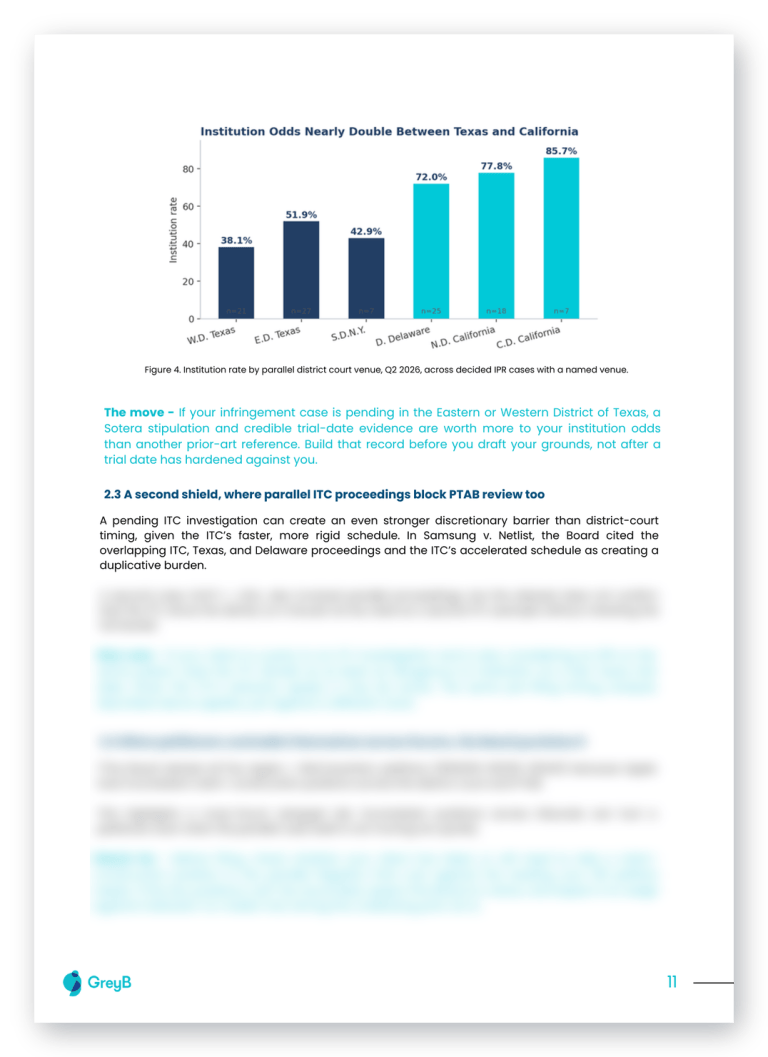
Institution odds ranged from 38.1% in West Texas to 85.7% in Central California, a larger gap than any technology or party-type comparison in the report.
Claim-mapping gaps and weak motivation-to-combine arguments produced much weaker institution outcomes than clean mapping and stronger combination logic.
Patent owners secured complete wins in 36% of Final Written Decisions, while technology-level outcomes diverged sharply between institution and trial.
Single-target campaigns posted stronger institution results than petitioners that spread filings across several unrelated targets.
The gap between high-volume individual filers was wider than the spread between many technology categories, making venue-specific track records more relevant.
The report follows the full IPR path from filing and institution through Final Written Decision, then connects case outcomes with venue, technology, petitioner strategy, patent-owner defense, and counsel performance.
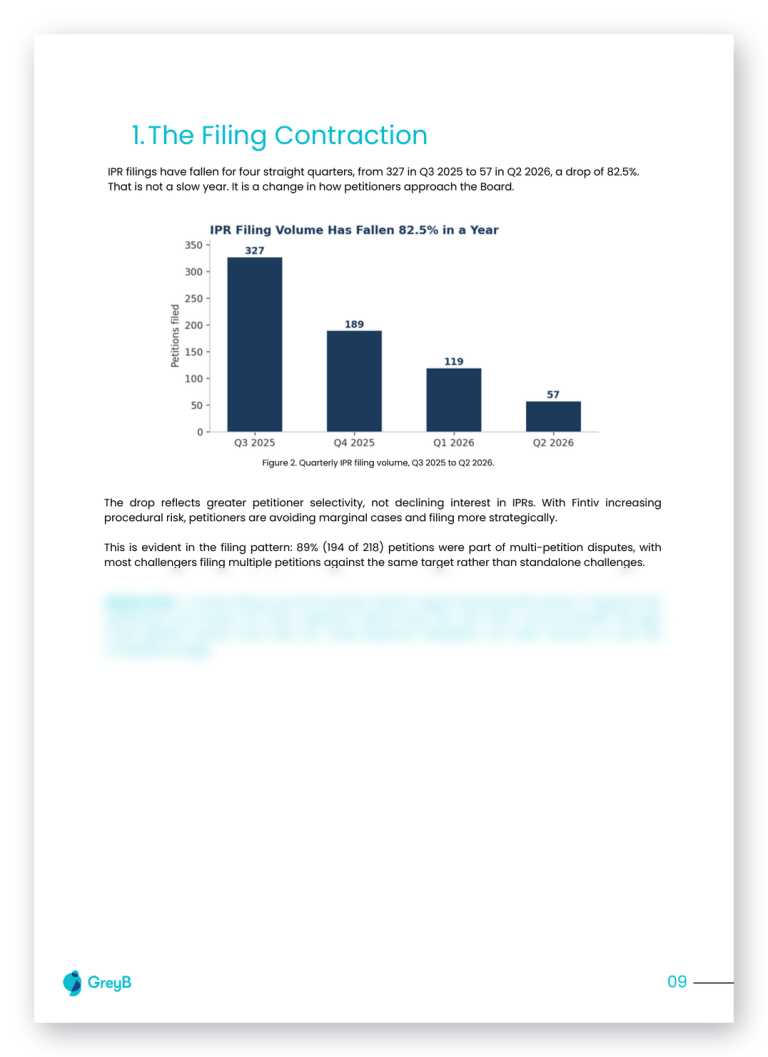
Quarterly IPR filings fell from 327 in Q3 2025 to 57 in Q2 2026. At the same time, 89% of the 218 tracked petitions formed part of multi-petition disputes.
The value of this signal is in the distinction between lower activity and greater selectivity. The quarter points to fewer marginal filings and more concentrated campaigns against targets that petitioners have already screened for timing and litigation risk.
Of the 50 denials in the dataset, 32 were discretionary and 29 were tied to parallel-court timing. Merit-based failures accounted for 18 denials.
The venue effect is large enough to change case planning before the grounds are drafted. West Texas posted a 38.1% institution rate, while Central California reached 85.7%.
The report turns Fintiv from a post-filing issue into a pre-filing screening question. Parallel-case location, trial timing, Sotera posture, and cross-forum claim construction need to be assessed before resources are committed to the merits brief.
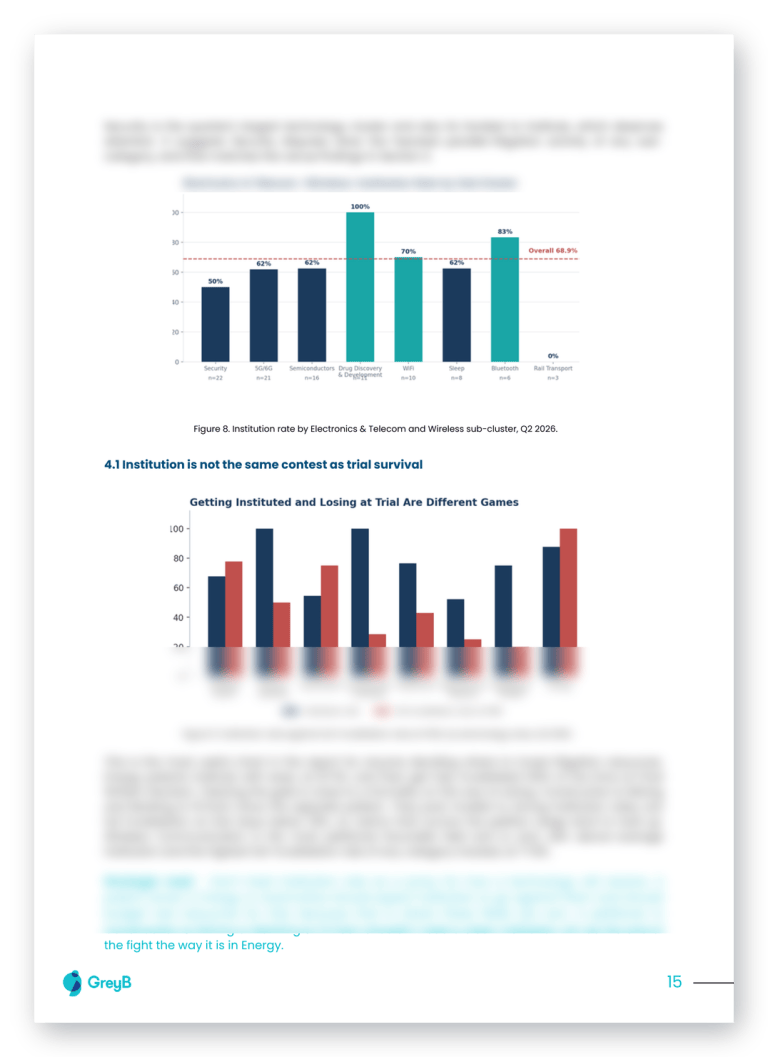
Patent owners won all challenged claims in 36% of Final Written Decisions this quarter. The report also shows technology areas where institution rates remain high but trial-stage invalidation outcomes move in the opposite direction.
This changes how institution should be read. A successful institution decision can create leverage without settling the final validity question, while some patent owners have more reason to carry a defense through trial than institution statistics alone would suggest.
Declaration activity has continued to climb through 2025, with pending filings consistently outpacing active granted families each year. The United States leads in active granted families. China ranks second in active enforcement footprint, and European filings remain the backbone of German court proceedings.
Apple, Google, Microsoft, Amazon, Meta, Samsung, and Cisco recorded a 41.5% institution rate across decided cases. Other operating-company petitioners reached 82.4%.
The report links the difference to strategy and venue exposure rather than resources. Large petitioners spread filings across more targets and face fast-moving Texas litigation more often.
Company size alone does not create a PTAB advantage. Cleaner case selection and lower Fintiv exposure can outweigh filing volume, brand scale, and legal budget.
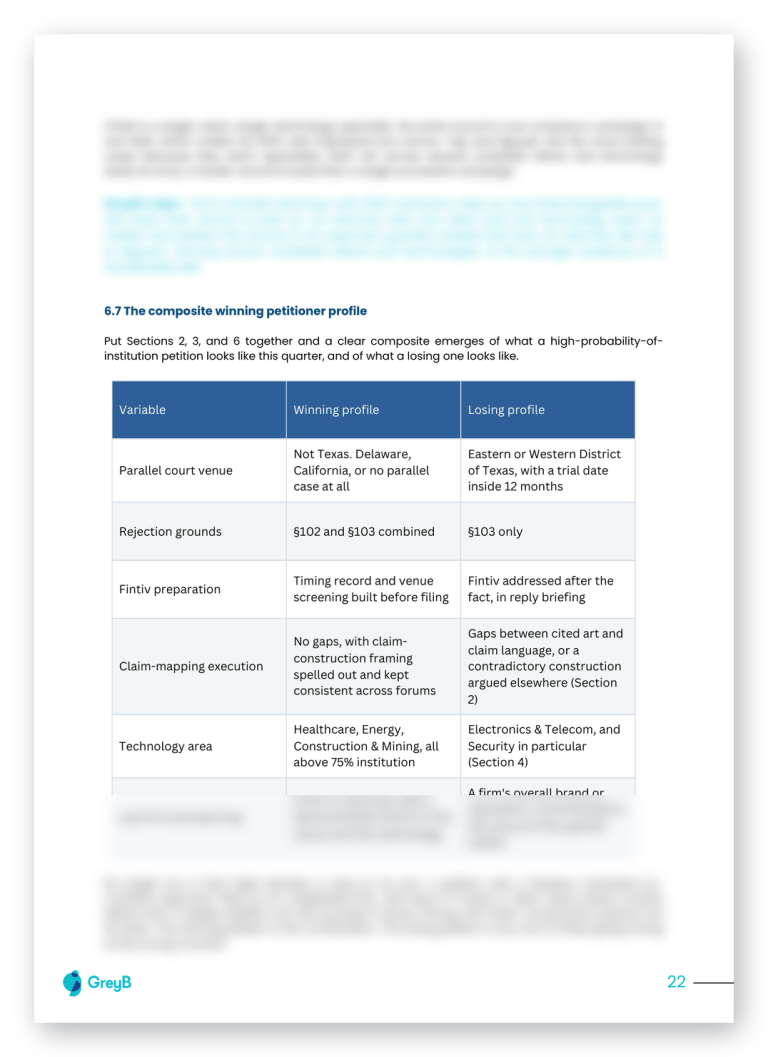
The Q2 data does not point to one winning variable. It points to a sequence of decisions that begins before drafting and continues through claim mapping, grounds design, counsel selection, and campaign scope.
A strong merits case can still fail when parallel litigation, claim-construction posture, or venue timing is misaligned. The composite winning profile in the report combines these variables rather than treating them as separate checks.
That makes the framework useful as a pre-filing screen. It helps separate cases that deserve a full IPR investment from cases where procedural exposure may erase the value of stronger prior art.
Check venue, trial date, ITC exposure, and the Fintiv record before the petition grounds are built.
Remove mapping gaps and keep claim-construction positions consistent across PTAB and district-court proceedings.
Use clear motivation-to-combine reasoning and a grounds structure that fits the available prior art instead of adding references for volume.
Evaluate the attorney's recent record in the actual venue and technology area, rather than relying on firm reputation alone.
Concentrate filings around one high-conviction target when the economics support it, while keeping the parallel-litigation clock in view.
The full report includes the complete quarter analysis across filing volume, denial grounds, venue, technology, institution predictors, counsel performance, Final Written Decision outcomes, party profiles, and GreyB’s outlook for Q3 2026.