
Webinar | Women’s Nutrition: Nourishing Womanhood From Pregnancy To Menopause
11 September | 12 PM ET: Register Now
AV1 is now deployed at scale, but its IP exposure extends beyond patents that explicitly mention the codec.
GreyB’s Phase 1 analysis maps 53 AV1 Level 2 features against HEVC and VVC and builds a technical framework for identifying where earlier codec patents may still read on AV1 implementations.
AV1 has a growing implementation base
Cross-codec overlap creates a second patent layer
Public pool data gives an early view of monetization
The report builds the technical foundation for patent mapping and essentiality work by connecting codec architecture, cross-standard overlap, patent pool activity, and implementation requirements.
GreyB’s AV1 taxonomy is organized into four levels of granularity. Level 1 defines eight major technical domains. Level 2 defines the primary coding features used as patent-mapping units. Level 3 captures specific algorithmic implementations and sub-procedures. Level 4 captures parameters, variables, flags, and syntax elements.
Each Level 2 node becomes a patent search cluster in Phase 2. The structure supports functional claim searches, cross-codec synonyms, and precise family-level deduplication when one patent family maps to more than one technical feature.


All three codecs share a broad architecture based on block prediction, residual transforms, quantization, entropy coding, and in-loop filtering. AV1 also builds on concepts such as recursive block partitioning, motion-vector prediction, sub-pixel interpolation, and skip or merge signaling.
The report separates these shared foundations from areas that have no real precedent in HEVC or VVC, including AV1’s compound inter-prediction with wedge-based blending, CDEF, normative in-loop super-resolution, and its frame-level global motion model.
This distinction matters for patent review. A patent does not need to mention AV1 to be relevant to an AV1 implementation if the claim covers the same underlying coding function.
The report identifies three commercial pool structures around AV1: Access Advance’s Video Distribution Patent Pool, Sisvel’s AV1 pool, and Avanci’s video licensing program. The public evidence differs across them.
VDP and Sisvel publish patent lists, which allow their public portfolios to be compared. VDP lists 327 patents grouped into 59 families, while Sisvel lists 1,338 patents grouped into 190 families. The report identifies eight licensors common to both pools and 254 patents common to their public lists.
Avanci is included as an active AV1-related licensing program, but it does not publish an AV1 patent list, so its portfolio cannot be counted or compared in the same way.

The report draws an important distinction between a tool being switched off in a particular stream and a decoder being allowed to omit that capability altogether. For decoder-side patents, the second question has a much stronger effect on how many conforming implementations a claim can reach.
AV1, HEVC, and VVC handle profile and constraint structures differently. AV1 keeps profile-level tool separation relatively limited. HEVC has a broader profile structure, while VVC adds General Constraints Information to provide finer control over tool availability.
These boundaries help determine whether a patent covers a broad population of conforming decoders or only a narrower implementation point. That is directly relevant to later licensing and essentiality analysis.
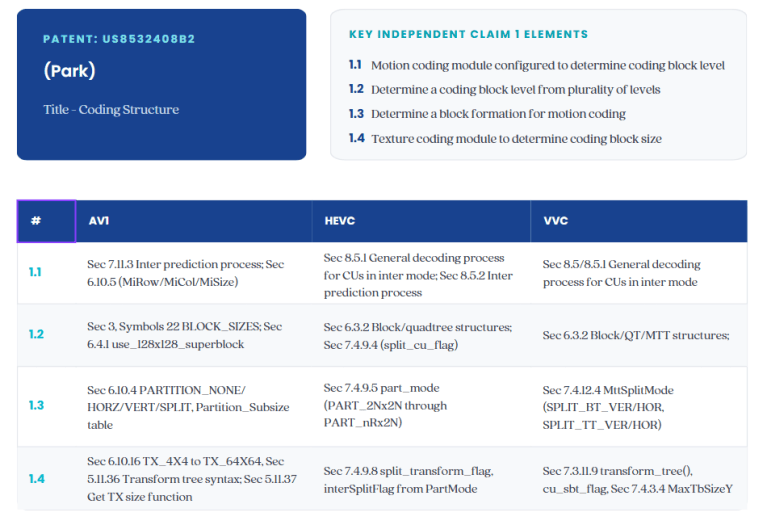
US8532408B2 serves as a worked example in the report. Its independent claim is framed around a broad video-coding workflow rather than AV1-specific syntax. The analysis maps the claim elements to AV1, HEVC, and VVC mechanisms for coding block levels, block formation, and coding block size.
The example demonstrates the practical reason for the taxonomy. The syntax can change between codecs while the underlying coding logic remains aligned. For licensors, this creates a route to evaluate older video-coding portfolios against a growing AV1 market. For implementers, it supports targeted freedom-to-operate review in high-overlap areas such as block partitioning, inter prediction, transform coding, entropy coding, and in-loop filtering.
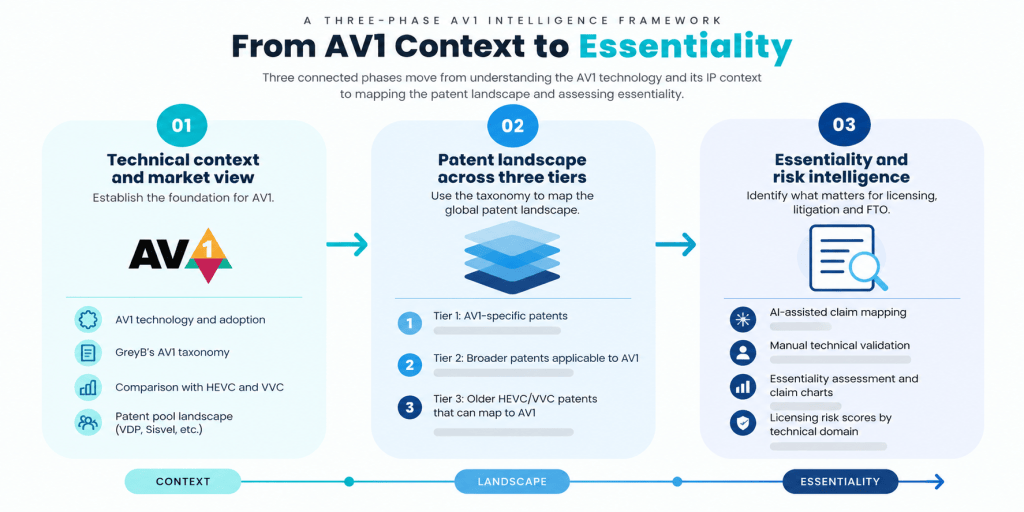
This report establishes why AV1 matters, who the key actors are, how AV1 differs from HEVC and VVC, where the technical overlap sits, and how the patent-pool environment is developing.
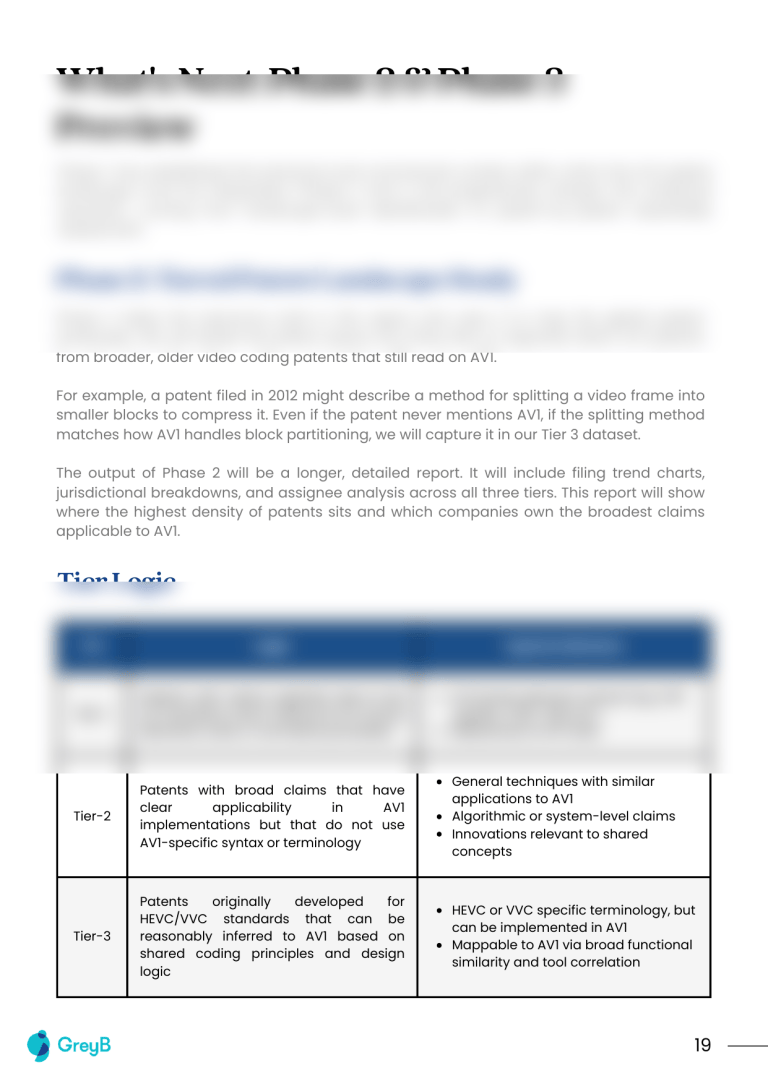
The taxonomy will be used to map the global patent landscape across three tiers. Tier 1 covers patents explicitly tied to AV1. Tier 2 covers broad claims with clear applicability to AV1. Tier 3 covers older HEVC/VVC patents that can reasonably be inferred to AV1 through shared coding principles and design logic.
Phase 3 will assess the complete Phase 2 patent set. AI will first map claims against the AV1 specification, followed by manual technical review to validate the output and finalize essentiality calls. Deliverables include an essentiality rating matrix, claim chart workbooks, and licensing risk scores by technical domain.
AV1 is no longer a niche codec. Large-scale streaming and growing hardware support have made it commercially important, while patent pools, independent licensors, and enforcement activity are changing how its royalty-free model is understood.
Phase 1 establishes the technical and IP context needed to interpret the patent landscape that follows. It maps AV1 against HEVC and VVC, builds a four-level taxonomy, examines patent-pool activity, and identifies where older video-coding patents may overlap with AV1.