

Autonomous vehicles are moving beyond identifying what is happening around them. Emerging AI architectures are being developed to anticipate vehicle trajectories, traffic interactions, human driving behavior, and future road conditions before decisions are made.
GreyB analyzed 900+ patents across US, EP, and CN jurisdictions, with the report highlighting recent 2025-2026 innovations in trajectory forecasting, prediction-planning integration, mixed-traffic behavior modeling, and intelligent path planning
Key Takeaways
AI-driven road prediction is developing across several layers of the autonomous-driving stack.
- Prediction is moving closer to planning and control. Emerging world-model approaches combine trajectory forecasting and motion planning instead of treating them as separate processes.
- Sensor fusion is becoming central to trajectory prediction. Camera and LiDAR data are being combined with graph neural networks and attention-based models to represent interactions between multiple road users.
- Human behavior is becoming part of the prediction problem. New approaches use real-time V2X data and predictive models to estimate the actions of human-driven vehicles in mixed traffic.
- Prediction is expanding beyond individual vehicles. New path-planning approaches account for intersections, traffic signals, road topology, one-way restrictions, and vehicle-passenger coordination.
Autonomous Driving Is Moving From Sense to Predict to Plan
Conventional autonomous-driving systems largely begin with perception: cameras, LiDAR, radar, and other sensors establish what is happening around a vehicle.
The innovations highlighted in the report add another layer.
Sensor information is fused and interpreted by AI models that estimate what vehicles, pedestrians, and the surrounding traffic environment are likely to do next. Those predictions can then feed motion-planning and driving decisions.
The resulting architecture moves toward a broader sequence:
Sense → Predict → Plan → Act
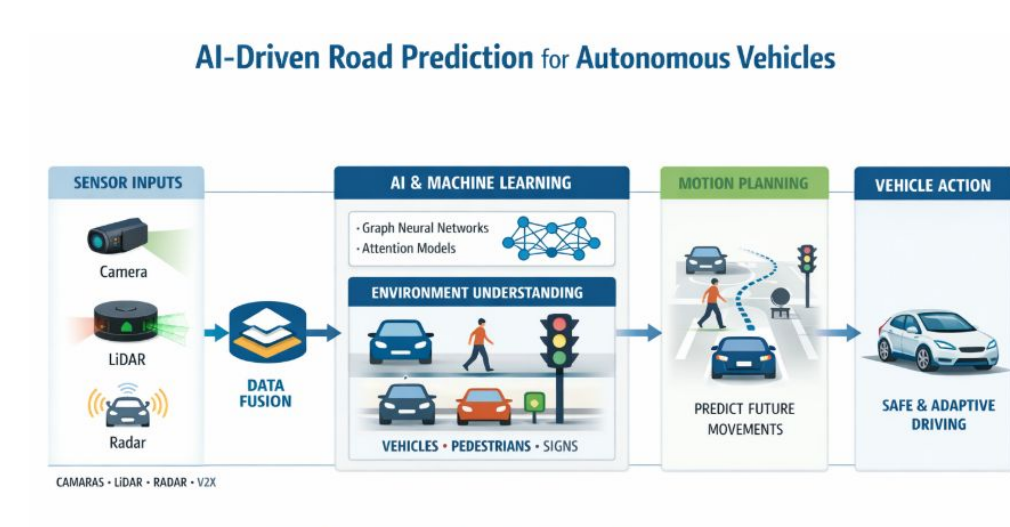
Four Patent Innovations Show Where Prediction Is Being Built Into Autonomous Mobility
Multimodal Vehicle Trajectory Prediction
Nanjing Antongjie Technology combines RGB camera images and LiDAR point-cloud data with graph neural networks and attention-based models to predict future vehicle trajectories.
Prediction and Planning in One Framework
East China University of Science and Technology uses a world-model-based architecture to jointly perform trajectory prediction and motion planning, including latent environment modeling, spatiotemporal graph neural networks, cross-attention, and closed-loop refinement.
Predicting Human Drivers in Mixed Traffic
Southeast University combines real-time V2X data, a physics-informed neural network, and model predictive control to model human driving behavior and support adaptive cruise control in mixed traffic.
Path Planning for Complex Urban Roads
Hong Kong University of Science and Technology incorporates road topology, intersections, traffic signals, and road structure into autonomous mobility path planning while combining vehicle-passenger pairing with route selection

Predicting Human Behavior Is Becoming Part of Autonomous Control
Mixed traffic remains fundamentally different from a fully autonomous environment because human-driven vehicles introduce uncertain and changing behavior.
One of the patents highlighted in the report addresses this by connecting vehicle-to-vehicle data, behavior prediction, and predictive control. A physics-informed neural network models human driving behavior, while model predictive control uses those predictions to adjust vehicle actions.
This illustrates a broader change in autonomous-driving intelligence: prediction is becoming part of the control loop rather than remaining a separate analytical function.

What the Report Covers
The report examines recent patent-backed approaches across four connected areas of autonomous mobility:
Trajectory prediction
Multimodal sensor fusion, graph neural networks, attention models, and confidence-based trajectory estimation.
Unified prediction and planning
World models, latent environment representations, interaction modeling, and closed-loop optimization.
Mixed-traffic behavior prediction
Human-driver modeling, V2X information, physics-informed neural networks, and predictive control.
Intelligent urban path planning
Road topology, traffic signals, intersections, routing constraints, and vehicle-passenger coordination.
The Shift Is From Seeing the Road to Anticipating It
The four innovations point in the same direction.
Autonomous-driving intelligence is moving beyond recognizing objects and road conditions toward forecasting future states and incorporating those forecasts directly into planning and control.
The full report examines the patent approaches behind that transition and how prediction-driven architectures are being developed across autonomous mobility.