




One afternoon at GreyB, Parth and Vishesh brought a simple activity to the team.
They gave different teams different amounts of money. The instruction was simple: use the amount to create more value.
At first, Greybians took the obvious approach.
What can you buy?
What can you sell?
How much profit can you make from the amount in hand?
But Parth & Vishesh wanted to change Greybians’ perspective that the amount in hand wasn’t the real asset.
The Stanford $5 Challenge
They shared that the activity was inspired by the famous Stanford $5 Challenge. In the exercise, students were given an envelope with $5. They could plan for several days, but once they opened the envelope, they had only two hours to make as much money as possible.
Most teams started with the obvious ideas. Buy supplies. Sell lemonade. Wash cars. Resell small items.
But the best ideas came from the teams that didn’t treat the $5 as the constraint. One team made restaurant reservations and sold the waiting spots. Another checked bicycle tire pressure for free and accepted donations.
In fact, the winning team did not use the $5 at all. They sold their three-minute presentation slot to a company that wanted to recruit Stanford students and made $650.
The lesson was simple, but powerful.
“Constraints can force better thinking, but only when you question the constraint itself.”
The best teams did not ask, “How do we use $5?”
They asked, “What valuable asset do we already control?”
This changed how Greybians viewed the challenge. Here are some of the before-and-after ideas teams shared in the email thread.
Sahil Goel introduced a penalty system for latecomers
I was given ₹50 and asked to create maximum value from it, my immediate focus was on how I could use that amount as a starting point rather than the end goal. My initial idea was to buy a packet of Melody toffees and distribute them to 50 people and starting funny conversations with them. The toffee itself was never the value, it was simply a conversation starter. Those conversations could then become opportunities to pitch a product or service, and even if a few people converted, the value created would be much higher than the original ₹50 investment.
What I found interesting during the session was the shift in thinking from “How do I use ₹50?” to “Why am I limiting myself to ₹50 in the first place?” The discussion reinforced that constraints are often just starting points, and real value comes from looking beyond them.
Applying the same thought process to a day-to-day work scenario, I picked the challenge of improving efficiency and discipline within my team. My After approach was to introduce a ₹50 deduction for late coming, delayed updates, late departures without proper communication, and other recurring inconsistencies. But instead of treating the collected amount as a penalty, I thought of using it as an investment back into the same people, whether through a course, a learning session, or another development activity that helps them improve their skills and efficiency.
For me, the key takeaway was that creating value is not always about the resources available. Sometimes it’s about reframing the problem and finding a way to create a larger positive outcome from the same starting point.

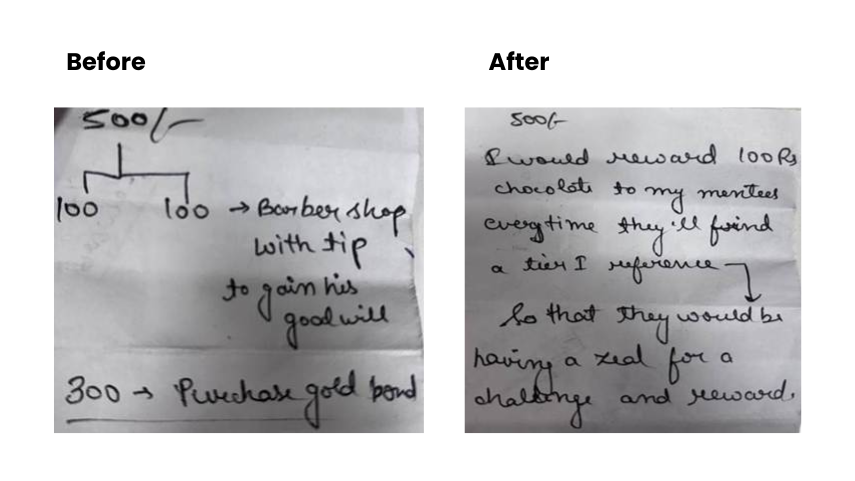
Anshul Maurya used the money to reward team members who brought Tier-1 results
I initially focused on utilizing the money itself. I invested INR 300 in what I believe is one of the most valuable appreciating assets of all time, gold. With the remaining INR 200, I thought of building goodwill and trust by tipping my barber extra, hoping to become a valued customer over time.
Later, I reframed my approach and stopped restricting myself to the INR 500 amount alone. Instead, I started thinking about the actual potential of the opportunity. I would use the amount to reward my mentees with INR 100 every time they identify a Tier I reference.
This would create a healthy competitive spirit and turn learning into a rewarding game, encouraging them to learn, adapt, and perform better. In the long run, this could translate into highly valuable outcomes for both the team and the client by improving the chances of winning cases.to create a larger positive outcome from the same starting point.
Astha Raj leveraged the opportunity to gain insights into broader industry trends
My initial thought was that if I had ₹1000, I would invest it in a self-development course. However, I realized that I was focused on how to spend the ₹1000 rather than questioning whether spending it was necessary at all.
This made me reflect on my own challenge of time management. My usual assumption is that self-development requires additional time or resources. The session helped me reframe that thought: instead of asking, “How can I find more time?”, I started asking, “How can I create more value with the time and resources I already have?”
To begin with, I have already started putting this into practice. As part of Aisle’s account mining and nurturing team, I subscribed to a couple of tobacco industry newsletters and spent dedicated time (15 mins.) today, understanding broader industry trends rather than looking at them only when a task required it.
Takeaway: Constraints are not always obstacles. Sometimes, when we take a step back and question the constraint itself, we discover opportunities to create value that we might have otherwise overlooked.

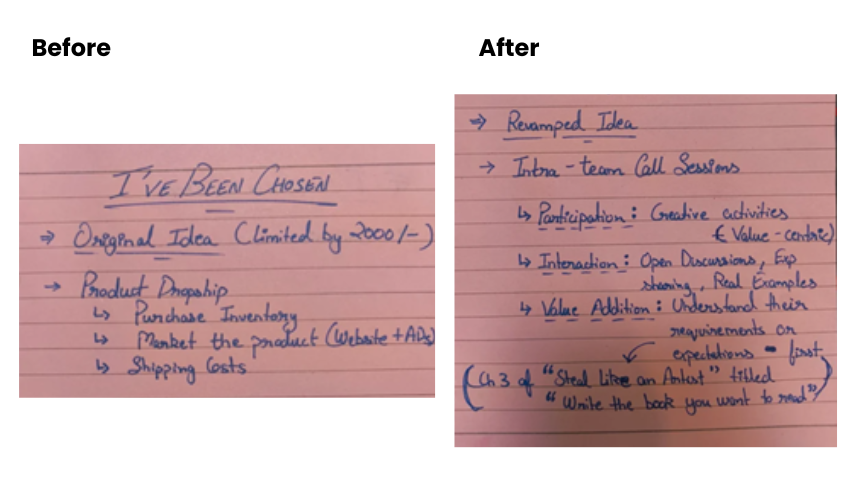
Vishesh Bhardwaj tried to extract value from intra-team calls
Yesterday’s session was interesting and triggered a simple, yet highly effective shift in my understanding of Value Addition and Constraints.
Before, I had a budget of ₹2,000, and my brainstorming was automatically boxed in by that constraint. My initial proposal was a standard drop-shipping service: buying items at wholesale, marketing them with a 30-40% profit margin, and shipping the orders.
However, the Stanford study helped me realize that value may come from many different avenues beyond just the monetary, including emotion (the bicycle tire-refilling example), convenience (restaurant reservations), and time/opportunity (selling the presentation slot to a hiring company).
Moving From Resource Thinking To Value Thinking
When we see a constraint, we often make it the center of the problem.
If the budget is small, we think small.
If the time is limited, we reduce the ambition.
If the task looks fixed, we stay inside its boundaries.
But value thinking starts differently.
It asks:
What asset do we already control to solve the problem at hand?
So now Greybians look beyond the visible constraint and find the path that creates stronger value.