





You run the AI search. The tool returns 40 references in under two minutes. The top results look relevant. The technology domain aligns. The concept matches. You feel like the search is heading somewhere.
This is precisely when the risk starts.
AI tools have changed the pace of patent searching. Semantic search finds conceptually similar documents faster than any Boolean string. Re-ranking engines process thousands of results in seconds. The coverage feels comprehensive. But coverage and completeness are not the same thing. In prior art searching, completeness is the only metric that matters when litigation is the downstream consequence.
The industry already recognizes this. As Lexology noted in early 2026, AI improves patent search but doesn’t eliminate the need for expert judgment because legal relevance stays contextual, depending on claim construction, jurisdictional standards, and procedural posture. PatSnap’s research team put it more directly: general-purpose AI struggles with the precise legal interpretation of novelty and non-obviousness as applied in patent law.
The practical consequence is that researchers who rely on AI-ranked results without interrogating what those results represent can walk away from a search believing they’ve found the relevant prior art, when they’ve found only what the AI was trained to surface.
We covered this in depth in a recent GreyB webinar on AI in patent searching, where our researchers walked through the specific failure points they encounter in live projects. Watch the recording here.

The First Trap: Over-Reliance Looks Like Efficiency
Many researchers start using AI with one expectation: if a relevant reference exists, the system will find it. That expectation is the trap.
An AI tool that fails to surface strong prior art doesn’t signal its own failure. The analyst sees a list of results, reviews them, and draws a conclusion. If no strong reference appears, the assumption becomes that no strong reference exists. The prior art may be hidden behind different terminology, a classification the tool didn’t reach, or non-patent literature the model deprioritized. None of that is visible in the output.
As Divyansh, Senior Research Analyst at GreyB, framed it:
“The biggest risk is not just missing the prior art. It is becoming too confident in the completeness of the search. AI identifies patents based on semantic similarity, but it doesn’t inherently perform claim interpretation or reason through the claim scope the way an experienced analyst would.”
This is also where AI outputs produce what practitioners describe as false confidence. A large language model asked to find prior art for a claim will present loosely related references with the same certainty it presents strong ones. This happens partly because prior art searching is a specialized task. These models are trained on general language patterns. They’re built to find papers related to a topic, not to test a document against a specific set of claim features. Topical similarity becomes the proxy for claim relevance. The two are not the same.
Semantic Similarity Is Not Claim Relevance
AI retrieval works through vector similarity. It finds documents where the language and concept profile resemble the input. That’s useful for narrowing a field. It’s structurally different from how a patent professional evaluates a reference.
A researcher working on a claim on prediction models needs references that disclose that specific model type. AI surfaces references to classification and recommendation models because they sit in the same machine learning domain and share semantic features. The documents are related. They don’t map the claim.
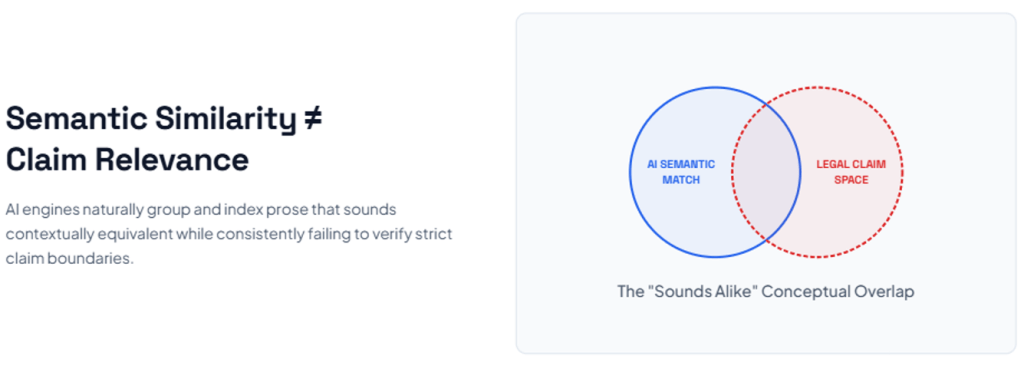
Mahesh Maan, Technical Architect at GreyB, separates this into two problems that most tools conflate. Pulling relevant documents from a database is one task. Analyzing whether a document actually discloses the claim features is another. Generative AI handles the second reasonably well.
The first handles through vector search, which retrieves documents that are textually similar but not necessarily precise at the claim level.
GreyB’s published case study on how technical context cracked a patent invalidity case illustrates this directly. The inventive element in that case was extracted from the prosecution history, not from the claim text itself, and the search that found the decisive prior art used a three-word query, not a semantic description of the full claim.
A researcher can complete the search, review 40 high-confidence results, and still not have covered the actual prior art landscape. The tool produced results. The search isn’t done.
Five Claim-Level Traps That Show Up Consistently
The gap between semantic similarity and claim relevance shows up in five recurring patterns. Each one produces a plausible-looking result that fails on closer inspection.
Fine-Grained Limitations
A reference can match the top-level concept of a claim and miss a single sublimitation that determines whether the reference is strong. A vehicle monitoring claim might disclose the system architecture clearly. If it doesn’t trigger an alert after a specific threshold duration, that sub-feature is absent. The reference looks strong at first glance. It isn’t.
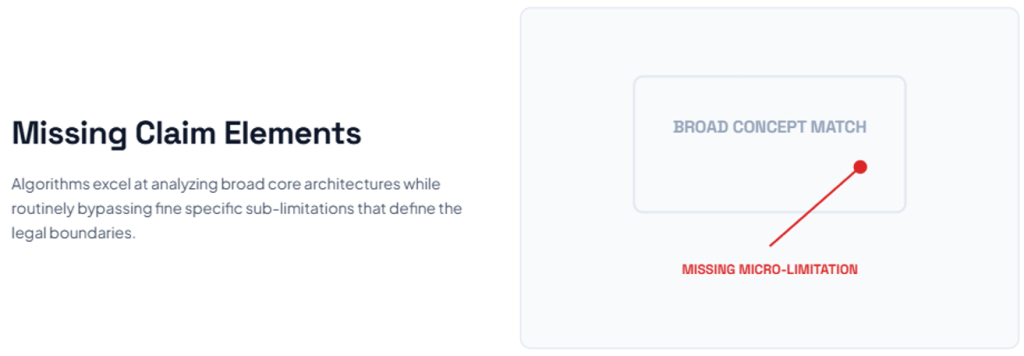
AI systems are good at identifying broad concept matches. They’re weaker at detecting the fine-grained claim limitations that define actual scope. The unconventional invalidity tactics that turn difficult cases often come from a close reading of prosecution history to isolate exactly which sub-feature the patentee added to survive examination, then targeting that specific element rather than the broad concept.
Conditional Triggers
Claims that include “when” logic or “in response to” language require more than presence. They require causality. AI will often map “in response to” language to a reference where step B follows step A, because the sequence is there. The reference may not establish that A causes B. In litigation, that distinction is the difference between a usable reference and one that gets challenged.
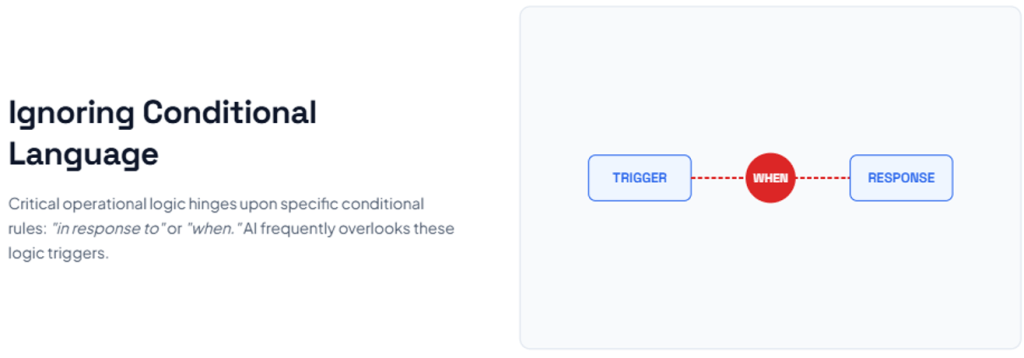
Kush, Team Lead at GreyB, made the point directly:
“Sometimes the invention is not about what it does. It’s about when and why. If the condition isn’t present in the reference, the reference is never useful, regardless of how well the rest of it maps.”
AI systems consistently overlook this granular detail. They produce a first-level mapping that looks complete. Human review has to verify the causality, not just the sequence.
Negative Limitations
What a claim excludes is as important as what it requires. AI systems optimized for semantic similarity bias toward documents that discuss the same components. A claim requiring a single-wire interface, in which the absence of a second wire is the inventive step, will yield results full of multi-wire systems because those documents use the relevant terminology most frequently.
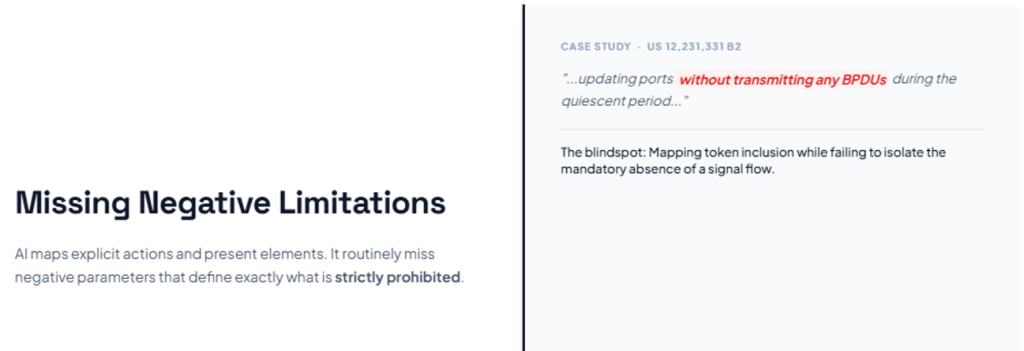
Searching for what’s absent is genuinely hard. Even experienced manual searchers build specific strategies around terms like “without,” “switchless,” “contactless,” or anything ending in “less” to capture these patterns. AI search, especially vector-based retrieval, works in the opposite direction. Asking it to find patents that don’t transmit BPDUs will bias the vector toward patents that do.
Mahesh Maan describes the gap this way:
“Identifying these results from the database is a very big challenge for today’s AI. If you tell a vector-based system you want patents without transmitting BPDUs, the vector will have a strong affinity toward patents that are actually transmitting BPDUs. It captures the opposite of what you need. When it comes to analysing a result that’s already in front of it, AI can work. But finding that result from the database in the first place — that’s where it fails.”
The practical lesson is that a researcher has to slow down and ask explicitly: what does the claim exclude, what must not be present, and what conditions must be absent. These questions can’t be left to the tool.
Sequence and Order
When a claim requires steps in a specific sequence, say detection, then authentication, then access, a reference that discloses the same steps in a different order can appear relevant but not anticipate. AI tends to assess component overlap without checking order.
This matters in FTO searches as much as it does in invalidity. A product that performs the same operations in a different sequence may not infringe. A reference that performs the same steps in a different order may not anticipate. AI often treats both as matches.

With longer sequences, eight or nine steps, this becomes more severe. The AI loses track of the required flow and often defaults to the more common sequence it has seen in training data, even when the claim specifies something different. The error repeats across all references it analyses because it hasn’t correctly parsed the claim in the first place.
Element Dependencies
A reference that discloses a sensor and a control unit can rank highly against a claim that requires the control unit to act on signals from the sensor. The components match. The functional relationship may not. AI flags the components as present without establishing whether the required interaction between them exists.

This connects to a deeper structural problem. Claims carry hierarchy through indentation in a patent PDF. When AI receives claim text from a database, that visual structure is often absent. The AI sees a flat list of features and analyses them independently. It may confirm that a reference has a memory register without recognizing that the memory register is only meaningful if the auxiliary processor it belongs to also exists. If the auxiliary processor isn’t present, the memory register analysis is irrelevant.
The fix is explicit. Tell the AI the relationship between elements, not just the elements themselves. Prompt it to track dependencies across limitations, not just feature presence.
Terminology Changes. Most AI Synonym Lists Don’t Reflect That.
Patent terminology evolves across generations of technology. Cloud computing was described as distributed network processing or remote server-based computing fifteen to twenty years ago. A machine learning claim has prior art in papers discussing statistical pattern recognition and adaptive algorithms. The concept is the same. The language is not.
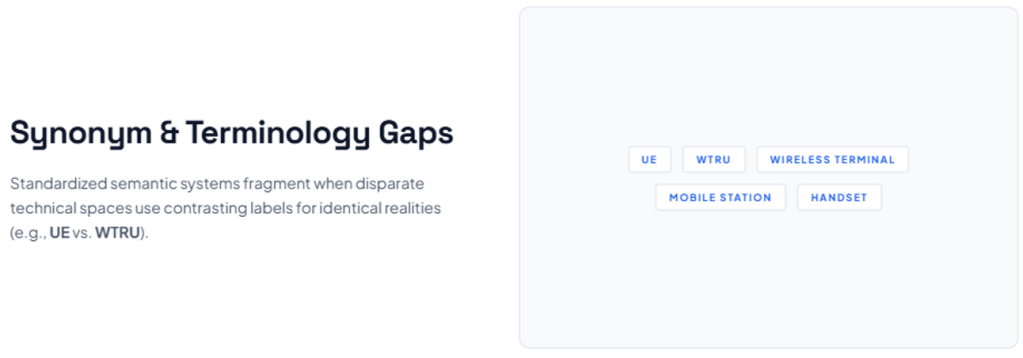
AI handles well-known synonyms well. Ask a language model for synonyms of “mobile phone,” and it produces a reasonable list. But it defaults to generic terms in the first pass. It won’t volunteer that UE was the dominant terminology in 3GPP LTE filings while WTRU was standard in earlier CDMA specifications, unless you prompt it specifically from that angle.
The AI has this knowledge. It doesn’t surface automatically. Mahesh Maan describes this as eliciting latent knowledge: the model holds it, but you have to pull it out from specific angles. Ask what terms were used in a specific decade. Ask how a particular standards body described the concept. Ask how it would have been framed in the context of a specific platform or regional filing practice. Each prompt pulls different terminology. The combination covers more ground than a single synonym query.
GreyB’s ten patent search tips from expert researchers cover this in detail, including how to use CPC class definitions to extract terminology that the technical literature uses in a specific domain, which is often different from what a language model produces in a generic synonym pass.
A researcher who accepts the first synonym list and builds a keyword strategy around it is leaving prior art in the database.
Classification and Citation Networks Are Not Optional
Text-based AI search ignores two of the most reliable prior art discovery paths: CPC classification and citation trails.
Classification organizes patents by technical concept, not by language. A patent on video streaming optimization filed in the mid-2000s may not use any modern terminology around adaptive bitrate streaming. It sits in a CPC class related to bandwidth management. Semantic search against a modern claim description won’t find it. A search starting with the right classification code will. GreyB’s Google Patents search guide explains how to apply CPC codes in practice, including how to use the classification hierarchy to move from broad to narrow and avoid pulling irrelevant results.
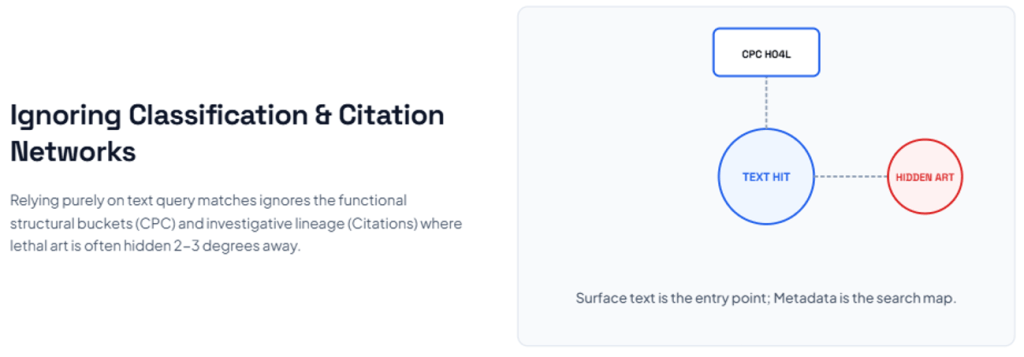
Language models know the CPC system. They can suggest relevant classes for most technical concepts, and they do so accurately when asked. They don’t use that capability by default when building search strings. They produce keyword queries. If you don’t explicitly prompt the AI to incorporate classification codes, it won’t.
Mahesh Maan puts the stakes clearly:
“Classification is one of the most powerful tools for patent searching. If an AI is not leveraging it, it’s leaving a lot on the table. But the burden of using classification falls on the user. The LLM already has this capability, but it won’t use it on its own.”
The same logic applies to using a found reference as a starting point. Feed a useful result back to the AI and ask it to identify CPC codes or terminology patterns from that reference that could expand the search. This feedback loop often surfaces classes or terms that the initial strategy missed.
Citation networks present a different scale problem. Ten citations, each with ten citations, create a tree that exceeds what a standard AI context window can efficiently manage. Manual searchers develop a sense for which citations to follow based on titles alone. Experienced researchers can scan 50 citation titles and know which two are worth pulling. Tools like Ambercite use citation-based AI ranking to make this more systematic, but even there, the analyst directs which part of the citation tree to enter. AI doesn’t match that pattern recognition reliably when left to work autonomously. It processes citations sequentially and loses context across a large tree.
Non-English Filings Create a Structural Blind Spot
A significant portion of global prior art sits in Japanese, Korean, and Chinese filings. For technology areas with deep Asian development histories, battery thermal management, semiconductor interfaces, and telecommunications protocols, the strongest prior art may live in regional databases in documents never indexed with English-first terminology.
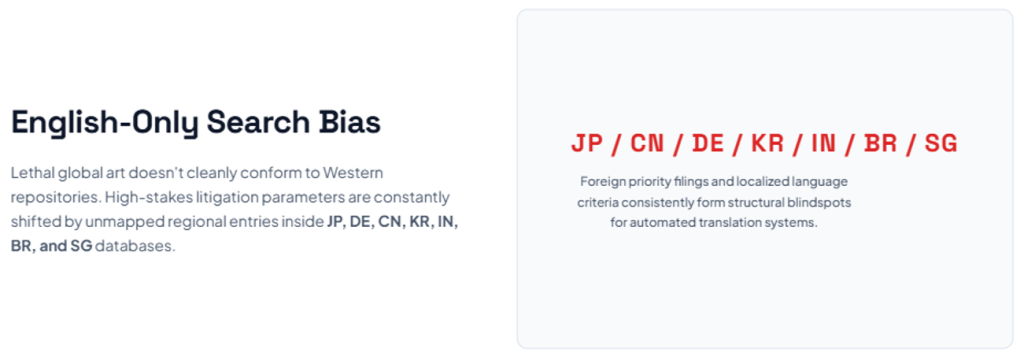
Machine translation has improved substantially. But older filings, translated before large language model tools were available, carry errors that distort both keyword search and semantic retrieval. A translation artifact that renders “Venetian blinds” as “dried bean curd” is not an edge case. It’s an example of how translation quality directly affects whether a document ever gets retrieved.
As Divyansh noted:
“The strongest prior art doesn’t always appear in an English-language search. Highly relevant references may exist in older Japanese, Korean, or Chinese filings that use completely different technical phrasing or region-specific drafting styles. Even when translations are available, automated systems may fail to preserve technical nuance. This creates a major blind spot. The search may appear comprehensive while critical prior art remains hidden.”
GreyB’s guide to advanced prior art search strategies covers the geography-first approach in detail, including why certain technical domains map to specific national patent offices and how to target JPO or KIPO when the technology’s origins point there. Separately, GreyB’s breakdown of advanced patent databases for invalidity searches lists the region-specific databases that are most useful when standard global platforms return limited results.
AI-powered semantic search of translated documents inherits the quality of the translation. A well-translated document is retrieved accurately. A poorly translated one may not retrieve at all, regardless of how relevant the underlying content is. Knowing which technical domains have significant non-English prior art and checking translation quality before drawing conclusions about completeness are part of the search process, not optional steps.
The First AI-Ranked Result Is Rarely the Best Disclosure
The top result from an AI-ranked search is not always the strongest version of a reference. US filings tend toward narrower descriptions. A Japanese priority application may contain broader figures, clearer implementation diagrams, or technical details that were narrowed during prosecution in other jurisdictions. A system architecture claim may appear in one family member. The specific workflow that maps the claim limitation appears in another.
AI tools don’t automatically check patent families when analyzing results. A reference from a jurisdiction with a post-priority date may be less useful than a family member filed earlier, and that family member may disclose the missing limitation clearly. An experienced searcher checks this instinctively. An AI agent does it only if explicitly instructed to do so.
Divyansh framed the implication:
“Relying only on the primary AI result can cause researchers to miss stronger disclosures, earlier priority support, or more complete technical explanations hidden within the patent family. A US filing may contain a narrower description while its earlier Japanese priority application includes broader figures or disclosures that were later removed during prosecution.”
Any AI-assisted search workflow needs explicit rules around patent family handling. Otherwise, the most useful version of a reference never reaches the analyst’s desk.
The Patent Search Framework Has to Evolve With the Tools
Before AI, patent searching had a defined process. A set of documented best practices, followed in sequence, produced a defensible search. AI has made that process harder to define, not easier.
More can be done now. An analyst can submit 3,000 results from a single CPC class to a re-ranking agent and find the strongest reference in the top 30. That wasn’t operationally feasible before. The same analyst can use AI to reconstruct the competitive and technical context around a patent’s priority date in minutes rather than days. The current landscape of AI-based patent search databases reflects this: tools now exist specifically for re-ranking, citation mapping, semantic concept search, and non-patent literature retrieval, each suited to a different part of the search problem.
But more options also mean more ways to spend time poorly. AI tools can absorb an entire working day on a technology where a well-built Boolean string would have produced better results in an hour. Some technologies yield strong results through AI retrieval. Others require manual keyword construction, and applying the wrong approach wastes time and produces worse outcomes.
Mahesh Maan describes the required shift:
“It’s no longer a set process. You have to get creative, understand where the AI lacks, and be adaptive in terms of what is the best thing you can do at each stage. If you let AI take the driver’s seat, it will always suggest what it can search next. But if you stay in the driver’s seat, you use AI and traditional tools to get where you need to go. The AI can do a lot of the leg work. What you need to do is maintain a clear view of where you are and where you need to go next.”
The most effective approach uses AI to shortlist, re-rank, and generate terminology, while keeping classification, citation analysis, negative limitation searches, and family checks as human-directed steps. Neither AI alone nor traditional methods alone produces the best outcome. The combination, with a researcher directing the process, does.
Before Calling a Patent Search Complete, Answer These Five Questions
- Have the AI results been mapped against specific claim limitations, not just the general concept?
- Have the conditional triggers and “in response to” language been verified for causality, not just sequence?
- Has the search covered what the claim explicitly excludes, with a strategy built around finding references where that feature is absent?
- Have non-English filings been reviewed, and has translation quality been checked for the relevant technical domain?
- Has CPC classification been applied, have citation trails been followed beyond first-page results, and have patent family members been reviewed for stronger disclosures?
If any answer is uncertain, the search has gaps. In a high-stakes litigation context, gaps are where the other side builds its case.
The prior art that invalidates a patent or defeats an FTO clearance doesn’t always sit in the most obvious place. Identifying where your current search strategy falls short before a court does is the difference between a defensible position and an exposed one.
If you’re running invalidity searches, FTO analyses, or validity studies where search completeness is at stake, identify the gaps in your current search approach.