
Last 18 months have changed the rules for building protein platforms for bars, extruded snacks, or baked formats. Microalgae, bacterial fermentation, and fungal proteins have moved beyond experimental trials. Several are now hitting commercial performance benchmarks that directly challenge pea and soy.
What follows is a technical and commercial breakdown of the protein systems already being piloted by R&D teams at Mars, Mondelez, Hershey, and emerging players, with a clear view of what makes them commercially viable.
Which Protein Systems Are Emerging and Scaling
1. Microalgae Proteins: Functionality Meets Sustainability Economics
Microalgae proteins are solving two long-standing problems at once. They deliver strong functionality (foaming, emulsification, oil-binding) while offering carbon-reduction stories that pencil out at scale.
| Protein System | What It Solves | Protein Yield & Process | Functional Advantage | Why It Matters Commercially |
|---|---|---|---|---|
| Spirulina (Arthrospira platensis) | Foaming + rapid processing constraints | • 40% recovery in 90 min (cellulase) • 67% total protein, 66% hydrosoluble • 30% yield in 10 min (deep-eutectic + microwave) | • 96–100% foaming capacity • Strong emulsification | Enables aerated snacks and protein bars with short cycle times and lower energy input |
| Chlorella vulgaris | Soy replacement without performance trade-offs | • 56% yield (alkaline + isoelectric) • 68% yield with high-pressure homogenization (35,000 psi) | • ~2× better solubility, oil-binding & foaming vs soy isolate | Reduces reliance on soy while cutting NaOH use by 80%, improving cost and sustainability economics |
| Nannochloropsis oceanica | Texture and extrusion performance | • 1-hour ethanol defatting at 70°C | • Protein–polysaccharide matrix suitable for extrusion | Matches commercial extruded snack benchmarks with minimal downstream processing |
Why this matters: Microalgae proteins enable clean-label, allergen-free formulations with functional properties strong enough to reduce or eliminate hydrocolloids and gums. That simplifies ingredient decks and improves margin control.
2. Bacterial & Fungal Proteins: Texture Innovation Without Extrusion
The most interesting development in bacterial and fungal proteins is structural, not nutritional. These systems create fibrous, meat-like textures through fermentation alone, bypassing the capital intensity of extrusion lines.
| Protein System | Protein Metrics | What It Solves | Structural / Functional Output | Production Advantage | Best-Fit Applications |
|---|---|---|---|---|---|
| Methylococcus capsulatus (Bacterial protein) | ≥70% crude protein with PDCAAS ≥0.9 (complete amino acid profile) | Eliminates need for extrusion to achieve structure | • Heat-set gelation (10–300 Bloom) • 200–600% foam overrun • Dense, cohesive protein matrix | • Continuous methane/methanol fermentation • Converts biogas & industrial emissions into food protein • δ¹³C isotope signature enables supply-chain authentication | Meat analog bases, hybrid protein products, structured emulsions |
| Myceliated Morel (Morchella esculenta) | ~0.3 g protein / g wet weight | Builds meat-like texture while fixing legume sensory issues | • Natural fibrous, meat-like texture • Jerky- and snack-ready structure | • Solid-state fermentation on pea, rice, chickpea, quinoa • No extrusion or chemical flavor masking | Jerky, savory snacks, whole-cut style products |
Strategic implication: Fungal fermentation allows you to upcycle side-streams (pea hull, rice bran) into premium protein ingredients while solving flavor and texture challenges that have limited plant protein adoption in savory snacks.
3. Yeast Proteins: The Processing Breakthrough That Changes Everything
Yeast protein has long been nutritionally rich but functionally limited, until recent high-pressure processing unlocked its water-holding, oil-binding, and emulsification capabilities.
| Protein System | Processing conditions | Protein composition | Functional Performance | Cost & Supply Advantage |
|---|---|---|---|---|
| High-Pressure Homogenized Yeast Protein | 100 MPa (14,500 psi) homogenization | 75% protein and 30% essential amino acids | Foam and emulsion stability exceeds pea, whey, and soy isolates | • Fermentation-scalable and predictable supply • 10–15% lower cost than pea isolate at scale |
Why this matters: Yeast protein shifts from a niche supplement ingredient to a functional platform capable of replacing multiple additives in bars and baked snacks. The result is cleaner labels and a more resilient margin structure.
4. Next-Generation Plant Protein Blends: Complete Nutrition, High-Heat Stability
Single-source plant proteins struggle with amino acid completeness and thermal stability. The most advanced R&D work is happening in engineered blends that achieve PDCAAS 1.0 while surviving high-temperature processing.
| Protein System | Protein & Nutrition Metrics | What It Solves | Processing Performance | Sensory / Functional Edge | Best-Fit Applications |
|---|---|---|---|---|---|
| Complete Legume–Grain Systems | 20g complete protein / 100g serving | Fixes incomplete amino acid profiles in single-source plant proteins | • Survives 140–160°C frying • Maintains texture after 3-min rehydration | • Al-dente bite retained • Stable structure under thermal stress | Instant noodles, baked snacks, protein bars |
| Fermented Soy–Rice–Coconut (30:40:30) | • 58% protein powder • 2× lysine in rice • 20–30% higher BCAAs in soy | Enhances nutrition and reduces need for masking | Separate Rhizopus (soy) and Aspergillus (rice) fermentation | • Mildly sweet, creamy profile • Clean taste without heavy flavors | Protein bars, baked snacks, nutrition-focused foods |
Strategic advantage: Fermented blends solve the flavor and nutrition gaps of single-source plant proteins while creating differentiated “ancient grain” or “fermented superfood” positioning that resonates with health-conscious consumers.
Which Companies Are Actually Scaling These Systems
The gap between publishable research and commercial viability is scale. The following organizations are building production capability, not just IP.
| Organization | Focus Area | Claimed Competitive Edge |
| MicroHarvest | Fast microbial protein | 24-hour production cycle, 95% CO₂ reduction vs. traditional protein sources |
| Dyadic | Scalable fermentation | Animal-free dairy protein analogues, cultured-meat protein inputs |
| Fraunhofer IVV(Smart Protein) | Plant, fungal & side-stream proteins | EU-backed sustainable protein research for snacks, meat/dairy alternatives |
| NRC Canada | Advanced processing & proteomics | Tailored ingredient functionality, supply-chain authentication protocols |
Access All the Research in Protein-Based Snacks With Slate
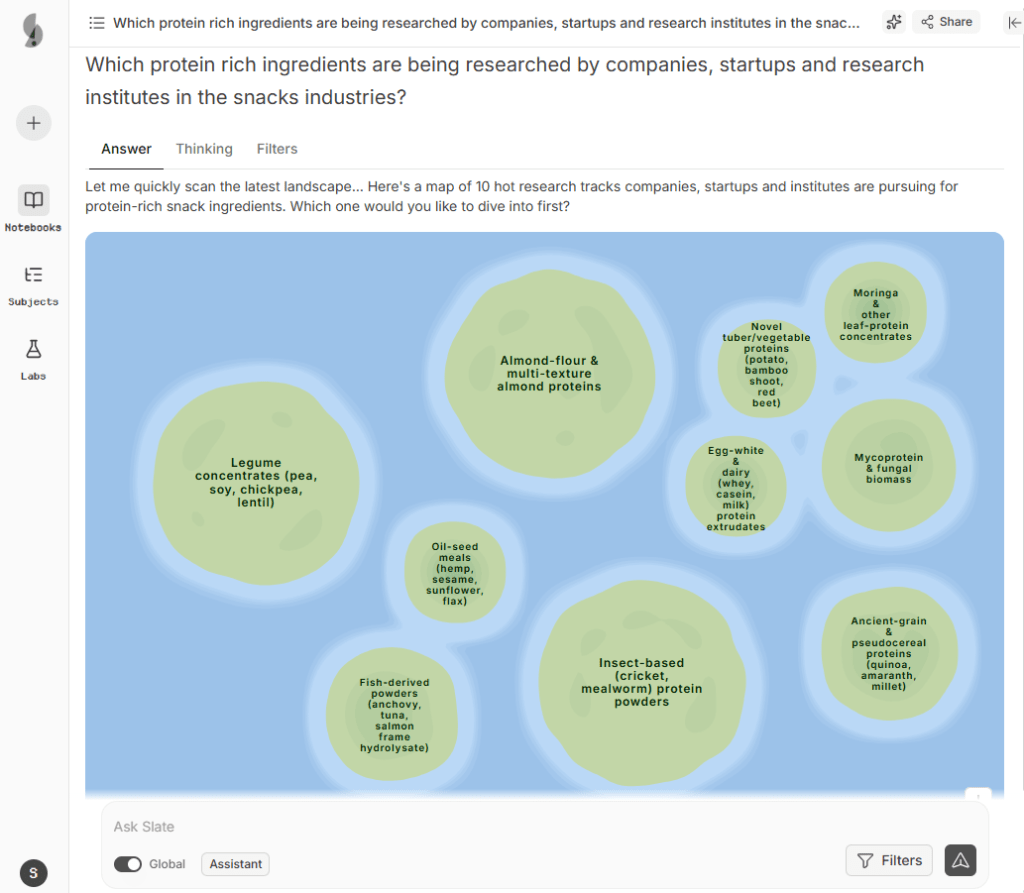
What you’ve seen here is roughly 5% of the protein innovation landscape. Beyond this, there are insect proteins, precision-fermented dairy analogues, tuber proteins, hybrid systems, and dozens of emerging platforms, each at different readiness levels with very different IP and scale risks.
Slate synthesizes millions of global patents, scientific literature, market data, supplier data, and regulatory filings and gives your R&D teams clarity in minutes, so decisions are based on evidence, not intuition.
Slate helps you find what should you work on next and why.
- Real-time mapping of emerging protein technologies
- Intelligence tailored to your formats, targets, and constraints
- Early identification of technical whitespace before competitors
- Faster validation with cost, process, and supplier readiness data
Want to Dive Deeper into Protein Systems?
If protein is part of your 2026-2027 roadmap, and you would like to know what other protein systems are viable to meet your specific needs. Book a Slate demo to see how it works.
