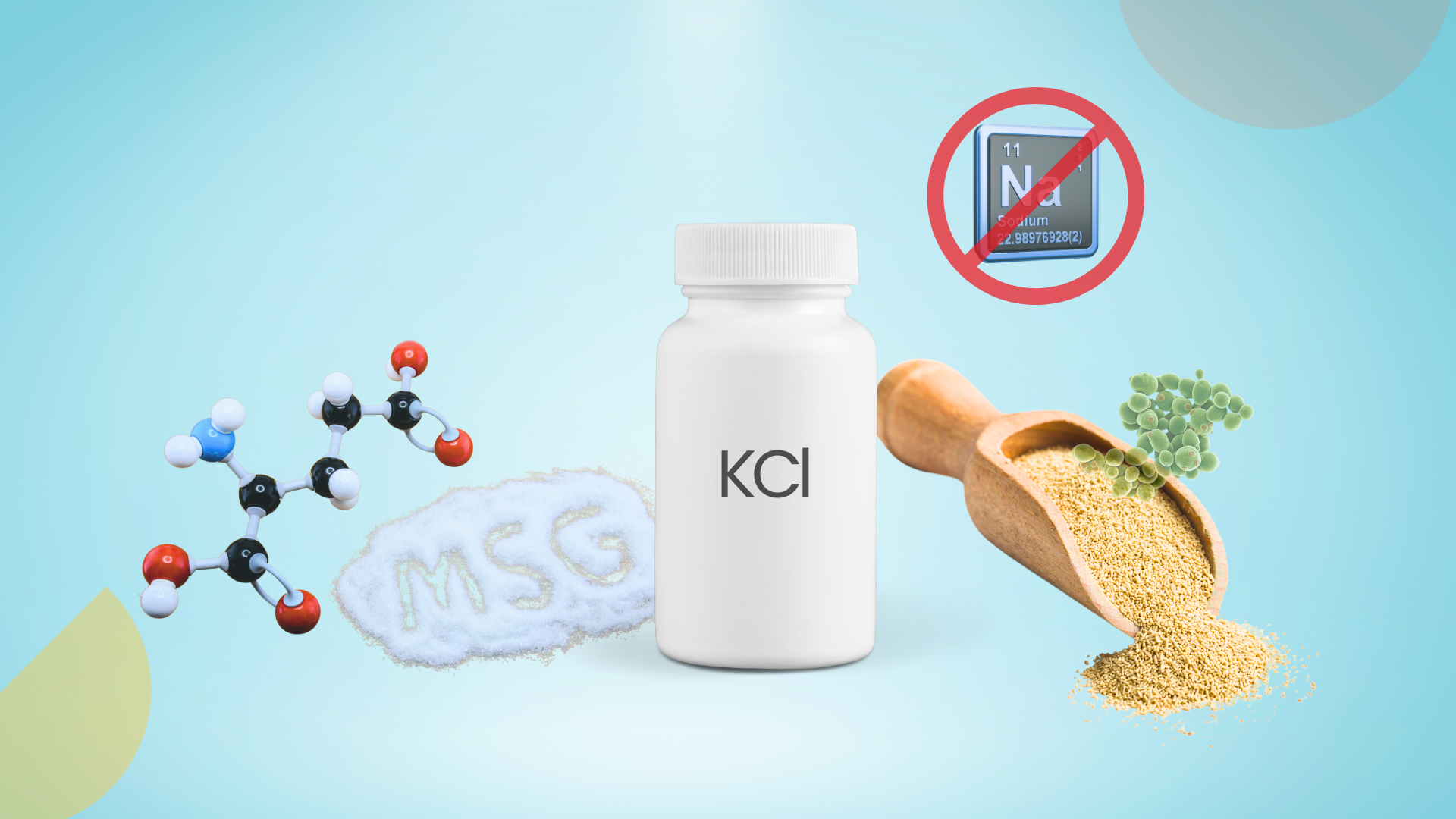




Your company wants you to remove sodium from the snack formulation while maintaining the same level of saltiness. But the problem isn’t just taste. Sodium shapes texture, ensures microbial stability, supports processing, and masks off-notes that quickly surface when reduced. Swapping to traditional substitutes like KCl can get you roughly a 20% reduction, but the trade-offs are higher: bitterness, texture shifts, and shelf life margins shrink.
Formulators at leading F&B companies such as Nestlé, PepsiCo, and Cargill are navigating these trade-offs by using bitter-taste masking agents, receptor-targeted saltiness enhancers, and micronization technology. In this artcile, we dive deep into the innovative solutions that help formulators meet their company’s sodium-reduction commitments.
You can also join us for a live session where we break down these technologies to identify which innovations are truly scalable versus those that are just a pilot-stage promise.
KCl-based salts are gaining traction across chips, seasonings, and more
In 2025, the WHO published guidance on lower-sodium salt substitutes (LSSS), which recommends partial replacement of sodium with potassium to reduce high blood pressure and cardiovascular diseases at a population level.
This global endorsement promotes the use of KCl-based substitutes for public health. However, WHO also highlights a critical limitation: these substitutes are not suitable for individuals with impaired kidney function. Meanwhile, bitter and metallic off-tastes of potassium also remain an industry challenge.
This makes across-the-board potassium-forward reformulation risky. Manufacturers must align with WHO dietary recommendations on potassium intake while ensuring strict compliance in labeling, health claims, and target audience communication.
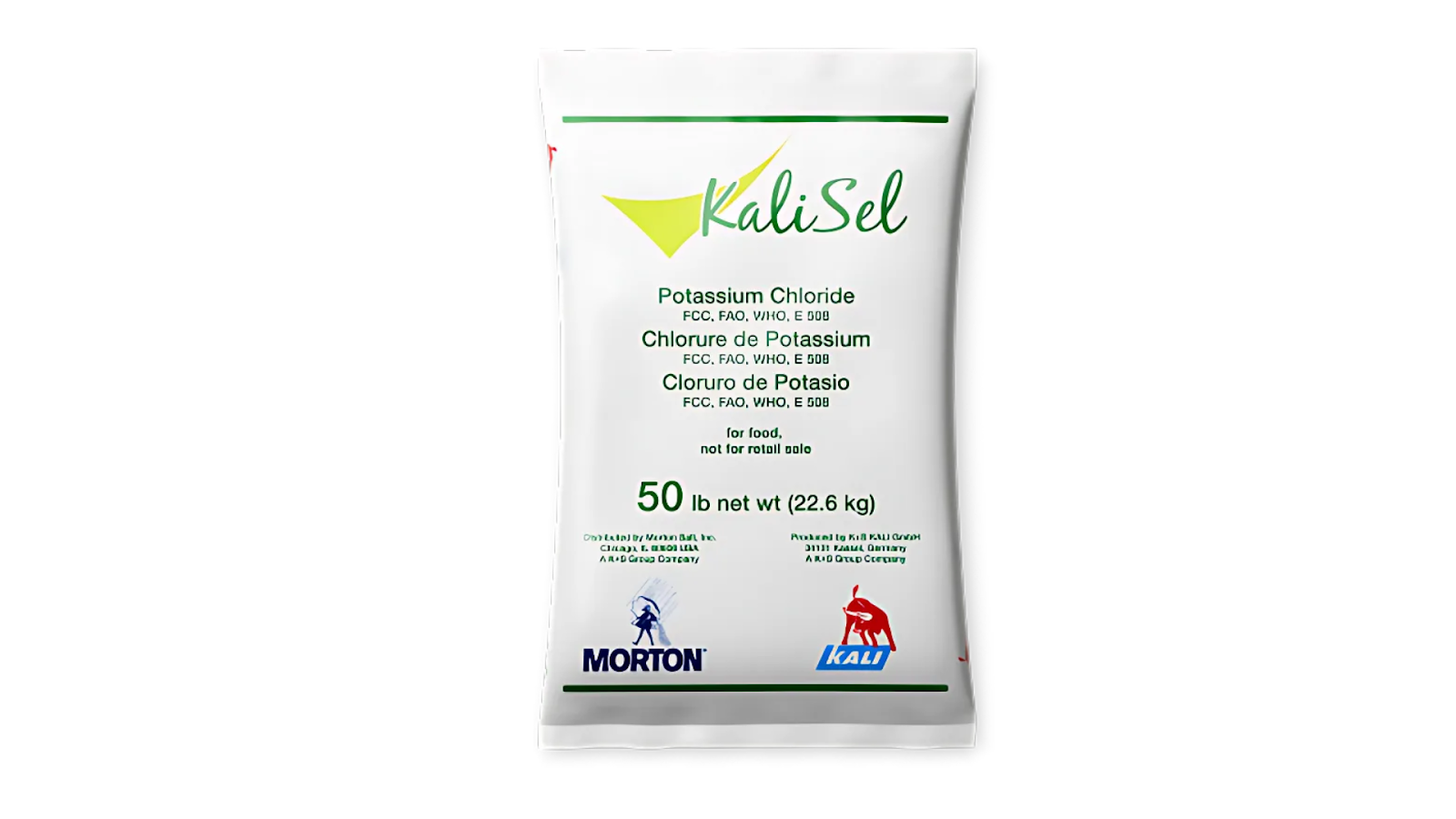
Currently, Cargill’s Potassium Pro and FlakeSelect®, Morton Salt’s KaliSel Potassium Chloride, and Ettlinger Corporation’s Potassium Chloride (KCl) are some of the established potassium-based salt substitutes in the market. However, formulators continue to explore novel techniques and flavor modifiers to eliminate taste challenges of KCl-based substitutes.
Frito-Lay controls how each component of its salt substitute dissolves to achieve 50% sodium reduction in potato chips
PepsiCo’s subsidiary Frito-Lay developed a salt substitute made of five key components:
- Sodium → provides real saltiness
- Potassium → replaces sodium but adds bitterness
- Ammonium → modifies taste perception
- Acidulant → adds slight acidity to enhance flavor
- Binder → improves structure and can enhance perceived saltiness
The composition is engineered as particles (25–345 µm in size). These particles form agglomerates (clusters of particles) rather than simple crystals, enabling controlled release of flavors, unlike normal salt crystals.
The key innovation lies in controlling the sequence in which ingredients dissolve in the mouth. The outer components, such as binders, acids, and bitter blockers, dissolve first. Meanwhile, inner components like potassium chloride dissolve later. This staged release ensures that bitterness is masked before it can be perceived. This allows the saltiness to feel stronger even with reduced sodium content.
The approach achieved a 50–57% reduction in sodium in potato chips (crisps) during sensory testing. Despite the reduction, the chips maintained a taste profile very similar to regular salt, including comparable saltiness intensity and overall flavor perception.
Frito-Lay is also exploring compounds such as gentisic acid 5-O-β-D-xylopyranoside and kukoamine A to enhance perceived saltiness without increasing sodium levels. The company’s patent filings show a step-by-step approach to sodium reduction. For instance, lowering sodium in expanded snacks like chips can lead to poor expansion, a higher glass transition temperature, and greater bulk density, resulting in a harder, denser texture.
To address this, Frito-Lay has patented functional ingredients that eliminate all the challenges. Its strategic portfolio is a roadmap for formulators working on sodium reduction in savory snacks. You can track it with our R&D intelligence platform, Slate. Just ask, “What is Frito-Lay doing in sodium reduction?”
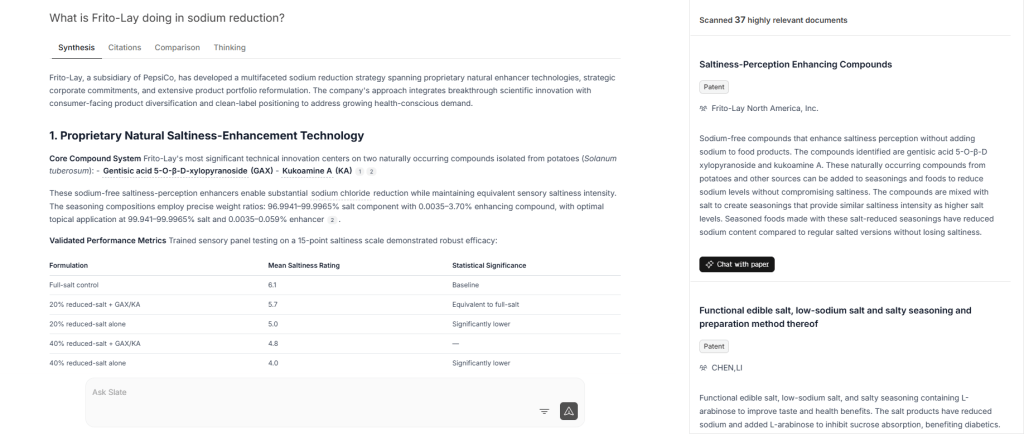
What is Frito-Lay doing in sodium reduction?
Dezhuang’s low-sodium seasoning achieved a 40% sodium reduction in hot pot soup base (broth)
Dezhuang has developed a two-step coordinated strategy to maintain taste while reducing sodium.
The approach first replaces regular salt with a mixture of salts. Sodium, potassium, magnesium, and calcium chloride are mixed in a 75:10:10:5 ratio.
Secondly, it incorporates a dual flavor-enhancer system.
- Enhancer I combines sodium glutamate and disodium nucleotides in a 19:10 ratio to replace MSG and nucleotide seasonings.
- Enhancer II blends sodium glutamate and disodium succinate in a 6:1 ratio to replace chicken essence.
The invention achieved a 40% reduction in sodium in hot pot soup base (broth). The broth became less salty and more umami, with no bitterness/metallic notes. Even the electronic nose analysis showed a similar overall flavor profile, with an increased level of the aroma compound 3-methylbutanal. This added a malty, nutty, meaty aroma.
Industry is exploring receptor-targeted delivery systems to boost perceived saltiness
The industry is leaning into how salt hits receptors rather than only how much sodium is present. Recent academic work continues to validate approaches like encapsulation and non-homogeneous salt distribution to preserve perceived saltiness at reduced sodium levels.
Food tech companies like Nissin Foods and Cargill are using the receptor-targeted approach to eliminate the bitter and metallic off-tastes of KCl-based salt substitutes. However, most of these innovations introduce a new ingredient in the formulation, which may impact the clean label positioning of the product.
For example, a recent study explores replacing conventional salt with xanthan gum-encapsulated salt in bread. The key innovation in the process is the uneven distribution of salt. The paper says that the brain responds more to peaks in stimulus than to averages. However, high costs and concerns around potential health effects, including links to diabetes, continue to limit the broader adoption of xanthan gum in the industry.
Nissin Foods uses aroma-based masking to reduce KCl bitterness
Nissin Foods’ patent describes the use of Balsam of Peru essential oil as the main ingredient to reduce the bitter taste of potassium chloride.
The invention works by altering how taste is perceived, not by removing bitterness chemically. Derived from a tree resin, Balsam of Peru oil influences flavor perception by providing sweet, warm, vanilla-like aromatic notes. It also simultaneously enhances NaCl salty taste perception.
Balsam of Peru oil can be used in various food products such as instant noodles, soups, sauces, processed meats, and seasonings using potassium chloride-based Salt. It can be added during manufacturing, included in seasoning packets, or added directly into formulations.
The patent also proposes combining this oil with compounds like amino acids, ketones, and terpenes to further improve taste.
Prima Meat Packers uses rooibos or honeybush to enhance perceived saltiness without increasing actual salt content
The innovation is compatible with foods containing sodium chloride (NaCl) or potassium chloride (KCl). The key idea is to use rooibos or honeybush to enhance the perceived saltiness of food.
Interestingly, these plant-based ingredients can be used in two ways:
- Mixed directly into the food, or
- Taken separately but during the same meal (before or alongside the food)
Even when consumed separately—such as drinking rooibos before eating —the saltiness of the food increases because it influences the taste receptors.
Cargill is using yerba mate–based modifiers to mask the bitter, metallic aftertaste of KCl
Cargill adds a sensory modifier (mono- and dicaffeoylquinic acids and their salts, e.g., yerba mate extract) to mask off-notes and restore saltiness. These molecules interact with taste perception pathways
Sensory panel studies showed reduced bitterness and metallic taste, improved saltiness timing. The patented approach enabled 25% sodium reduction while matching full-salt taste. The composition (KCl + sensory modifier) can be added to beverages (ready-to-drink or powdered) and to food products such as seasonings, sauces, gravies, and dressings; snacks (chips, popcorn, crackers, pretzels); and bakery items.
However, a key challenge with these salt substitutes is the need for additional additives to replicate sodium’s functionality. These additives increase the complex INS numbers on the label, appearing technical to everyday consumers. This makes the product unappealing.
Startups are shrinking the particle size of salt for clean-label sodium reduction

Today’s health-conscious consumers carefully skim through the food labels to check for artificial additives. They seek choices without artificial additives, which are common in products using sodium substitutes. This makes using micronized salt particles an ideal solution. Reducing the size increases the surface area exposed to taste receptors. This helps deliver the same salty taste with less sodium.
The innovation also simplifies the integration process for manufacturers, as they do not have to overhaul their existing production lines or recipes. Micronized salt particles can be easily incorporated into current manufacturing processes, resulting in a more efficient, cost-effective solution for sodium reduction.
It is all-natural, non-GMO, gluten-free, and free from artificial additives appraoch, catering to the growing consumer preference for clean-label products.
Additionally, micronized salt is highly versatile and can be used across a wide range of food products. Its ability to deliver consistent flavour without altering product quality makes it a scalable and cost-effective solution for sodium reduction in clean-label formulations.
MicroSalt helps manufacturers reduce sodium, without adding complicated INS numbers to the label
MicroSalt uses a patented process to produce micron-sized salt crystals that are about 100× smaller than regular salt grains. Smaller particles have stronger electrostatic attraction. This helps in better coating on food surfaces and faster dissolution.
Additionally, traditional sodium often clumps and is distributed unevenly. This makes it difficult for manufacturers to achieve a uniform flavour.
MicroSalt addresses this challenge by spreading the salt particles over a carrier (like maltodextrin). This ensures the salt sits on the surface of food rather than getting trapped inside, improving taste with lower sodium levels.
The solution works well in products like bread, chips, and snacks. No additives or masking agents are used in this approach. This ensures manufacturers offer clean-label products, avoiding complex INS numbers that make the product unappealing.
In 2025, Canadian company Daiya Foods partnered with MicroSalt to reduce the sodium content in its cheese alternatives and pizza dough.
MicroSalt was also recognized by Fast Company at IFE London 2025 for its innovation.
Similarly, Israeli startup O’taste also reduces the particle size of salt to less than 15 μm using its patented micro-milling technology to enhance perceived saltiness. The technology also enables sugar reduction in chocolate, ice cream, and bakery products.
Conclusion
Various new approaches are emerging to reduce sodium beyond KCl-based substitutes and particle-size innovation. Some startups are exploring saline coastal plants like Salicornia and red algae as plant-based salt alternatives. Meanwhile, Mars is working with the University of Tennessee to combine peptides and organic acids to enhance saltiness.
Emerging innovations in the sodium reduction space also address processing challenges. For example, Unilever is addressing increased fouling and dosing issues in standard equipment while producing bouillon tablets with reduced or no added sodium.
Most R&D teams struggle to identify which of these solutions can scale and fit into existing products, rather than remain at the pilot-stage success. If you, too, are evaluating salt reduction strategies and need clarity on what actually works at scale, this is a conversation worth joining. Be part of our live discussion to explore practical, ready-to-implement solutions.