





Ryan Mercer, Senior IP Counsel at a mid-size audio technology firm, was three months into an active patent infringement lawsuit. The plaintiff held a multi-mode audio signal decoder patent, a 150-word independent claim covering a specific spectral processing behavior that Ryan’s firm’s products were alleged to infringe on.
Settlement was not the preferred path. The faster, more defensible route was invalidation through an IPR proceeding. That required prior art precise enough to survive claim-level scrutiny, not conceptually adjacent references, but art that mapped directly to what the patent described.
This is when Ryan came to us.
KEY OUTCOME
A Canadian patent filed in 1993 surfaced as decisive prior art, a document that had existed for nearly 15 years before the subject patent’s priority date. It disclosed both approaches to TCX implementation as alternatives from the very beginning. What made the difference was not a smarter tool, a broader database, or a more exhaustive keyword strategy.
It was the decision to stop searching through the claim’s vocabulary and start understanding the invention’s actual technical history. Once that understanding was in place, the right query almost wrote itself.
The Standard Approach to Prior Art Search and Its Structural Limit
Standard prior art search follows a set process. Prosecution history is reviewed first. The examiner’s rejections and the applicant’s responses identify what the patent office considered novel. That novelty becomes the search target.
The tools used to execute that search matter as much as the methodology, and not all platforms handle claim-level precision the same way. If you are evaluating which search platforms hold up under this kind of technical scrutiny, GreyB’s expert-reviewed breakdown of the top FTO tools in 2026 covers exactly that.
The 150-word claim was parsed through exactly this method. The inventive element, as extracted from the prosecution history, was specific: a spectrum processor applying spectral shaping in two distinct modes, once dependent on linear-prediction-domain parameters for LP-encoded audio, and once on scale-factor parameters for frequency-domain-encoded audio.
| Claim | Novelty |
| A multi-mode audio signal decoder (1100; 1200) for providing a decoded representation (1112; 1212) of an audio content on the basis of an encoded representation (1110; 1208) of the audio content, the audio signal decoder comprising:a spectral value determinator (1130; 1230a, 1230c) configured to obtain sets (1132; 1230d) of decoded spectral coefficients (1132; 1230d; r[i]) for a plurality of portions (1410, 1412, 1414, 1416) of the audio content;a spectrum processor (1230e; 1378) configured to apply a spectral shaping to a set (1132; 1230d; r[i]) of decoded spectral coefficient, or to a pre-processed version (1132′) thereof, in dependence on a set of linear-prediction-domain parameters for a portion of the audio content encoded in the linear-prediction mode, and to apply a spectral shaping to a set (1132; 1230d; r[i]) of decoded spectral coefficients, or a pre-processed version (1232′) thereof, in dependence on a set of scale factor parameters (1152; 1260b) for a portion (1410; 1416) of the audio content encoded in the frequency-domain mode, anda frequency-domain-to-time-domain converter (1160; 1230g) configured to obtain a time-domain representation (1162; 1232; xi,n) of the audio content on the basis of a spectrally-shaped set (1158; 1230f) of decoded spectral coefficients for a portion of the audio content encoded in the linear-prediction mode, and to obtain a time-domain representation (1162; 1232) of the audio content on the basis of a spectrally-shaped set of decoded spectral coefficients for a portion of the audio content encoded in the frequency-domain mode. | “a spectrum processor (1230e; 1378) configured to apply a spectral shaping to a set (1132; 1230d; r[i]) of decoded spectral coefficient, or to a pre-processed version (1132′) thereof, in dependence on a set of linear-prediction-domain parameters for a portion of the audio content encoded in the linear-prediction mode, and to apply a spectral shaping to a set (1132; 1230d; r[i]) of decoded spectral coefficients, or a pre-processed version (1232′) thereof, in dependence on a set of scale factor parameters (1152; 1260b) for a portion (1410; 1416) of the audio content encoded in the frequency-domain mode;” |
The extraction process narrowed the effective search target from 150 words to roughly 60. We then applied AI tools to this reduced target. The results were gathered, reviewed, and evaluated for their relevance at the claim level.
Also Read:

However, the limitation was not in how the searches were executed; it stemmed from the very structure of the queries themselves. AI tools function based on the inputs they receive. When a query is framed using functional claim language, the tools return documents containing similar functional terms, which is their primary purpose.
What no tool can accomplish, without intentional human intervention, is to step beyond the claim’s specific vocabulary and pose a fundamentally different question about the invention. This critical step requires judgment at the level of the invention itself, rather than focusing solely on the claim.
Reframing the Problem: From Claim Language to Technical History\
The shift that changed the trajectory of this prior art search began with a decision to study the patent itself before constructing another query. It began with studying the patent itself.
The subject patent, as patents routinely do, disclosed a reference system before presenting the invention.
Figure 2 depicts the prior-art architecture, a USAC encoder that reflects the established state of the field. Figure 3 depicts the patent’s own embodiment. When the two figures were examined side by side, something the claim language had obscured became apparent. The architectures were nearly identical in structure.
The difference between them was localized to a single operation: how TCX, Transform Coded Excitation, was performed within the LPD coder chain.
| Admitted as Prior-art in Subject Patent (USAC Encoder) | Embodiment of the Subject patent |
Everything else the 150-word claim described was a restatement of what the prior art system in Figure 2 already accomplished, and the patent itself had acknowledged Figure 2 as prior art.
That observation collapsed the entire search problem into one precise technical question: whether the method of performing TCX shown in Figure 3 had been known and documented before the subject patent’s priority date.
That question had nothing to do with spectral shaping parameters, frequency-domain converters, or multi-mode decoding architectures. It was a question about the chronological development of a specific technical operation, and answering it required understanding what TCX researchers had known and published from the very beginning.
Claim language describes an implementation. Novelty is defined by what was absent from the prior art. Treating the two as identical is the structural error that causes technically thorough searches to return the wrong results, and recognizing that distinction is what separates a search that produces references from a search that produces the right one.
Also Read:

The Query That Followed from Understanding
With the actual technical question identified, the query constructed was:
“Transform coded excitation” before:priority:20091009
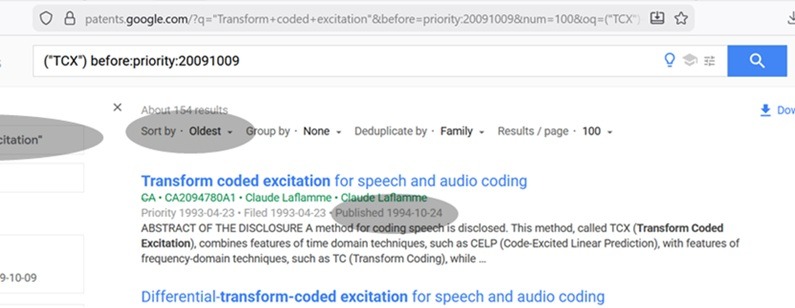
Three words and a date filter anchored to the subject patent’s priority date. No claim language. No references to spectral shaping or frequency-domain encoding.
The logic was chronological, tracing TCX from its earliest published forms forward and determining whether the Figure 3 approach had ever been presented as an alternative or known variant of TCX implementation before the subject patent existed.
The search returned approximately 154 results, sorted from oldest to most recent.
What the First Result Revealed
The first result was CA2094780A1, filed by Claude Laflamme on April 23, 1993, and published October 24, 1994, under the title Transform Coded Excitation for Speech and Audio Coding. This was the foundational patent on TCX technology, predating the subject patent’s priority date by nearly 15 years.
The 1993 patent did not describe a single method of performing TCX. It described two methods and presented them as alternatives from the outset. One mapped precisely to the architecture depicted in Figure 2 of the subject patent, the system that the subject patent itself had designated as prior art.
The other was mapped to the architecture in Figure 3, the system that the subject patent was claiming as its inventive contribution.
The implication was direct. The novelty claimed by the subject patent had been part of the TCX literature since the technology was first documented. What the subject patent had done was take one of the original, explicitly described alternatives and apply it in a new technical context, with 15 years of separation from the source material giving the appearance of independent invention.
The first result in the first query answered the technical question that the claim had framed as novel.
Conclusion
This prior art search case reflects a pattern that recurs across invalidation projects in mature technical domains. Patents built on foundational technology, audio coding, networking protocols, and semiconductor architectures often derive their apparent novelty from applying well-documented mechanisms to new configurations or contexts.
The claims are drafted to describe that application in language that sounds inventive, and foundational prior art is frequently overlooked precisely because the search was aimed at the claim’s vocabulary rather than the invention’s technical lineage.
When the stakes of an IPR proceeding, a licensing dispute, or a freedom-to-operate analysis demand prior art that holds at the claim level, the right question cannot be delegated to AI tools alone.
It requires the depth of technical understanding that makes a 3-word query more powerful than a 150-word claim.